


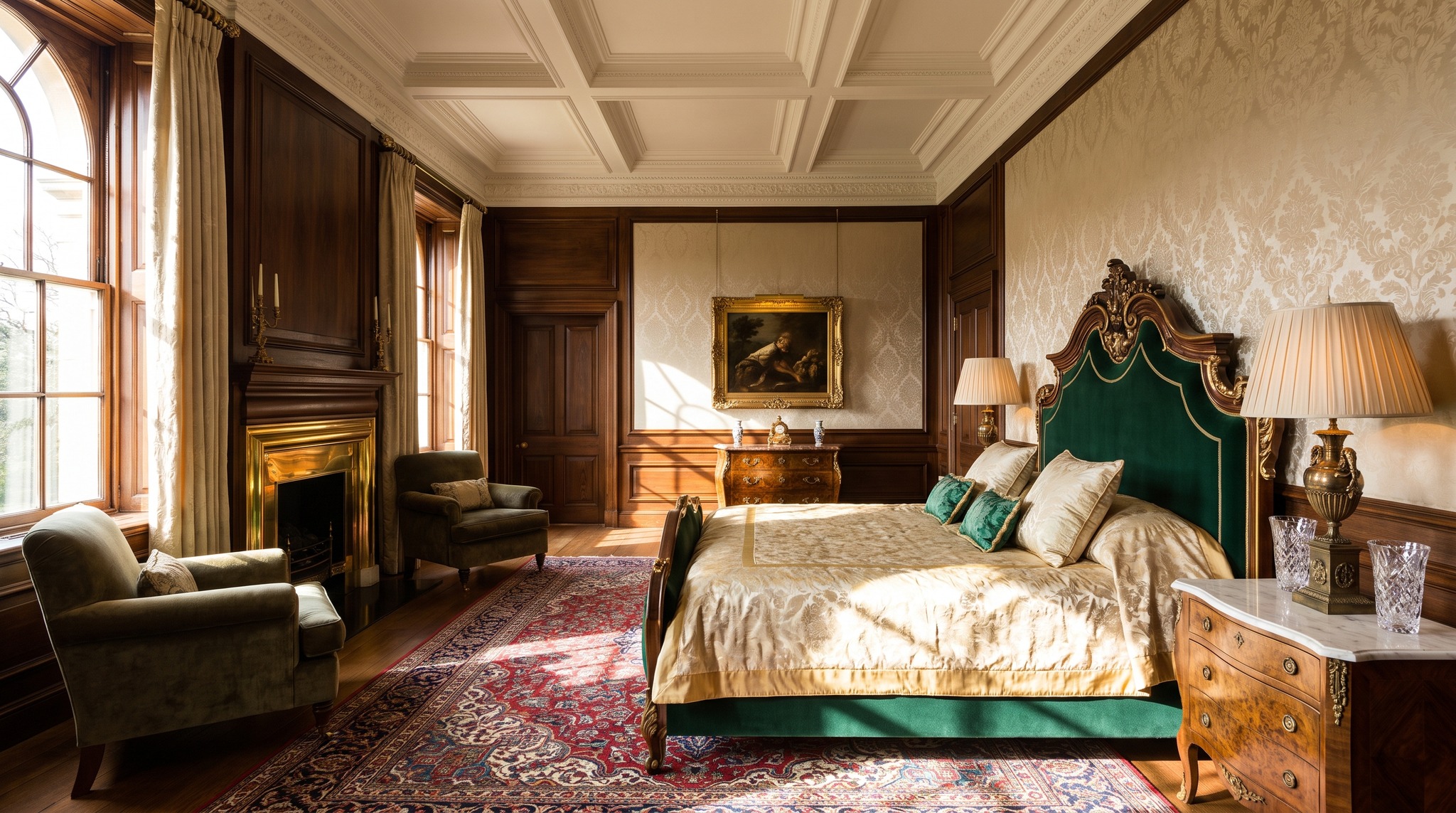
Bed with High Headboard: What Wall Height Is Optically Required
You are planning a bed with a high headboard and wondering whether your ceiling height is sufficient? An impressive headboard can become the focal point of the bedroom, but the proportions must be right. Ceilings that are too low make the bed appear oppressive, while too much space above weakens the effect. In this article, you will learn what wall height makes sense for different headboard heights and what you should consider when planning.
Standard Dimensions and Proportions
A classic headboard measures between 100 and 130 cm in height, measured from the floor. With a typical ceiling height of 240 to 260 cm, this leaves sufficient space to the ceiling. As a rule of thumb: there should be at least 80 to 100 cm of clearance between the top edge of the headboard and the ceiling so that the bed does not appear cramped. For higher headboards of 140 to 160 cm, as are common with Beds in baroque style, the ceiling height should be at least 250 cm.
Very High Headboards from 160 cm
Headboards with heights of 160 to 200 cm are real statements and appear particularly harmonious in period buildings with ceiling heights of 280 to 320 cm. Here, the full effect of elaborate upholstery, carvings or fabric covers unfolds. In rooms with standard heights around 240 cm, you should avoid such dimensions, as otherwise hardly any wall surface remains visible above the bed and the room appears optically lower.
Width of the Headboard in Relation to the Wall
In addition to height, width also plays a role. The headboard should be at least as wide as the mattress, but may be 20 to 40 cm wider. For a 180 cm wide mattress, headboards of 200 to 220 cm width are ideal. Ensure that 30 to 50 cm of wall surface remains visible on each side so that the bed does not dominate the entire wall and space remains for bedside tables.
Material Height and Visual Effect
The choice of material influences the optical height. Dark velvet or leather covers make the headboard appear more massive and draw the eye more strongly than light linen fabrics. Textured surfaces with capitonné tufting or carvings additionally enhance the presence. If you choose such variants for Beds, you should be rather conservative with the height to avoid overloading.
Practical Notes on Installation
Before purchasing, check whether the headboard is attached to the bed frame or requires wall mounting. Wall-mounted variants can be positioned more flexibly in height but require load-bearing masonry. With sloped ceilings or suspended ceilings, measure the usable wall height at the lowest point where the bed is to stand. A headboard should end where the slope begins to avoid protruding into the roof angle.
Spatial Effect and Design Tips
A high headboard optically elongates the room, provided the proportions are right. In small bedrooms under 12 square metres, heights over 140 cm quickly appear bulky. Here, slimmer variants around 110 to 120 cm are the better choice. Large rooms from 20 square metres can also accommodate monumental headboards up to 180 cm, especially if the ceiling height is correspondingly generous.
Related items: Display Cabinets, Resin and Fiberglass Sculptures, baroque mirrors. baroque mirrors. The complete range: Baroque Furniture.
Related categories: Display Cabinets, Resin and Fiberglass Sculptures, baroque mirrors. The full range: Baroque Furniture.
Read more: Oval Dining Table: Which Length Is Suitable for How Many People, Marble Coffee Table: What Weight the Floor Must Support, Stylish free-standing luxury Art Nouveau bathtubs by Casa Padrino with lion feets, News, Decorating a Console Table: What Height for Objects Placed Side by Side