


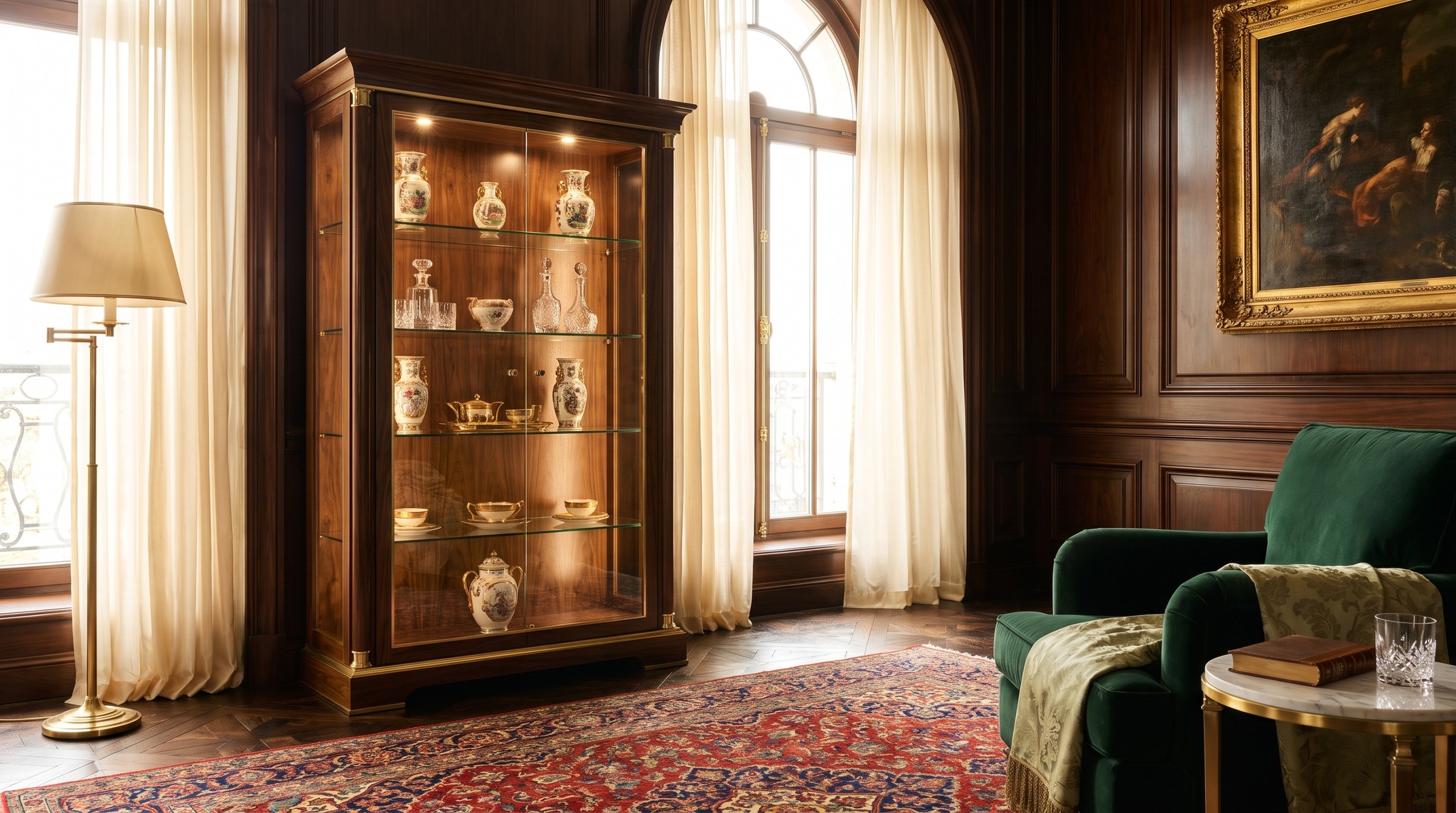
Display Cabinet Next to the Window: When Daylight Changes Colours
You would like to place a display cabinet near a window and wonder whether daylight might damage your exhibits? The concern is justified: UV radiation and direct sunlight can fade colours, darken wood and attack delicate materials. At the same time, natural light shows porcelain, glass and silver to particularly beautiful effect. What matters is which objects you display and how intensely the sun strikes the cabinet.
Which Materials React to Sunlight
Textiles, watercolours, photographs and coloured papers fade within a few months under direct sunlight. Leather, dyed wood and plastics also lose their original colour. Porcelain, ceramics, glass and metal, by contrast, are largely lightfast. If you present mainly tableware, crystal or silver cutlery in your Display Cabinets, there is little objection to a location by the window. For collectibles made of fabric, paper or lacquered wood, you should avoid direct sunlight.
Consider Compass Direction and Angle of Incidence
A north-facing window provides even, diffuse light without direct sun. Here you can place a display cabinet without hesitation. East and west windows bring direct radiation for a few hours in the morning or evening, entering at a shallow angle and reaching deep into the room. South-facing windows mean intense midday sun for several hours in summer. Measure the distance: if the cabinet stands at least 150 centimetres from the window, UV exposure is already significantly reduced. A half-height curtain or venetian blind covering only the lower half of the window admits light whilst protecting the lower shelves.
UV Protection Film and Glazing
Modern insulating glazing filters part of the UV radiation, but not completely. Special UV protection films for window panes block up to 99 per cent of harmful radiation whilst allowing visible light through. The film is applied from inside and costs between 15 and 40 euros per square metre, depending on quality. Alternatively, you can have the cabinet itself fitted with UV protection glass. This is particularly worthwhile for high-quality collections and furniture with large glass surfaces.
Rule of Thumb for Choosing the Location
Check whether the sun falls directly on the cabinet at any time of day. To do this, place a white sheet of paper on the planned location and observe over the course of a day when a sharp shadow forms. The following guidelines help with the decision:
- No direct sun: cabinet can stand directly by the window
- Up to two hours direct sun: maintain a distance of at least 100 centimetres
- More than three hours direct sun: distance of 150 centimetres or UV protection required
- All-day south orientation: place cabinet against a different wall or install sun protection
Regular Inspection Protects Against Damage
Place a piece of fabric or paper in the cabinet, half covered by a book. After three months, compare the two halves. If a colour difference appears, the light is too strong. Also rotate exhibits every few months so that they age evenly. For valuable objects, additional LED lighting inside the cabinet is advisable, which you switch on in the evening. This way the presentation remains effective even with curtains closed.
Related items: Coffee Tables, Decorations, Dining Tables. baroque mirrors. The complete range: Baroque Furniture.
Related categories: Coffee Tables, Decorations, Dining Tables. The full range: Baroque Furniture.
Read more: Dining Table Under the Chandelier: What Height Between Tabletop and Light, Coffee Table with Multiple Armchairs: The Right Position for All, Dining Table by the Window Front: Consider Glare and Seating Direction, Sofa with Chaise Longue: What Room Size Is Required, Bed with Storage Drawer: Which Height Remains Comfortable for Getting Up