


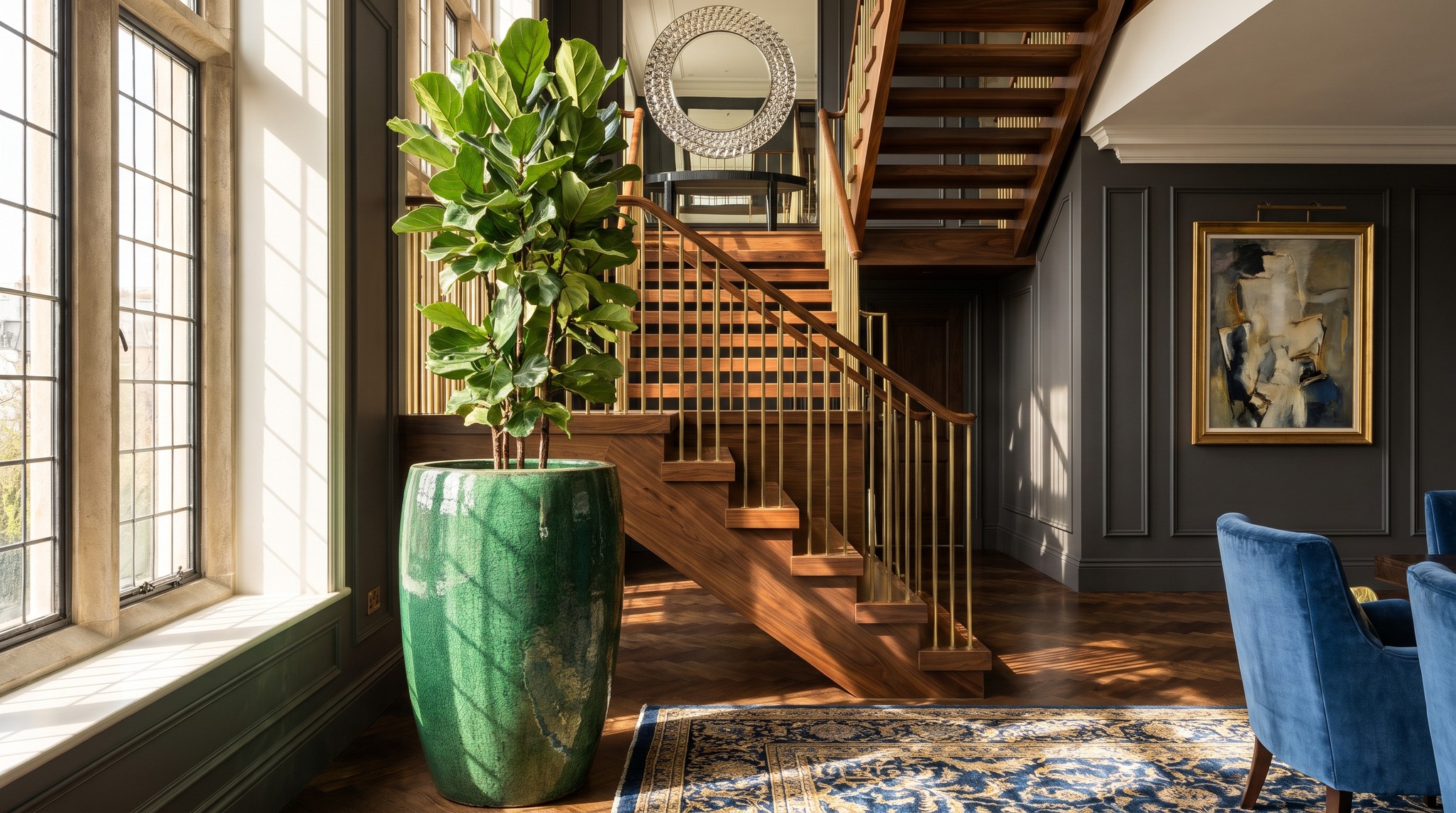
Planters on Staircases: Which Height Keeps the Steps Clear
Anyone wishing to add greenery to their entrance area or stairwell faces a practical question: How tall may a planter be on or beside the steps to prevent tripping hazards and keep the staircase safely passable? Particularly in narrow stairwells or on outdoor stairs with limited width, the planting must be chosen so that it does not constrict the passage. At the same time, the greenery should naturally be visible and enhance the space. In this article, you will learn which dimensions have proven effective and what you should consider when positioning planters.
Minimum Passage Width and Safety Clearance
According to DIN standards, a staircase must provide at least 80 centimetres of usable walking width, with 100 centimetres being standard for main staircases in residential buildings. Planters must not reduce this width. Therefore, always position containers outside the walking line, ideally against the wall or in the corner area of the landing. On the steps themselves, planters should only be placed if the staircase is significantly wider than one metre and at least 30 centimetres of clearance remains from the step edge.
Recommended Height for Planters on Stair Landings
On a stair landing or the top step, planters with heights of 40 to 70 centimetres have proven effective. These dimensions allow sufficient space for upright plants without branches or leaves protruding at eye level. For low greenery, such as grasses or ground cover, containers 30 to 40 centimetres tall are also sufficient. Ensure that the total height of planter and plant does not exceed head height if the staircase runs beneath a passage or ceiling.
Positioning Beside the Steps
If the planter stands to the side of the staircase, for example on a landing or in the hallway, it may be taller. Heights of 70 to 100 centimetres are possible here without affecting the traffic route. It is important that the pot is stable and cannot tip over if someone accidentally bumps into it. Heavy materials such as stoneware, concrete or metal offer advantages over lightweight plastic. A wide base with a diameter of at least 30 centimetres additionally increases stability.
Material Selection and Maintenance in Stairway Areas
For indoor areas, Flower Pots made of ceramic, fibreglass or metal are suitable, as they do not release moisture onto the floor. Always use a saucer to avoid water stains on wood or stone. For outdoor stairs, frost-resistant materials such as glazed ceramic or powder-coated metal are recommended. Check regularly whether water is collecting in the saucer and remove fallen leaves to prevent the steps from becoming slippery.
Plant Selection for Narrow Stairway Areas
In confined stairwells, compact, upright-growing plants are the best choice. Columnar plants such as Sansevieria, dragon tree or narrow palms require little floor space and grow upwards rather than outwards. Avoid sprawling species such as ferns or broad-leaved philodendrons, whose fronds can protrude into the walkway. Trailing plants are also problematic if they grow over the step edge and become a tripping hazard.
Lighting and Visibility
Ensure that planters on the staircase are clearly visible, especially in low light. Dark containers can be overlooked in shadowy corners. Light or patterned surfaces increase visibility. Ideally, supplement the planting with step lighting or spotlights that illuminate both the staircase and the decoration. This combines safety with an appealing atmosphere.
Related items: Display Cabinets, Resin and Fiberglass Sculptures, baroque mirrors. baroque mirrors. The complete range: Baroque Furniture.
Related categories: Display Cabinets, Resin and Fiberglass Sculptures, baroque mirrors. The full range: Baroque Furniture.
Read more: Garden Table on Sloped Ground: Which Leg Frame Remains Stable, Console with Three Drawers: Which Height for Which Purpose, Console with Two Drawers: When This Provides More Storage, Water Column in the Courtyard: Which Height for Multi-Storey Facades, Side Table by the Window: The Right Height Relative to the Windowsill