


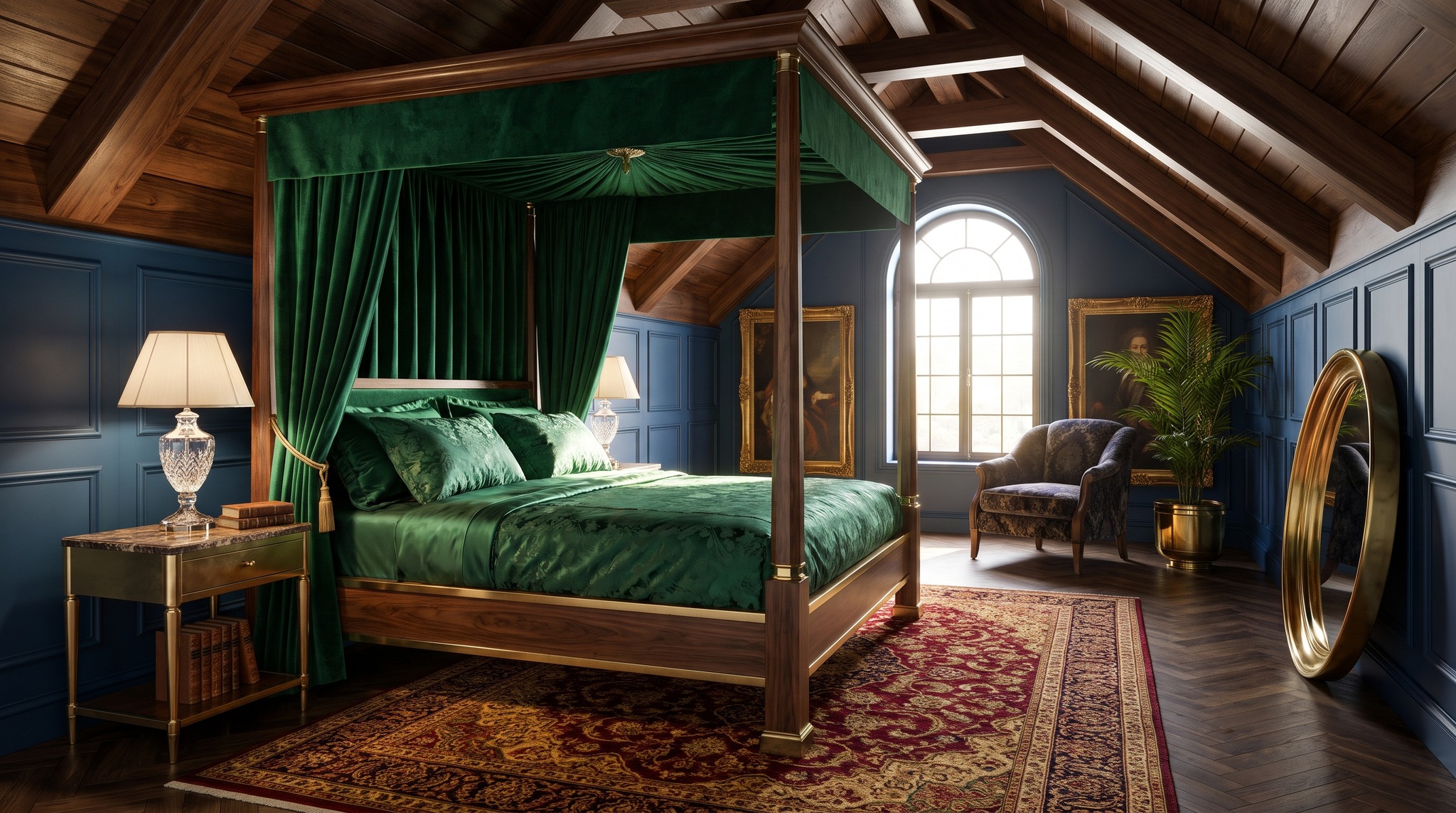
Bed Under a Sloped Ceiling: Which Side for the Headboard
When furnishing a bedroom under the roof, you often face the question: Should the headboard of the bed face the low wall or the centre of the room? The answer depends on the slope angle, the ceiling height and your personal habits. Incorrect placement can result in bumping your head when sitting up or making the room feel cramped. In this article, you will learn which option is right for your situation.
Headboard Towards the Low Side: The Classic Solution
In most cases, it is advisable to place the headboard at the lowest point of the sloped ceiling. This way, your head rests where you are lying flat anyway, and your feet point towards the higher part of the room. When getting up, you automatically move towards the greater standing height. This arrangement works well if the knee height of the slope is at least 120 cm. Below that, it becomes tight, and you will have to bend considerably when sitting on the edge of the bed.
Headboard Towards the High Side: When It Makes Sense
If the slope is very steep or begins at a height of 80 to 100 cm, it may make sense to position the bed the other way round. Then your head is in the centre of the room, where you can sit upright, for example for reading or watching television. The foot area disappears under the slope, which is unproblematic as long as 60 to 80 cm of height remains there. This option is particularly suitable if you like to have breakfast in bed or wish to sit upright for longer periods.
Reference Values for Minimum Height
To sit comfortably in bed, the ceiling height above the headboard should be at least 100 cm, preferably 120 cm. For the foot end, 60 cm is sufficient if you only lie there. Always measure the height from the top of the mattress, not from the floor. A rule of thumb is:
- Head area: at least 100 cm, ideally 120 cm or more
- Foot area: at least 60 cm for pure lying surface
- Sitting area: at least 90 cm if you want to sit upright
Consider Spatial Effect and Light Incidence
The orientation also influences how spacious the room appears. A bed with the headboard towards the low wall often makes the room seem airier, because the view extends upwards. If the headboard is in the centre of the room, however, a niche is created that can feel cosy but also confining. Also check where windows or roof windows are located: Direct morning light in your face can be disturbing, as can draughts from a tilted window near your head.
Trial Phase and Individual Adjustment
Before you commit, you can mark the sleeping area on a trial basis with a mattress or blankets and test it for a few nights. Pay attention to whether you bump your head when getting up, whether there is enough space for bedside tables and whether the arrangement suits your movement patterns. When selecting suitable Beds, you should also consider the height of the headboard: High, upholstered versions require more space upwards than flat models. This way, you will find the solution that optimally combines comfort and spatial feeling.
Related items: Display Cabinets, Resin and Fiberglass Sculptures, baroque mirrors. baroque mirrors. The complete range: Baroque furniture.
Related categories: Display Cabinets, Resin and Fiberglass Sculptures, baroque mirrors. The full range: Baroque Furniture.
Read more: Display Cabinet with Lighting: Which Lamp Does Not Discolour Porcelain, Dining Table by the Patio Door: How Much Space to Leave for Opening, Armchairs in the Living Room: How Much Space an Armchair Really Needs, Timeless Luxury Furniture, Investing in Lasting Elegance, Designing a Luxury Bedroom, Ideas for Your Retreat