

Dining Table Against the Wall: How Much Space Remains for Seating
Anyone wishing to place a dining table against a wall faces the question of whether enough space remains for comfortable seating. Particularly in smaller rooms or with open floor plans, the wall side can be a practical solution. But how much distance do you really need so that chairs remain freely movable and no one sits cramped? This article provides concrete guidelines and shows what you should consider when positioning the table.
Minimum Distance Between Table Edge and Wall
For a person to sit and stand up comfortably, you need at least 80 cm of free space between the table edge and the wall. This value is composed of the chair depth of approximately 50 cm and an additional 30 cm of movement space for pushing back the chair. Plan for 90 to 100 cm if you also wish to pass behind seated persons without them having to stand up. For frequently used passages, 120 cm is ideal.
Choosing Table Size and Wall Position Correctly
A rectangular table can be positioned with its long side parallel to the wall, so that several people can sit side by side. The short side should remain at least 80 cm away from the opposite wall. With Dining Tables having a depth of 90 to 100 cm, this results in a total room depth requirement of approximately 170 to 200 cm. Smaller round or square models are particularly suitable for niches or corners, as they require no fixed orientation.
Considering Chair Type and Armrests
The choice of chairs significantly influences the space required. Chairs without armrests can be pushed completely under the tabletop and thus save approximately 10 to 15 cm of depth. Models with armrests, however, require more space and should only be chosen if at least 90 cm to the wall is available. Ensure that the seat height matches the table height: standard is 45 cm seat height with 75 cm table height.
Testing Freedom of Movement in Daily Use
Before you position the table permanently, a practical test is worthwhile. Set up chairs, sit down and simulate standing up as well as walking past. Also check whether cupboard doors, windows or radiators nearby remain freely accessible. In households with children or elderly persons, you should plan more generously, as more movement space provides safety and comfort here.
Visual Effect and Sense of Space
A table directly against the wall can visually reduce the room if too little distance remains. Leave at least 20 cm of air between the back of the table and the wall to avoid an oppressive effect. Light wall colours and a slender table frame create additional lightness. In elongated rooms, the arrangement parallel to the long wall often appears more harmonious than across it.
Flexible Solutions for Changing Requirements
Extendable or folding tables are suitable if you wish to use the space flexibly. In everyday use, the table stands compactly against the wall; when needed, it can be pulled into the centre of the room. Benches on the wall side are also a space-saving alternative to individual chairs, as they can be pushed completely under the table. This way, you gain up to 30 cm of additional movement space in the closed position.
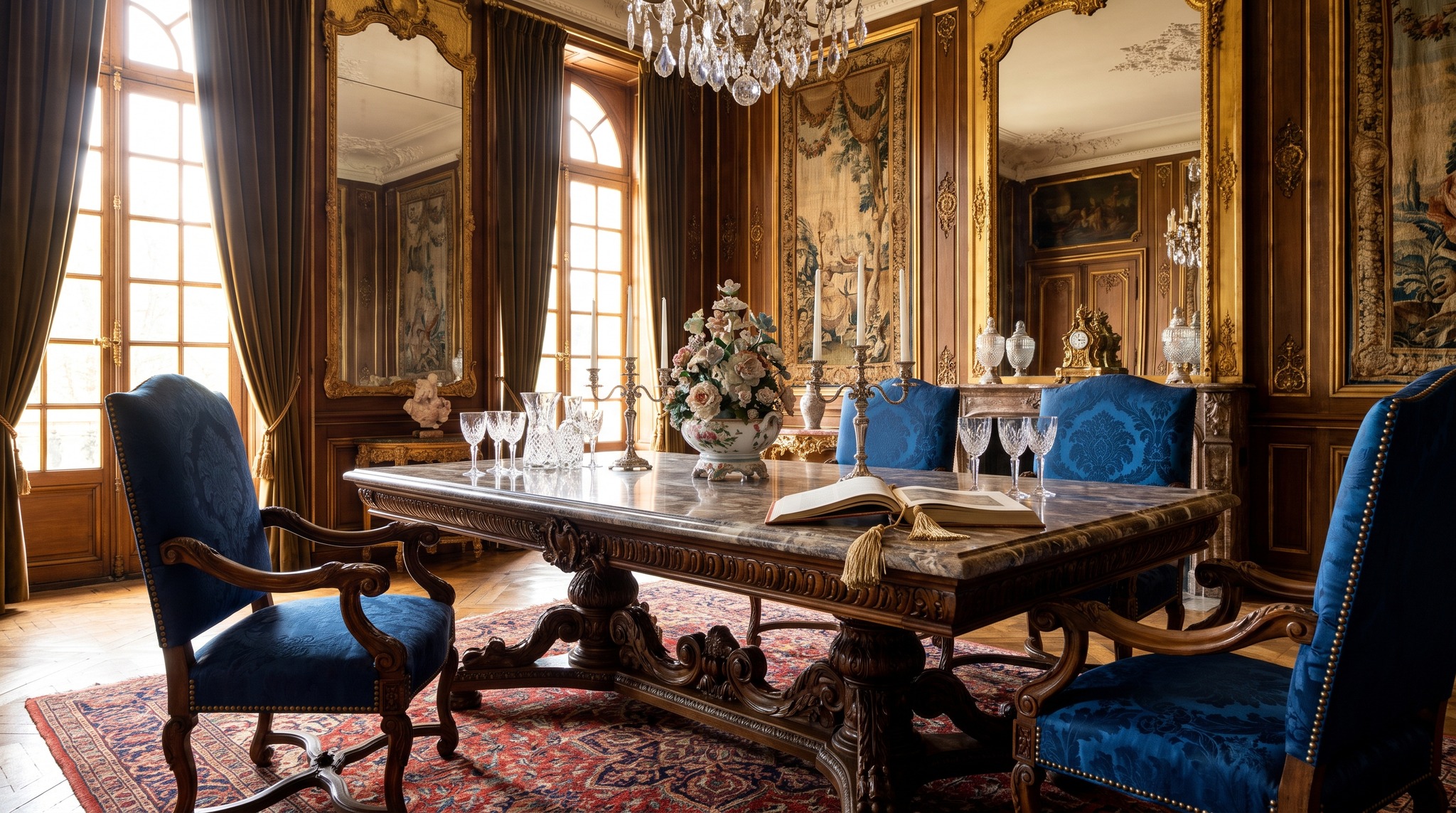
Related items: Coffee Tables, Decorations, Garden Furniture, Stoves and Decoration. baroque mirrors. The complete range: Baroque furniture.
Related categories: Coffee Tables, Decorations, Garden Furniture, Stoves and Decoration. The full range: Baroque Furniture.
Read more: Decorating Shelves: Ideal Height and Spacing Between Objects, Coffee Table with Storage Shelf: When Two Levels Make Sense, Casa Padrino News, All Articles at a Glance, Casa Padrino Baroque Consoles, Magnificent Console Tables for Stylish Hallways and Living Spaces, Exclusive Country Style Cabinet Collection by Casa Padrino, Refined Living in Timeless Elegance