


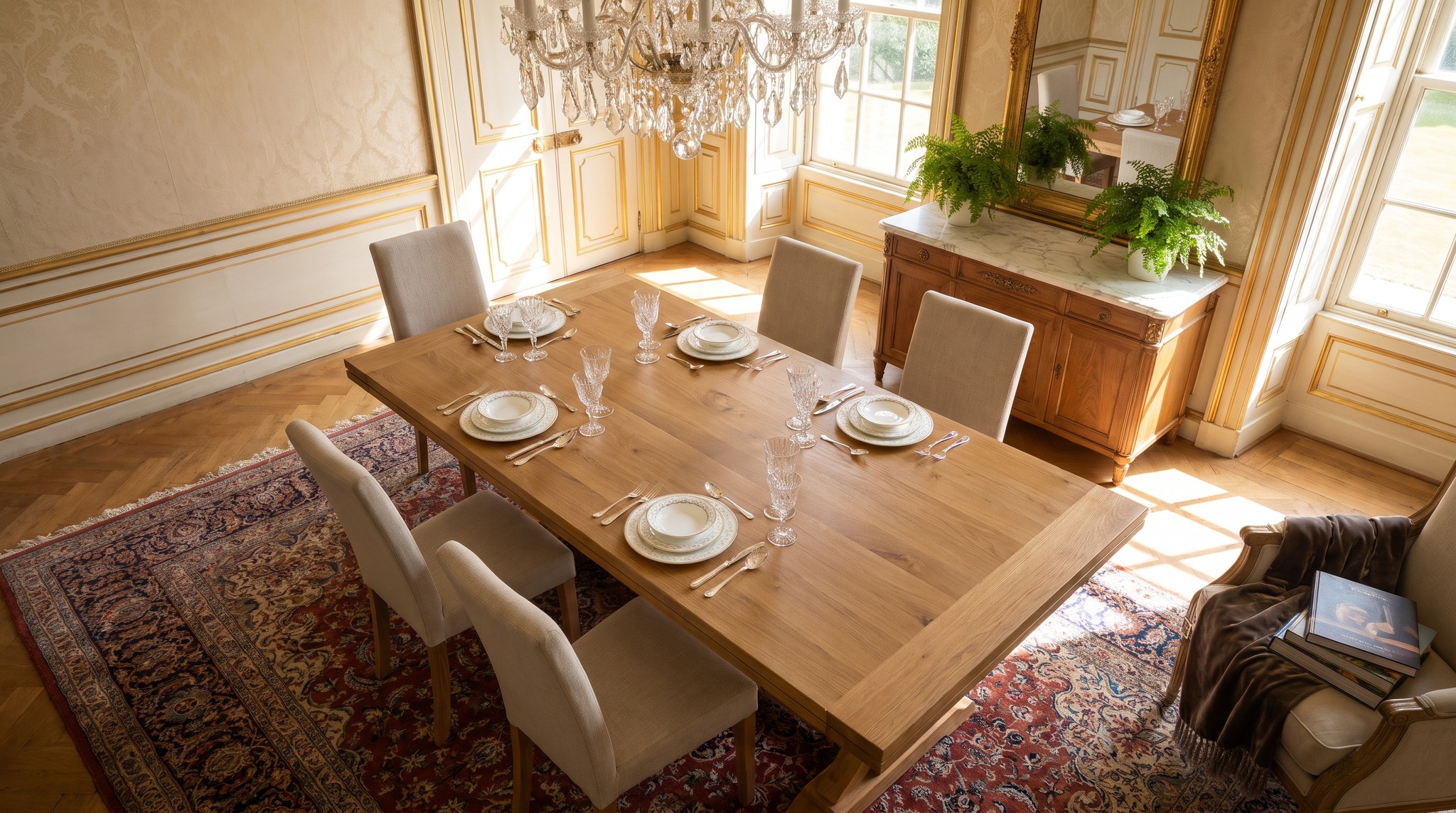
Dining table for six people: what minimum size is required
You are planning a dining area for the family or regular guests and are wondering how large the table needs to be so that six people can sit comfortably. The right size determines whether everyone can sit relaxed and have enough freedom of movement. Too small feels cramped, too large wastes space. This article shows you the most important dimensions and what you should pay attention to when making your selection.
Minimum width and space required per person
Each person requires a width of at least 60 cm at the table so that elbows do not bump and cutlery, plates and glasses have space. In depth, one calculates 40 cm per place setting. For six people, this results in a minimum length of 180 cm for rectangular tables when three people sit on each long side. The width should be at least 90 cm so that bowls, carafes or decoration can still be placed in the middle without space becoming tight.
Rectangular, square or round
Rectangular Dining Tables from 180 × 90 cm are the most common solution for six people. They use space efficiently and fit into most dining areas. Round tables require a diameter of at least 120 cm, preferably 130 cm, so that six people can sit around them. Round shapes promote communication but require more floor space in the room. Square tables from 140 × 140 cm also work, but are rarer and often appear too bulky in narrow rooms.
Consider legroom and table frame
Under the tabletop, at least 60 cm of height should remain to the lower edge of the frame so that thighs have comfortable space. Tables with a central frame or a single pedestal base offer more legroom than models with four corner legs or wide aprons. Make sure that the Chairs match the table in seat height: the difference between seat height and table top should ideally be 27 to 32 cm.
Distance to wall and movement space
Around the table, you should plan at least 80 cm distance to the wall or to furniture so that chairs can be pulled out comfortably and someone can pass behind. In heavily frequented passage areas, 100 cm is more sensible. Measure the available space before purchase and subtract these distances to determine the maximum table size.
Material and care in everyday use
Solid wood, veneered panels, glass or ceramic have different care requirements. Solid wood forgives small scratches and can be re-oiled, glass shows fingerprints more quickly. Ceramic tops are heat-resistant and resistant to stains. For families with children, a robust surface is recommended that does not show marks with every contact. Dark woods and matt surfaces are easier to care for than high gloss.
Extendable variants for flexibility
Those who occasionally host more than six people can opt for extendable models. These can be extended from 160 or 180 cm to 220 to 260 cm and then offer space for eight to ten guests. In everyday use they remain compact. Pay attention to stable extension mechanisms and ensure that the insert leaf can be stored within easy reach.
Related items: Sofas, Mirrors, Garden Fountains. baroque mirrors. The complete range: Baroque furniture.
Related categories: Sofas, Mirrors, Garden Fountains. The full range: Baroque Furniture.
Read more: Coffee Table with L-Shaped Seating: Finding the Right Position, XXL Figure in the Conservatory: What Floor Load for Glass Extensions, Luxury Art Nouveau park bench collection from Casa Padrino for hotels, cities, restaurants, commercial parks and private individuals, Magnificent baroque marble columns from Casa Padrino, Art Nouveau Console in the Hallway: Which Depth with Coat Rack Alongside