


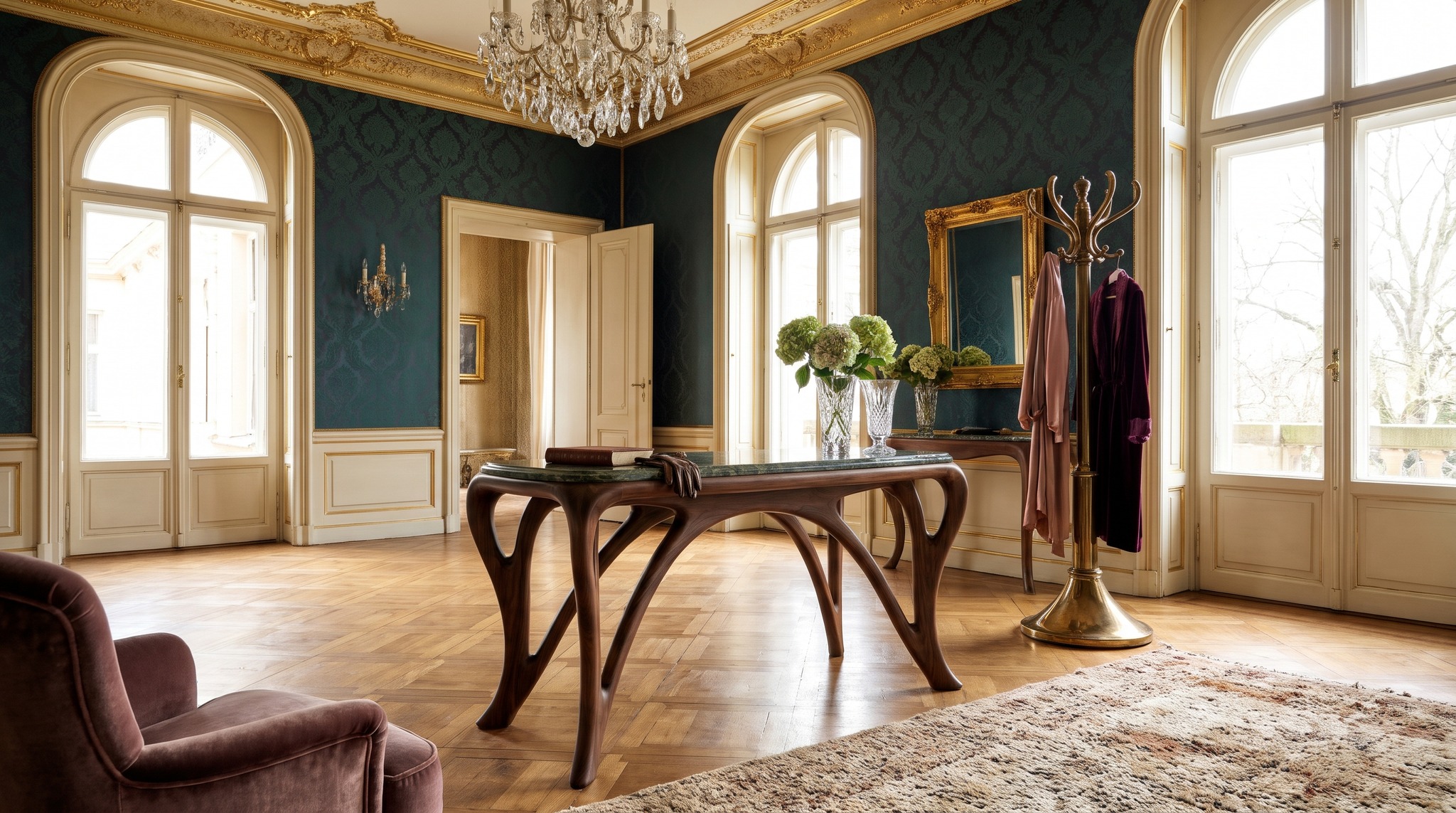
Art Nouveau Console in the Hallway: Which Depth When Placing a Coat Rack Alongside
You are planning an Art Nouveau console for the hallway and would like to place a coat rack alongside it? This raises the question of how deep the console may be so that both pieces of furniture work together without blocking the passage. Especially in narrow hallways, every centimetre counts. This article shows which dimensions make sense and what you should consider when combining them.
Minimum Width of the Hallway and Passage Measurement
As a rule of thumb: the clear passage in the hallway should be at least 80 cm, preferably 90 cm. First measure the width of your hallway from wall to wall. Subtract the depth of the coat rack, which usually lies between 25 and 35 cm, depending on whether hooks, coat hangers or a closed wardrobe are used. What remains is divided between passage and console. With a 180 cm wide hallway and a 30 cm deep coat rack, 150 cm remain. Of this, 80 to 90 cm should remain clear, so that approximately 60 to 70 cm of space is available for the console.
Typical Depths of Art Nouveau Consoles
Classic Consoles in Art Nouveau style are usually between 35 and 50 cm deep. Models with curved legs and marble tops often measure 40 to 45 cm. For narrow hallways, there are also shallower variants from 30 cm depth, which primarily serve as a surface for keys, post or a table lamp. Ensure that the console does not protrude beyond the coat rack, otherwise the arrangement appears restless and the hallway visually even narrower.
Arrangement: Side by Side or Offset
If console and coat rack stand directly next to each other on the same wall, both should ideally have the same depth or the console should be somewhat shallower. A difference of 5 to 10 cm is unproblematic. The difference should not be greater, so that no tripping edge is created. Alternatively, you can place the console on the opposite wall. Then the depth of the console plays a lesser role, as long as the passage remains clear. This solution is particularly suitable when the hallway is wider than 120 cm.
Material and Care in the Entrance Area
Art Nouveau consoles are frequently made of solid wood with inlays or carvings, combined with marble or glass. In the hallway, these materials are exposed to moisture, dirt and temperature fluctuations. Marble can be wiped down easily, wood should be treated occasionally. Do not place the console directly next to the front door if rainwater or road salt comes in there. A distance of at least 50 cm from the door protects the surface and makes care easier.
Lighting and Decoration on the Console
A table lamp or a mirror above the console make the hallway more welcoming and functional. Ensure that the lamp does not protrude too far over the table edge, otherwise there is a risk of bumping into it. The mirror should hang high enough so that it remains usable even with jackets hung on the coat rack. Vases, bowls or small sculptures complete the ensemble, but should not completely occupy the storage surface. Leave at least one third of the console top free so that you can place practical items there.
Style Mix or Uniform Period
Art Nouveau consoles suit coat racks in the same style well, but also simple modern hook rails or country house furniture. What matters is that the proportions are right and the colour scheme harmonises. Dark wood goes well with black or anthracite, light woods with white or cream. Those who wish to carry through the Art Nouveau style consistently will also find suitable additions among Baroque and Art Nouveau Garden Furniture, which are suitable for covered entrance areas or conservatories. A uniform style creates calm, a deliberate break can enliven the hallway.
Related items: Columns and Pedestals, Armchairs, Sideboards. baroque mirrors. The complete range: Baroque Furniture.
Related categories: Columns and Pedestals, Armchairs, Sideboards. The full range: Baroque Furniture.
Read more: Baroque Armchairs with Gold Frames: How Many Fit in a Room?, Multi-Tiered Fountains: What Distance to Consider from the House Wall, Display Cabinet in an Alcove: Which Depth for Limited Space, Column in the Room Corner: Which Height Draws the Eye Upward, Sideboard with Glass Doors: Which Depth for Glasses and Decanters