

Extendable Dining Table: How Much Space the Mechanism Needs at the Sides
You are planning an extendable dining table for your dining room and wondering whether it will actually fit between the walls or next to the sideboard? Unlike fixed tables, extendable models require consideration of more than just length. The extension mechanism needs additional space at the sides so that you can pull out the leaves or insert extension panels. How much space you actually need to allow depends on the design.
End Extension: Space Only Required at the Head Ends
With an end extension, the table is lengthened at one or both head ends. The mechanism runs lengthwise, and the side edges remain unchanged. You therefore do not need any additional clearance at the sides. Simply ensure that there is enough space at the head ends for pulling out: at least 80 cm per side if you want to operate the extension comfortably. This design is well suited to narrow rooms where the table stands between two walls or pieces of furniture.
Centre Extension with Insert Leaf: Side Access Required
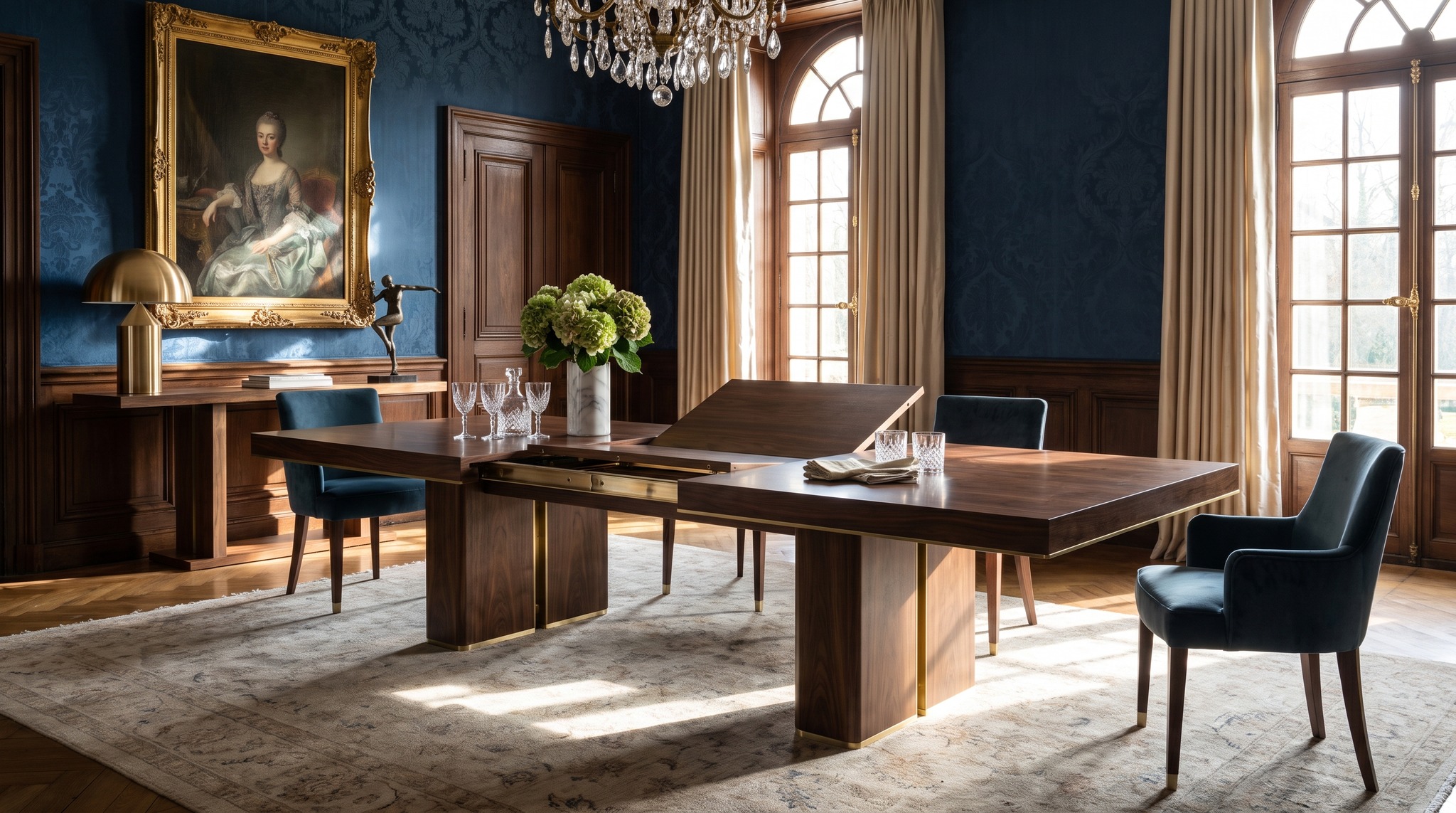
With many traditional Dining Tables, the tabletop opens in the middle and you insert a separate leaf. To do this, you must be able to approach the table from the side. Allow at least 60 cm of free space on one long side, preferably 80 cm, so that you can insert the extension leaf without contortions. If the table stands directly against the wall, extending it becomes laborious or impossible. This variant therefore requires freestanding placement or sufficient distance from adjacent furniture.
Slide Extension and Synchronous Extension: Mechanism Inside the Table
With a slide extension, the additional leaves emerge from beneath the main top; with a synchronous extension, both table halves open simultaneously. The mechanism operates entirely within the table frame. No side access is necessary; you operate the extension from the head ends. Allow approximately 70 to 90 cm of clearance at at least one head end. These systems are suitable for locations where the table is laterally constrained, such as in alcoves or between sideboards.
Rule of Thumb for Space Planning
To enable you to use the extension comfortably, the following guidelines apply:
- End extension: 80 cm clearance at the head end, no requirement at the sides
- Centre extension with insert leaf: 60 to 80 cm clearance on one long side
- Slide or synchronous extension: 70 to 90 cm clearance at the head end, no requirement at the sides
- Circulation space around the table: at least 80 cm, preferably 100 cm for comfortable sitting and standing
Observe Trial Setup and Manufacturer Specifications
Before purchasing, measure the available space and mark the footprint with tape on the floor. This will show you whether the mechanism will work in your room situation. Also check whether radiators, doors or window handles are in the way. You will find the precise dimensions of the extension mechanism in the product specifications or on enquiry with the manufacturer. Some models require only 50 cm at the sides, others up to 90 cm. Careful planning will spare you later disappointment.
Related items: Coffee Tables, Decorations, Garden Furniture, Stoves and Decoration. baroque mirrors. The complete range: Baroque Furniture.
Related categories: Coffee Tables, Decorations, Garden Furniture, Stoves and Decoration. The full range: Baroque Furniture.
Read more: Oval Dining Table: Which Length Is Suitable for How Many People, Marble Coffee Table: What Weight the Floor Must Support, Luxury fountains by Casa Padrino in Baroque and Art Nouveau Design, Bed on Platform: Which Height Remains Practical in the Bedroom, Round Garden Table: How Much Space Between Chairs