


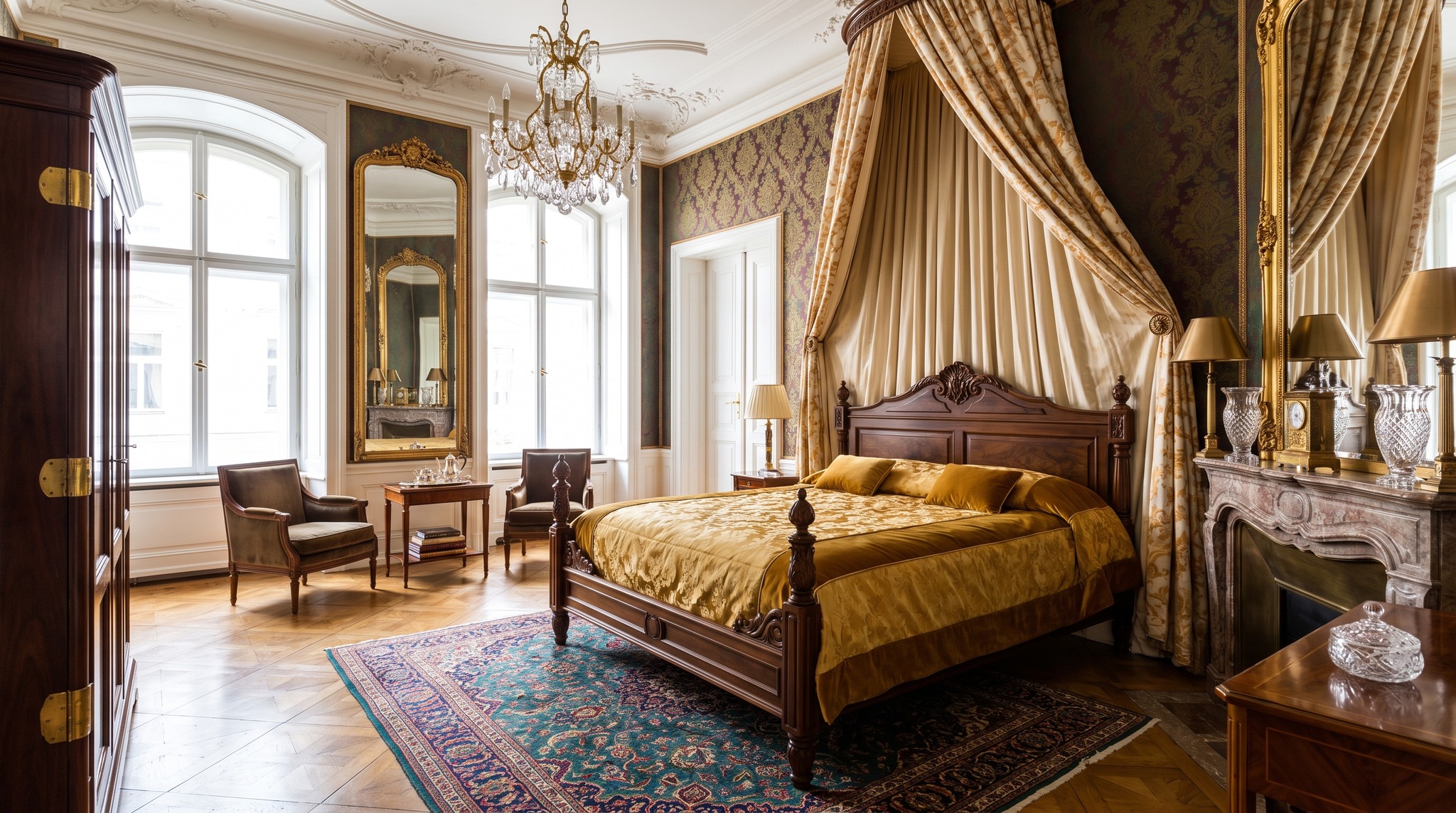
Canopy Bed: What Ceiling Height Is Required for the Fabric
Are you planning a four-poster bed or would you like to equip an existing bed with a canopy? The question of how much upward space is actually required quickly arises. The ceiling height determines whether the fabric falls elegantly or whether the whole arrangement appears cramped. The construction of the canopy also plays a role: Does the fabric hang freely from the ceiling, or is it guided over a frame? In this article, you will learn which dimensions you should plan for and what matters during installation.
Minimum Height for a Classic Four-Poster Bed
A four-poster bed with four posts and a continuous frame generally requires a room height of at least 2.60 metres. The posts themselves often measure between 2.00 and 2.20 metres, plus the upper frame with approximately 5 to 10 centimetres in height. This leaves a distance of around 30 to 50 centimetres to the ceiling, which appears optically balanced and leaves sufficient air. In lower rooms, the bed can appear squat; with very high ceilings from 3.00 metres upwards, a taller frame or additional fabric draping is recommended to balance the proportions.
Ceiling-Mounted Canopy Without Frame
If you do not wish to use a bed frame, the canopy can be attached directly to the ceiling. Here, theoretically any standard height from 2.40 metres is sufficient, as the fabric hangs freely and no fixed construction is required. The length of the fabric is decisive: it should reach at least to the upper edge of the mattress, better still 20 to 30 centimetres beyond, so that it can be gathered or tied at the sides. With a ceiling height of 2.50 metres and a bed height of approximately 0.60 metres, this results in a usable fabric length of 1.90 metres, which is sufficient for most purposes.
Reference Values for Different Room Heights
The following overview shows which variant is suitable for which ceiling height:
- 2.40 to 2.50 metres: ceiling canopy without frame, fabric falling freely or lightly gathered
- 2.60 to 2.80 metres: classic four-poster bed with four posts, frame at approximately 2.10 to 2.30 metres height
- 2.80 to 3.20 metres: tall four-poster bed or double fabric draping, upper frame at 2.40 to 2.60 metres
- from 3.20 metres: additional fabric panels or extended posts to maintain proportions
Distance Between Fabric and Sleeping Surface
For the canopy to be not only decorative but also practical, sufficient space should remain between the lower edge of the fabric and the mattress. A distance of 1.50 to 1.70 metres allows comfortable sitting in bed without the fabric hanging in one's face. With a mattress height of 0.60 metres, this means that the fabric ends at approximately 2.10 to 2.30 metres height. If you wish to open and close the fabric at the sides, plan an additional 10 to 15 centimetres so that the gathering does not become too tight.
Material and Weight of the Fabric
Light voile or organza fabrics require fewer attachment points and appear airy even with low ceilings. Heavy velvet or brocade panels, however, require stable suspension and only come into their own in rooms with heights from 2.70 metres upwards. Ensure that the ceiling or bed frame bears the weight: per metre of fabric, depending on the material, between 300 and 800 grams can accumulate. With Beds with a fixed frame, load capacity is usually not a problem; with ceiling hooks, you should check the load-bearing capacity.
Planning with Sloped Ceilings
In rooms with sloped ceilings, the usable height is often underestimated. Measure the ceiling height directly above the bed edge, not in the centre of the room. A four-poster bed can also be positioned under a slope, as long as there is at least 2.20 metres of space above the headboard. The canopy can then be guided asymmetrically, with the fabric falling on only three sides or the front panel remaining shorter. This creates an individual look that embraces the structural conditions rather than working against them.
Related items: Display Cabinets, Resin and Fiberglass Sculptures, baroque mirrors. baroque mirrors. The complete range: baroque furniture.
Related categories: Display Cabinets, Resin and Fiberglass Sculptures, baroque mirrors. The full range: Baroque Furniture.
Read more: Oval Dining Table: Which Length Is Suitable for How Many People, Marble Coffee Table: What Weight the Floor Must Support, Sideboard Under the Television: Which Width and Which Height, Display Cabinet in the Dining Room: Which Depth for Crockery and Glassware, Chest of Drawers as Room Divider: The Right Height and Back Panel Design