

Chest of Drawers as Room Divider: Which Height and Which Back Panel
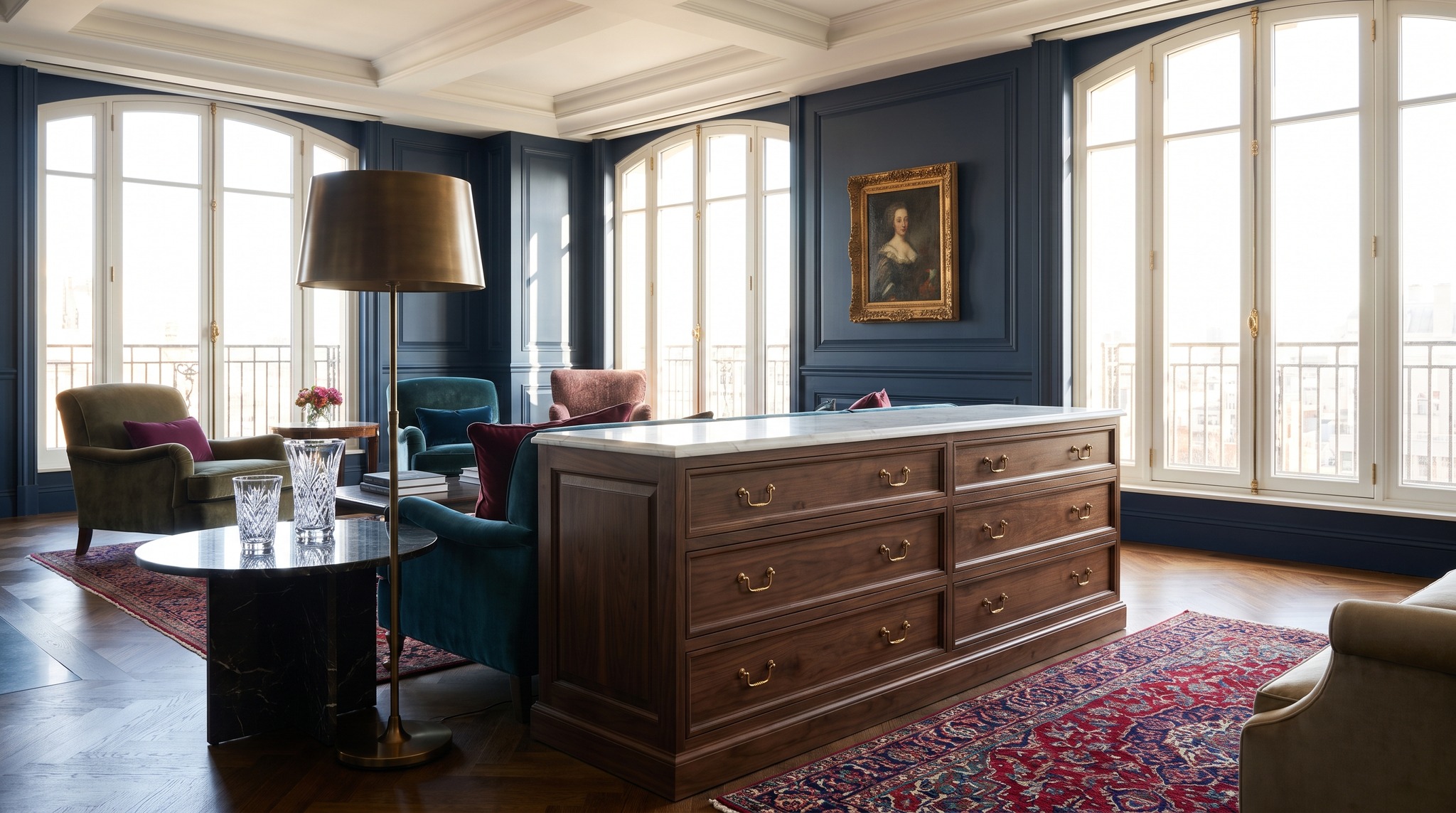
You want to structure an open living area without building a wall? A chest of drawers can serve as a room divider while providing storage space. Two central questions arise: How high should the chest of drawers be to divide the room without closing it off too much? And what about the back panel, which will now be visible?
The Right Height for a Room Divider
A chest of drawers as a room divider should be high enough to create a visual boundary, but low enough not to completely block light and sight lines. Heights between 90 and 120 cm have proven effective. At this height, the room remains open and airy, while a clear separation is noticeable when seated. For stronger demarcation, you can also opt for 140 to 160 cm, which creates a more distinct separation but also makes the room feel more enclosed.
Back Panel: Visible or Covered
When the chest of drawers stands freely in the room, the back panel becomes a second display side. However, many Commodes are only designed from the front, with the back panel often consisting of simple chipboard or thin plywood. Check before purchasing whether the back panel is veneered, lacquered or otherwise finished. If not, you can cover the back panel with fabric, clad it with a wooden board or treat it with paint.
Models Usable from Both Sides
Some manufacturers offer chests of drawers that are accessible from both sides or at least have been finished attractively on both sides. Such models either have drawers on both sides or a consistently high-quality surface throughout. This is particularly practical if you want to use the chest of drawers between living and dining areas or in the hallway. Look for descriptions such as "veneered on all sides" or "usable from both sides".
Width and Depth in Proportion
The width should suit the room size. For a room divider, widths from 120 cm are suitable so that the chest of drawers has presence. The depth should ideally be between 40 and 50 cm, leaving sufficient freedom of movement on both sides. In very narrow rooms, 35 cm can also suffice, but then there is less storage space. Bear in mind that the chest of drawers should be accessible from both sides without being in the way.
Material Choice and Stability
Freestanding furniture should be stable. Solid wood or veneered MDF boards provide sufficient weight and stability. Ensure that the chest of drawers is not too light, otherwise it may wobble when touched. A plinth construction or adjustable feet ensure a secure stand, even on uneven floors. For taller models, wall anchoring can be advisable, especially if children live in the household.
Combining Design and Function
Use the top of the chest of drawers as a surface for decoration, plants or lamps. This turns the room divider into a design element. You can use the drawers or doors for crockery, textiles or office supplies, depending on which areas you are separating. A well-considered selection of Commodes helps you balance function and appearance without the back panel becoming a weak point.
Related products: Dining Tables, Garden Furniture, Stoves and Decoration, Garden Decoration. baroque mirrors. The complete range: Baroque Furniture.
Related categories: Dining Tables, Garden Furniture, Stoves and Decoration, Garden Decoration. The full range: Baroque Furniture.
Read more: Garden Sculpture in Winter: Which Material Can Stay Outside, Garden Furniture Under Trees: Materials, Moss and Leaf Fall, Armchairs in the Living Room: How Much Space an Armchair Really Needs, Timeless Luxury Furniture, Investing in Lasting Elegance, Designing a Luxury Bedroom, Ideas for Your Retreat