


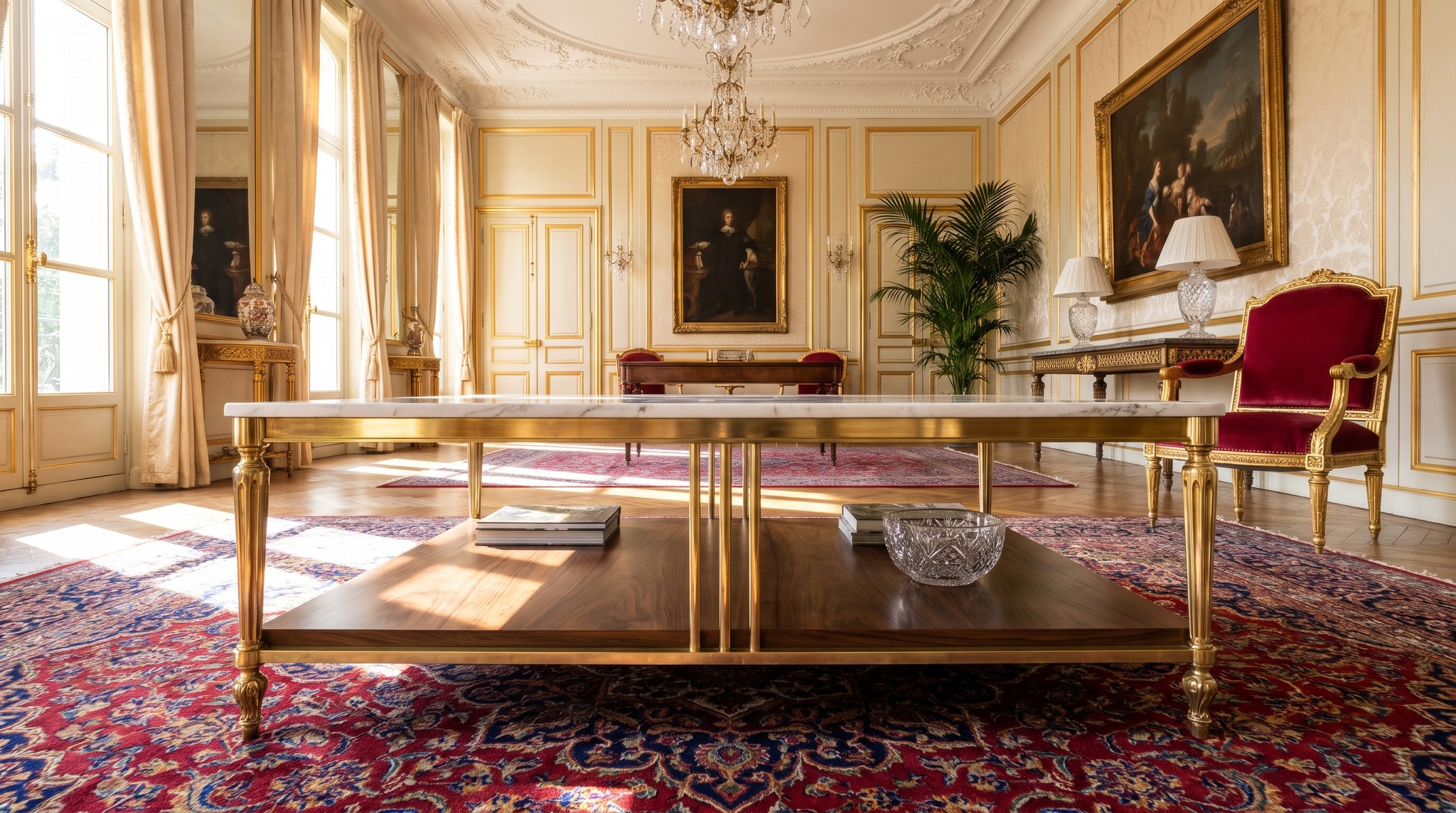
Coffee Table with Shelf: What Height Between the Levels
A coffee table with two levels offers more storage space and surface area, but how much space should there be between the top and the shelf? Many buyers ask themselves this question when selecting a new table or evaluating an existing piece of furniture. The height between the levels determines which items you can accommodate and how practical the table is in everyday use. In this article, you will learn which dimensions have proven effective and what you should consider when planning.
Standard Dimensions for the Distance Between Top and Shelf
For most Coffee Tables with a shelf, the distance is between 20 and 35 centimetres. This range has proven functional in practice because it provides sufficient space for magazines, books and remote controls without the table appearing oversized. Tables with less than 20 centimetres of clearance are only suitable for flat items such as magazines or coasters. Models with more than 35 centimetres of distance can accommodate larger objects such as baskets or boxes, but appear visually bulkier.
Which Items Fit at Which Height
The usable height determines what you can place on the shelf. Here is a guide for common everyday items:
- 15 to 20 cm: magazines, flat coffee table books, coasters, remote controls
- 20 to 25 cm: standard format books, small decorative bowls, storage boxes
- 25 to 30 cm: higher stacks of books, vases, trays, baskets
- 30 to 35 cm: large decorative objects, plants, storage boxes
If you intend to use the shelf primarily for reading material, 22 to 25 centimetres are usually sufficient. For mixed use with decoration and storage, 28 to 32 centimetres are more practical.
Consider the Ratio to the Total Height of the Table
The height between the levels should match the total height of the coffee table. A table with 45 centimetres total height and 30 centimetres clearance leaves only 15 centimetres for the legs, which appears visually squat. With a total height of 40 to 45 centimetres, a distance of 20 to 25 centimetres is recommended. Higher tables with 50 to 55 centimetres can also accommodate 30 to 35 centimetres between the levels. As a rule of thumb: the clearance should be approximately half to two thirds of the total height so that the proportions remain balanced.
Consider Access and Visibility
Another practical aspect is the accessibility of the shelf. With very little clearance, you have to bend down far to reach items. With very large clearance, the lower area visually disappears into the depth. A clearance of 25 to 30 centimetres allows comfortable access without having to get on your knees. At the same time, the shelf remains clearly visible from the side, so you can see at a glance what is there.
Include Material Thickness and Construction
The stated height between the levels usually refers to the clear distance, that is, the usable space. The actual material thickness of the top and the shelf does not reduce this value. However, with solid wood panels 4 to 6 centimetres thick, the overall construction can be higher than with thin glass panels. When selecting, check whether the manufacturer's specifications refer to the internal distance or the external dimensions. High quality tables made of solid wood or with elaborate carvings often have thicker panels, which must be considered in space planning.
Adaptation to Personal Needs
Ultimately, the ideal height depends on your use. If you want to store many books, choose at least 25 centimetres. For pure decoration or a few flat objects, 20 centimetres are sufficient. Measure in advance which items you want to accommodate and add 2 to 3 centimetres reserve. This way you avoid the shelf being too tightly dimensioned and you being dissatisfied later.
Related items: Chairs, Display Cabinets, Resin and Fiberglass Sculptures. baroque mirrors. The complete range: Baroque Furniture.
Related categories: Chairs, Display Cabinets, Resin and Fiberglass Sculptures. The full range: Baroque Furniture.
Read more: Sideboard with Open Compartments: What Height for Books and Binders, Side Table with Metal Base on Parquet: Permissible Weight, Garden Table Under the Pergola: Which Shape Fits Best, Sideboard Under the Television: Which Width and Which Height, Display Cabinet in the Dining Room: Which Depth for Crockery and Glassware