


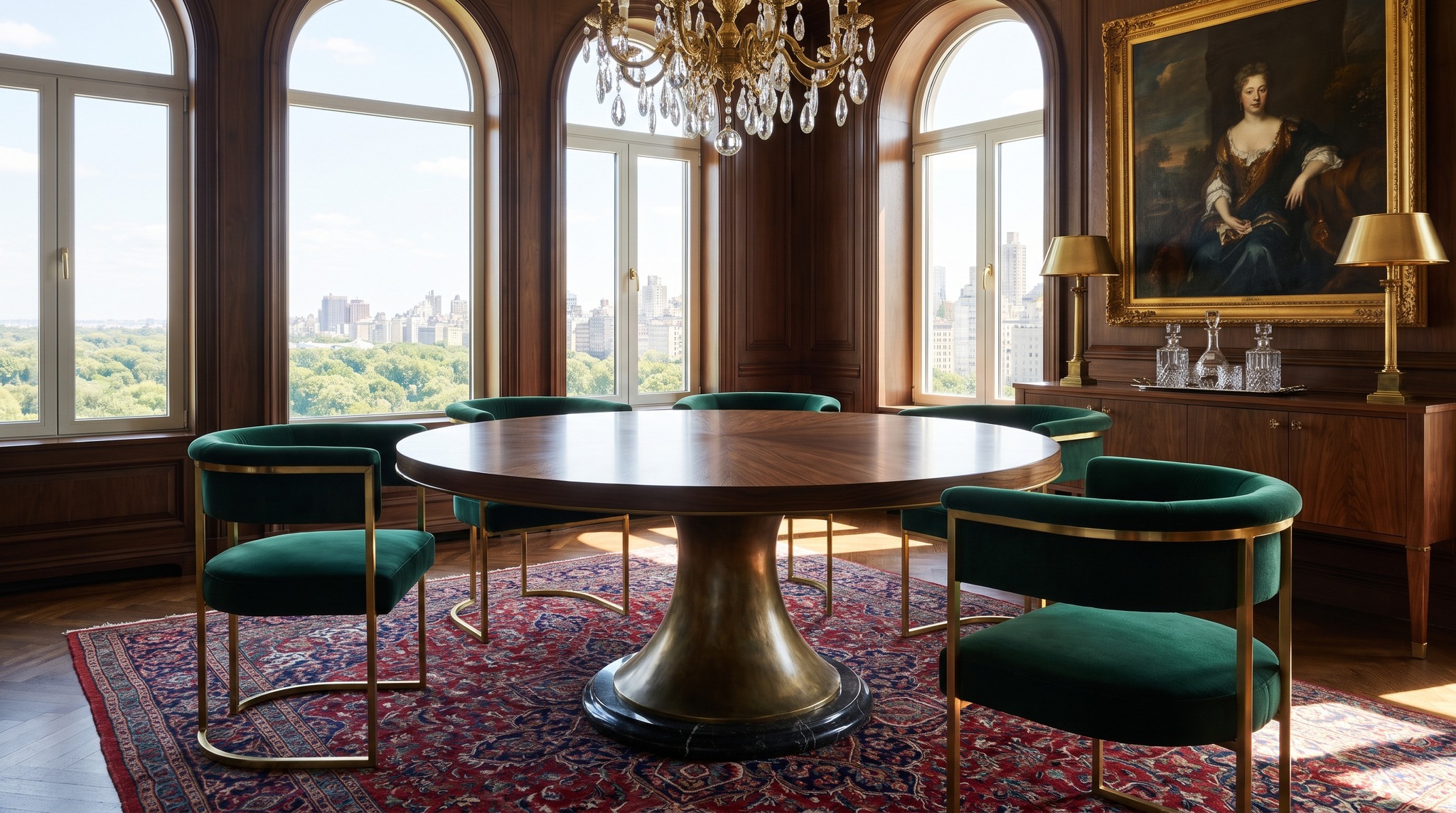
Dining Table with Central Base: How Much Legroom Remains at the Sides
You are planning a new dining table and wondering whether a model with a central base is the right choice. Unlike four table legs, this design promises more freedom of movement along the long sides. But how much space actually remains for guests' legs, and what should you look for when buying? We clarify these questions below.
Why a Central Base Offers More Legroom
A table with a central base dispenses with legs at the corners. This means no obstacles for knees or feet, regardless of where someone sits. Particularly at the ends, you can easily place additional chairs without anyone having a table leg in the way. This makes this design especially flexible if you frequently receive guests or wish to vary the seating arrangement.
Typical Dimensions and Distances with Central Bases
Most central bases consist of a vertical column or a cross-shaped foot positioned in the centre of the table. The width of the base is usually between 40 and 70 cm, often narrower for rectangular tables than for round ones. The distance between the table edge and the base edge is important: at least 50 cm should remain free here, preferably 60 cm, so that a chair can be pulled up comfortably without knees bumping. With a 180 cm long table with a 50 cm wide base, 65 cm of legroom remains on each side.
Seating Comfort Along the Long Sides
Along the long sides, you benefit most from the central base. Here you can place several Chairs side by side without table legs restricting the seating position. Ensure that the table top is at least 90 cm wide so that two people can sit comfortably opposite each other with room remaining in the middle for crockery. With narrower tables, space becomes tight quickly, even if the legroom is adequate.
Material and Stability of the Base
Central bases are available in wood, metal or a combination of both. Metal bases are usually slimmer and appear lighter, while solid wooden columns look more rustic. Stability is crucial: a heavy base made of cast iron or solid oak prevents the table from wobbling when someone leans against it. Before purchasing, check whether the base suits the size of the top. As a rule of thumb: the larger the table top, the wider or heavier the central base should be.
Combination Possibilities with Different Styles
The selection of Dining Tables with central bases ranges from baroque models with turned columns to modern variants with slender stainless steel crosses. In country house style, you often find tables with turned wooden bases, whilst Art Nouveau designs favour curved metal forms. Ensure that the base matches your chairs in colour and form. A dark wooden base harmonises well with upholstered chairs in warm tones, whilst a chrome-plated metal base fits elegantly into modern or Chesterfield interiors.
Space Requirements and Spatial Effect
A table with a central base often appears lighter than a model with four legs because less mass is visible on the floor. This can be advantageous in smaller rooms. Nevertheless, you need sufficient space all around: allow at least 80 cm between the table edge and wall or furniture so that chairs can be pulled out comfortably. For a 200 cm long table, you therefore need a room depth of at least 260 cm if the table is to stand freely.
Related items: Sofas, Mirrors, Garden Fountains. baroque mirrors. The complete range: Baroque Furniture.
Related categories: Sofas, Mirrors, Garden Fountains. The full range: Baroque Furniture.
Read more: Chesterfield Sofa with Stud Trim: Which Wall Colour Suits It, Water Column in the Courtyard: Which Height for Multi-Storey Facades, Chair Upholstery in the Dining Area: Which Material Withstands Stains, XXL Sculpture in the Entrance Area: What Ceiling Height Is Required, Sculpture on Pedestal: Which Height for Which Viewing Angle