


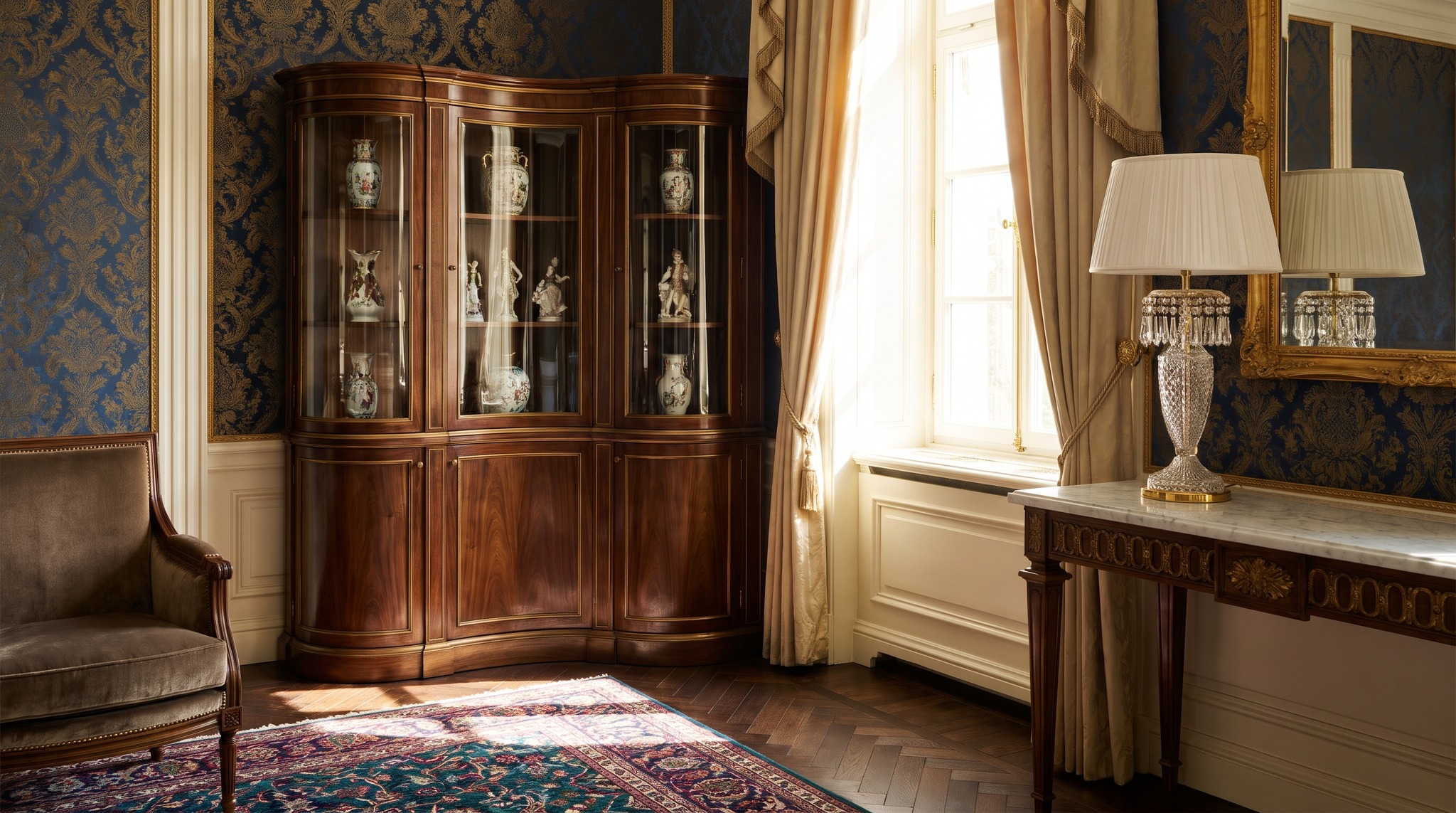
Display Cabinet in the Corner: Which Shape Makes Better Use of Space
You would like to place a display cabinet, but space along the straight walls is limited or already occupied? Many living rooms and dining rooms offer free corners that are suitable for furniture without blocking the passage. The question then is: Does a normal rectangular display cabinet fit into the corner, or do you need a special corner model? And which shape really makes use of the available space without the piece of furniture appearing lost or bulky?
Rectangular Display Cabinet Diagonally in the Corner
A classic rectangular display cabinet can be placed diagonally in a room corner. One edge points towards the corner, the front side stands at an angle in the room. This arrangement appears dynamic and loosens up strict room structures. However, a triangle of unused space is created behind the display cabinet, which you can neither reach nor furnish sensibly. With Display Cabinets with a depth of 40 to 50 cm, the lost space quickly adds up to 0.3 to 0.4 square metres per corner. For small rooms, this is often too much. In addition, the display cabinet protrudes further into the room than a corner model, which narrows the passage.
Corner Display Cabinets with Pentagonal Floor Plan
Specially constructed corner display cabinets have a pentagonal or bevelled floor plan. The back consists of two surfaces that rest at right angles against the walls, while the front runs bevelled or slightly rounded. Such models make full use of the corner without leaving dead space. Typical dimensions are 60 to 80 cm width per wall side and 40 to 50 cm depth at the widest point. The floor space remains compact, yet the display area inside is generous. This shape is particularly suitable for rooms under 20 square metres, where every centimetre counts.
Height and Proportion to Ceiling Height
In a corner, a display cabinet appears visually more prominent than against a straight wall because it is visible from two sides. Therefore, the height should match the room height. With standard ceilings of 240 to 260 cm, display cabinets between 180 and 210 cm height are recommended. Lower models around 120 to 150 cm are suitable for period buildings with 280 cm and more, so that the proportions are correct. A display cabinet that is too tall in a low corner oppresses the room, one that is too low in a high room appears lost. Measure the ceiling height in advance and plan at least 30 cm distance upwards so that the piece of furniture does not appear overwhelming.
Lighting and Visibility from Different Viewing Angles
Corner display cabinets are viewed from several directions. Ensure that the glazing on the sides is also transparent, not just at the front. Integrated LED lighting should come from above or from the sides to avoid shadows. With diagonally placed rectangular models, daylight often falls unfavourably because the panes are at an angle. Corner models with bevelled fronts catch light more evenly and allow the contents to be clearly seen from several viewpoints. Check whether the model includes connections for lighting or whether you need to install spots afterwards.
Material and Style Matching the Room Corner
Corners are often dark because two walls absorb the light. Light woods such as oak or maple and display cabinets with plenty of glass make the corner appear airier. Dark walnut or mahogany models suit classic Baroque or Art Nouveau interiors, but can visually reduce small corners. If you already have heavy furniture in the room, choose a delicate model with a narrow frame for the corner. If the display cabinet stands alone, it may be more substantial. Ensure that the base and cornice do not protrude beyond the skirting boards of the wall, otherwise the piece of furniture will not fit flush into the corner.
Related items: Coffee Tables, Decorations, Dining Tables. baroque mirrors. The complete range: Baroque Furniture.
Related categories: Coffee Tables, Decorations, Dining Tables. The full range: Baroque Furniture.
Read more: Garden Bench on the Terrace: Optimal Distance to the Seating Group, Sculpture in the front garden: the right plinth for uneven ground, Cast Iron Garden Bench: Weight, Stability and Care, Sideboard or Display Cabinet in the Dining Room: What for Which Purpose, Dining Table on Rug: Which Size Belongs Under Table and Chairs