


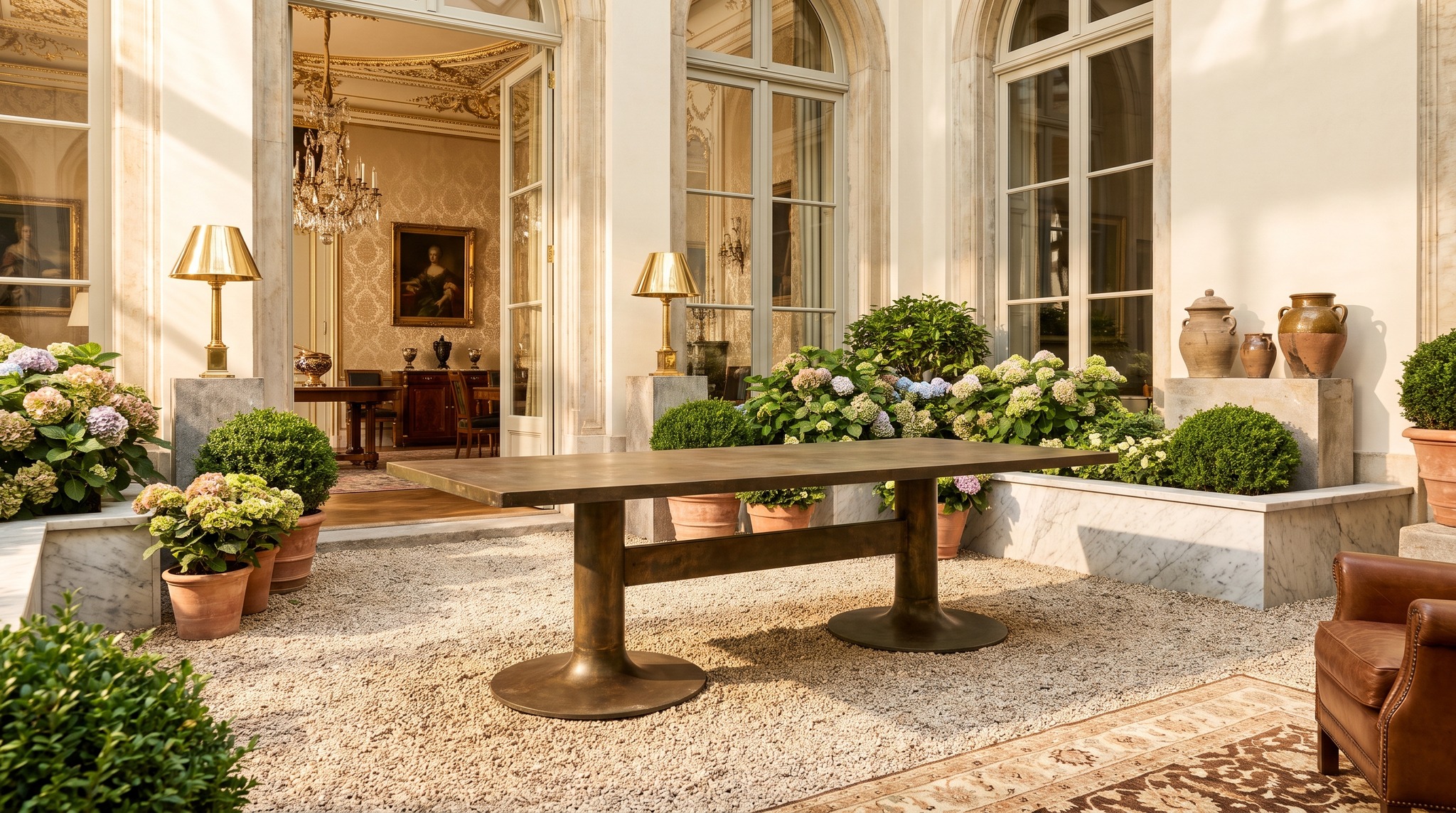
Garden Table on Gravel: Which Leg Shape Does Not Sink
You want to place your garden table on a gravel surface, but after a short time the legs sink in and the table stands crooked. Many garden owners who have designed their patio or seating area with gravel are familiar with this problem. The choice of the right leg shape determines whether your table remains stable or shifts after each use. We will show you which constructions are suitable for gravel surfaces and what you should look for when purchasing.
Why Some Table Legs Sink into Gravel
Gravel does not provide a solid support surface like concrete or wooden decking. The smaller the contact area of the table leg, the higher the pressure per square centimetre. A thin metal tube with a two centimetre diameter creates a pressure of approximately 3.2 kilograms per square centimetre on a 20 kilogram table, just from its own weight. When the weight of dishes and resting forearms is added, the leg inevitably sinks between the pebbles. The grain size of the gravel also plays a role: fine gravel with 8 to 16 millimetre grain size compacts differently than coarse gravel with 32 to 63 millimetre.
Wide Base Feet Distribute the Weight
Table legs with wide base feet or floor plates offer the best solution for gravel surfaces. Feet with at least 8 to 10 centimetres in diameter or rectangular plates from 10 by 10 centimetres are ideal. Such constructions distribute the weight over a larger area and significantly reduce the pressure. Many high-quality Garden Furniture pieces feature specially shaped feet that have been developed precisely for this purpose. Ensure that the base surface is flat and has no sharp edges that could dig into the ground.
Cross Base and Panel Constructions as Stable Alternatives
Tables with a cross base or continuous panels instead of individual legs distribute the load across multiple contact points. A cross base rests along its entire length and prevents localised sinking. Panel tables have two wide side sections, each offering a contact surface of 60 to 80 centimetres in length. This construction is particularly common with solid wood tables and combines stability with classic appearance. The disadvantage: such constructions make flexible chair placement more difficult, as legroom is restricted.
Additional Supports for Narrow Legs
If you already own a table with slender legs, you can help with simple aids. Suitable options are:
- Patio slabs made of concrete or natural stone, 30 by 30 centimetres, under each leg
- Rubber pads or special furniture glides with at least 8 centimetres in diameter
- Flat wooden discs, 15 to 20 centimetres in diameter, made of weather-resistant hardwood
- Metal plates measuring 12 by 12 centimetres, galvanised or stainless steel
These supports artificially increase the contact area and prevent sinking. It is important that they lie flat in the gravel and cannot tip over themselves.
Consider Material and Weight of the Table
A heavy table made of solid wood or cast iron requires more stable feet than a lightweight aluminium table. As a rule of thumb: for every 10 kilograms of table weight, the total contact area of all legs should be at least 80 square centimetres. A 40 kilogram table therefore needs at least 320 square centimetres of contact area, distributed across all legs. For round feet, calculate the area using the formula radius times radius times 3.14. A foot with 10 centimetres in diameter thus has approximately 78 square centimetres of area.
Related items: Fountains and Water Columns, Coffee Tables, Decorations. baroque mirrors. The complete range: Baroque Furniture.
Related categories: Fountains and Water Columns, Coffee Tables, Decorations. The full range: Baroque Furniture.
Read more: Upholstered chair: which fabrics withstand pets, Planter Pairs: What Distance Frames an Entrance, Sofa in a Bay Window: How to Use the Angle, Bedroom Chest of Drawers: How Much Drawer Height for What, Console in the Entrance Area: Decoration and Storage Space Used Optimally