


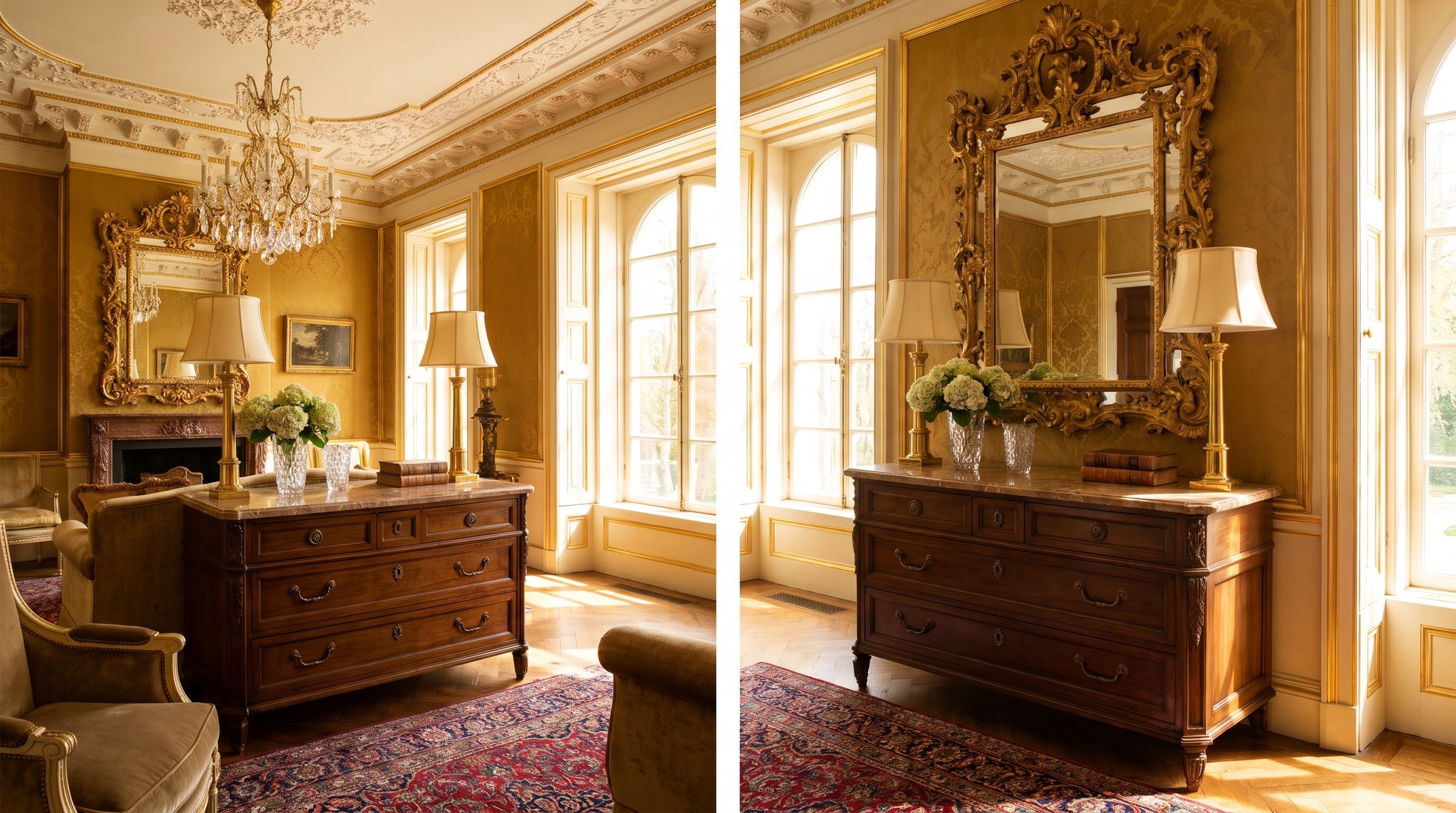
Mirror with Carved Frame: Which Width for the Chest of Drawers Below
You have purchased a chest of drawers and would like to hang a mirror with a carved frame above it. But what width should the mirror be to create a harmonious combination? Too narrow, and the mirror gets lost visually. Too wide, and it extends beyond the furniture edges. In this article, you will learn which proportions have proven successful and what you should pay particular attention to with carved frames.
The Basic Rule: Two Thirds to Three Quarters of the Chest Width
As a rule of thumb, the width of the mirror frame should be approximately two thirds to three quarters of the chest width. For a chest of drawers 120 cm wide, a mirror of 80 to 90 cm would be ideal. This proportion ensures that the mirror does not appear lost, but also does not seem oversized. The frame should under no circumstances be wider than the chest itself, otherwise the balance tips.
Carved Frames Appear Wider Than Plain Ones
With Mirrors featuring elaborately carved frames, you must consider the visual effect. A baroque frame with ornaments, volutes or gold leaf appears significantly more prominent than a plain wooden frame of the same width. If your frame is very three-dimensional, you can therefore tend towards the smaller variant. A mirror 70 cm wide above a 100 cm wide chest can appear just as space-filling through a richly decorated frame as an 80 cm wide mirror with a narrow profile.
Distance from the Wall and Height Above the Chest
The mirror should hang approximately 10 to 15 cm above the top edge of the chest of drawers. This distance prevents decorative objects on the chest from visually merging with the frame, and gives both elements room to breathe. Ensure that the lower edge of the frame does not sit lower than the top edge of the chest, otherwise the arrangement appears compressed. With very tall carved frames, the distance can also increase to 20 cm to maintain proper proportions.
Style Unity Between Commodes and Mirrors
Besides width, stylistic coordination plays an important role. A baroque carved mirror harmonizes best with a chest in the same style or with classic lines. If the chest is already richly decorated, the mirror frame may be somewhat more restrained. Conversely, an opulent frame can enhance a plain chest. Pay attention to the wood colour or surface finish: gold, silver, natural wood or lacquered surfaces should match each other or deliberately contrast.
Practical Dimensions for Common Chest Widths
Here is guidance for typical furniture dimensions:
- Chest 90 cm wide: mirror 60 to 70 cm
- Chest 120 cm wide: mirror 80 to 90 cm
- Chest 150 cm wide: mirror 100 to 115 cm
- Chest 180 cm wide: mirror 120 to 135 cm
These values refer to the outer dimensions of the frame. Measure the actual width of your chest before purchasing and factor in the frame thickness, especially with carved profiles that can extend outward beyond the actual mirror surface.
Consider Room Size and Wall Space
In small rooms, you should tend towards the smaller mirror width so that the wall does not appear overloaded. In spacious rooms, the mirror may also be at the upper end of the recommended range. Also check whether other furniture or doors are positioned to the left and right of the chest. A mirror should not reach adjacent elements, but leave at least 20 cm distance so that the arrangement remains airy.
Related items: Chairs, Display Cabinets, Resin and Fiberglass Sculptures. baroque mirrors. The complete range: Baroque Furniture.
Related categories: Chairs, Display Cabinets, Resin and Fiberglass Sculptures. The full range: Baroque Furniture.
Read more: Baroque Armchairs with Gold Frames: How Many Fit in a Room?, Art Nouveau Console in the Hallway: Which Depth with Coat Rack Alongside, Casa Padrino Baroque Chairs, Magnificent Chairs for a Luxurious Dining Room, Round Luxury Rugs by Casa Padrino, Exclusive Designer Rugs for Luxury Hotels, Private Homes & Boutique Interiors, The Grandeur of Festive Artistry, Casa Padrino’s Majestic XXL Nutcracker Sculptures