


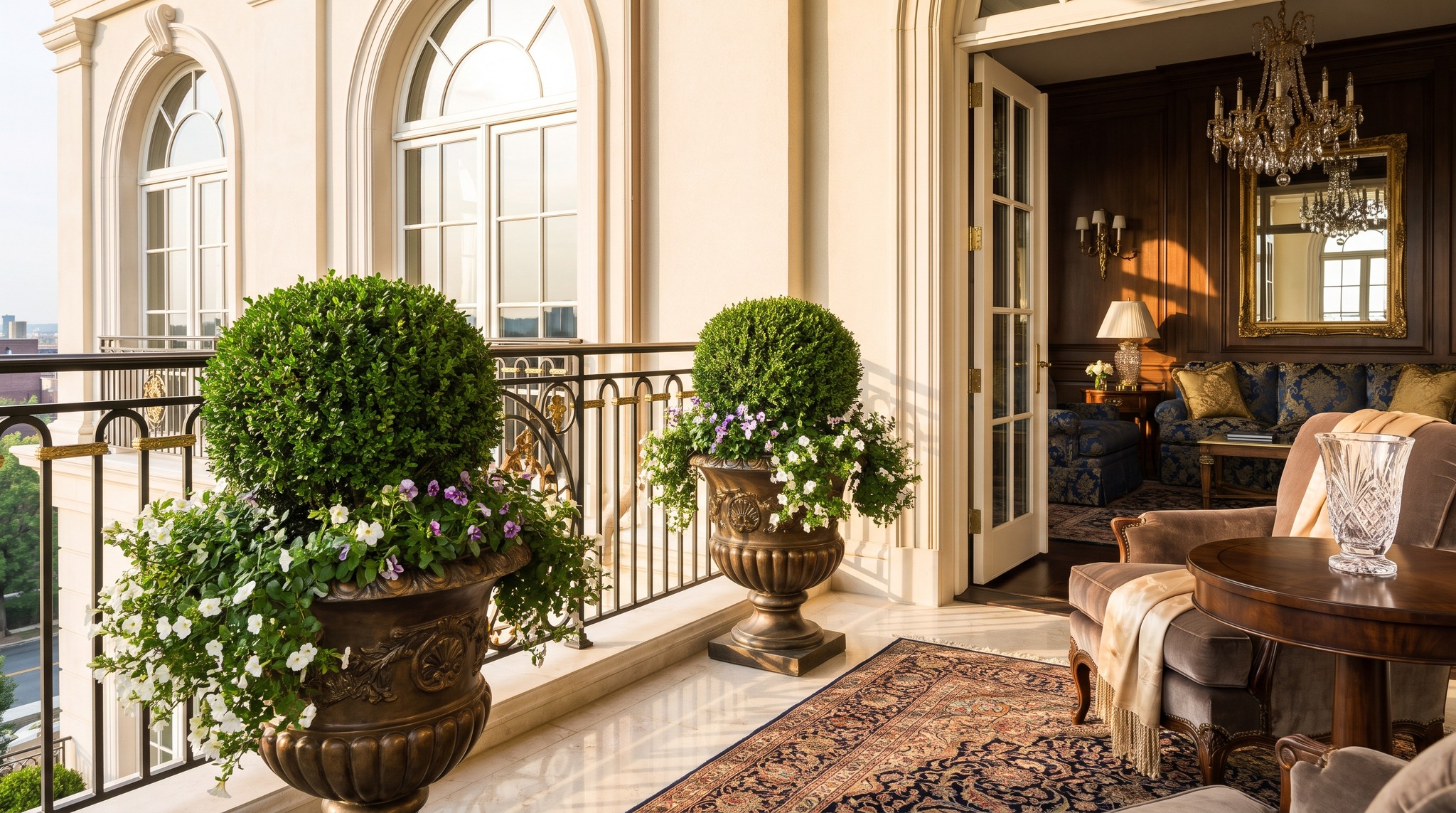
Planters on the Balcony: What Weight Per Square Metre Is Permitted
You would like to green your balcony with large planters but are unsure how much weight the surface may bear? This question is justified, as a planted container quickly weighs several dozen kilograms. Particularly with older buildings or generous plantings, it is important not to exceed the load-bearing capacity. This article shows which guideline values apply and what you should consider when planning.
Permissible Load Capacity According to Year of Construction and Building Method
The load-bearing capacity of a balcony depends on the year of construction and the building method. Modern balconies built according to current standards must be able to bear at least 400 kilograms per square metre in Germany. Older balconies from the 1960s or 1970s often only reach 300 to 350 kilograms per square metre. With listed or very old buildings, the load capacity may be even lower. In case of doubt, the structural engineer or property management can provide information about the exact load capacity of your balcony.
Calculating the Weight of a Planted Planter
A planter consists of the weight of the container itself, the soil and the plant itself. A medium-sized plastic container with 40 litres capacity weighs approximately two to three kilograms when empty, but around 50 kilograms when filled with moist soil. Containers made of terracotta, concrete or fibreglass are considerably heavier. For a 60-litre concrete container, calculate a total weight of 80 to 100 kilograms when soil and plant are added. Watering increases the weight by an additional ten to twenty per cent.
Distribution of Load on the Balcony Surface
The permissible load capacity refers to the entire balcony surface, not to individual points. A balcony with six square metres and a load capacity of 400 kilograms per square metre may bear a total of 2,400 kilograms. Nevertheless, you should place heavy containers as close as possible to the house wall, as the structure is most stable there. Avoid concentrating several large Flower Pots at the balustrade, as the balcony slab projects furthest there and the leverage effect places greater stress on the material.
Lighter Alternatives for Planting
If you wish to conserve the load capacity, there are several options. Use planters made of plastic or fibreglass instead of concrete or ceramic. Fill the bottom of the container with expanded clay or polystyrene flakes, which saves weight and simultaneously improves drainage. Special plant substrates based on coconut fibres or perlite weigh only half as much as conventional potting soil and are particularly suitable for larger containers. Choosing smaller plants also noticeably reduces the overall weight.
Plan Safety Reserve and Check Regularly
Always plan a safety reserve of at least 20 per cent to account for snow load in winter or additional furniture. A balcony with 400 kilograms load capacity per square metre should not permanently bear more than 320 kilograms per square metre. Check once a year whether cracks are visible in the balcony slab or on the fastenings. In case of uncertainty, it is worth investing in a structural assessment, particularly if you wish to place several heavy containers. The selection of Flower Pots is large enough to find the right solution for every load capacity.
Related items: Display Cabinets, Resin and Fiberglass Sculptures, baroque mirrors. baroque mirrors. The complete range: Baroque furniture.
Related categories: Display Cabinets, Resin and Fiberglass Sculptures, baroque mirrors. The full range: Baroque Furniture.
Read more: Garden Table in the Wind Tunnel: Which Shape and Weight Remain Stable, Display Cabinet Next to the Window: When Daylight Changes Colours, Sideboard Under the Television: Which Width and Which Height, Display Cabinet in the Dining Room: Which Depth for Crockery and Glassware, Chest of Drawers as Room Divider: The Right Height and Back Panel Design