


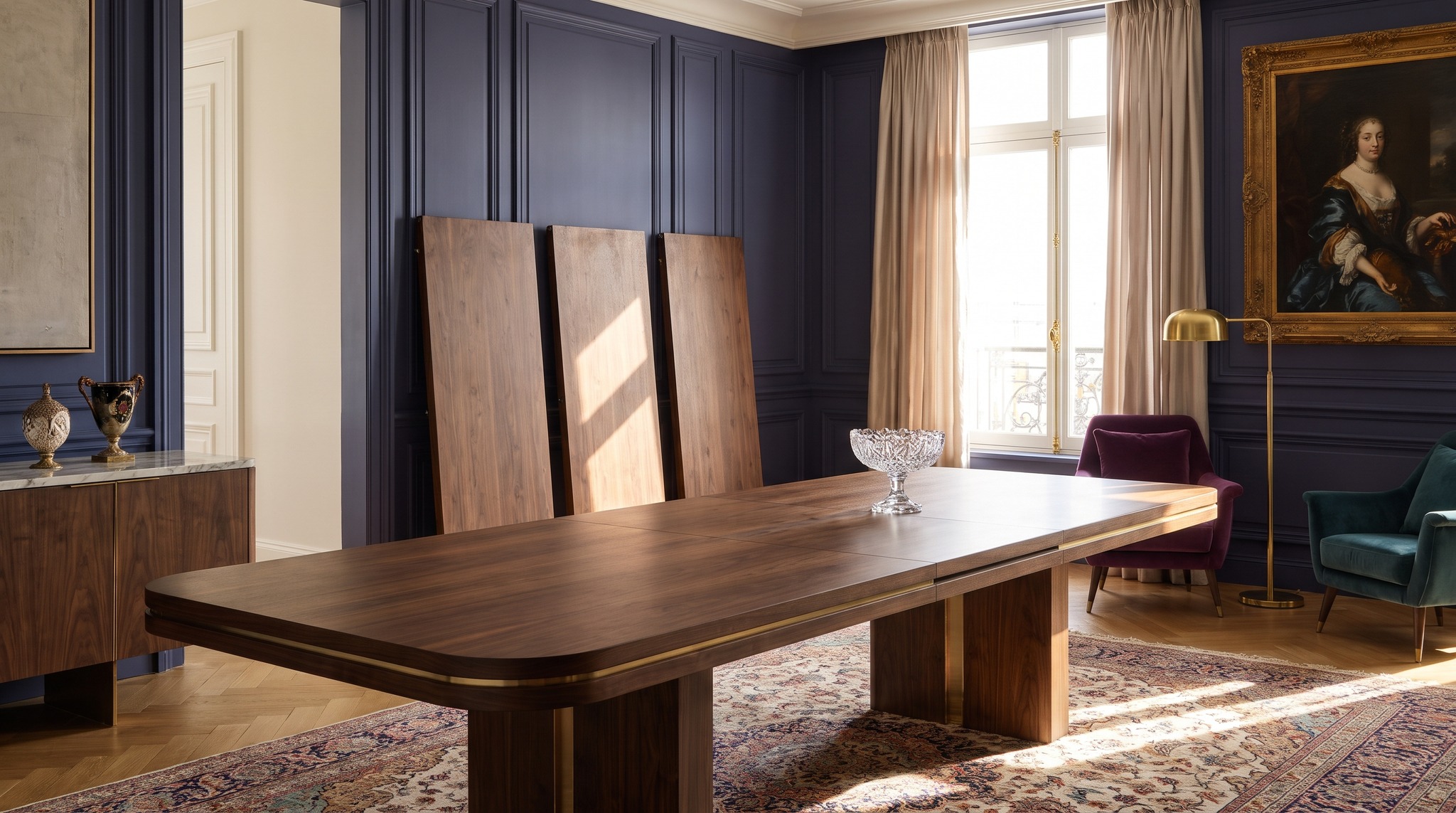
Dining Table with Extension Leaves: How Much Storage Space Is Required
You are planning to purchase an extendable dining table with separate extension leaves and wondering where to store the additional leaves when they are not in use? Unlike tables with integrated extensions, extension leaves must be stored separately. Here you will learn how much space you should plan for and which solutions have proven effective in practice.
Typical Dimensions of Extension Leaves
Extension leaves are usually 40 to 60 cm wide and have the same depth as the table top itself, often 90 to 110 cm. A single leaf weighs between 8 and 15 kg depending on the material. Solid wood is at the upper end, veneered chipboard is lighter. The thickness is typically 3 to 5 cm. If you own two extension leaves, you will need to plan for approximately 100 × 100 cm of space if you store both stacked on top of each other.
Storage Under the Bed or in a Wardrobe
Many households use the space under the bed, provided the height is at least 15 cm. The leaves can be slid in flat and are protected from dust if you wrap them in a thin blanket or duvet cover. Alternatively, a wardrobe is suitable: two leaves fit side by side on the wardrobe floor or on the top shelf, provided the wardrobe depth is at least 60 cm. Make sure that no heavy objects are placed on the leaves to avoid deformation.
Space Requirements in the Cellar or Storage Room
Those who use a cellar or storage room can lean the leaves vertically against the wall. This requires a wall area of approximately 110 cm width and 10 cm depth. It is important that the room remains dry: wood reacts to moisture with swelling or mould formation. A relative humidity of 40 to 60 per cent is ideal. Do not place the leaves directly on cold concrete, but on a polystyrene board or cardboard to prevent condensation.
Special Storage Solutions
Some manufacturers offer trolleys or hanging devices specifically designed for extension leaves. A trolley occupies approximately 50 × 110 cm of floor space and allows vertical storage of up to four leaves. Hanging systems on the garage wall or in the utility room save floor space but require stable wall mounting. Both solutions are suitable if you change the leaves frequently and want quick access.
Practical Tips for Care During Storage
Clean the leaves before storing with a slightly damp cloth and allow them to dry completely. Avoid direct sunlight at the storage location, as UV light causes wood to fade. For longer storage, a thin layer of furniture polish is recommended to seal the material. Check every three months whether the leaves have warped and turn them over if necessary. If you own high-quality Dining Tables, this care is worthwhile to maintain the precise fit of the extension leaves for years.
Space Requirements Compared to Pull-Out Tables
A table with an integrated extension does not require separate storage space, but is often more expensive to purchase and mechanically more susceptible to problems. Extension leaves offer more flexibility: you decide each time whether to use one or both leaves. The storage space requirement is approximately 1 square metre if you stack the leaves on top of each other, or 0.1 square metres if you stand them vertically. This space can be found in most households without requiring a dedicated storage room.
Related products: Coffee Tables, Decorations, Garden Furniture, Stoves and Decoration. baroque mirrors. The complete range: Baroque Furniture.
Related categories: Coffee Tables, Decorations, Garden Furniture, Stoves and Decoration. The full range: Baroque Furniture.
Read more: Wall Fountain: What Distance Keeps Moisture Away, Mirror Between Two Windows: The Right Width for a Narrow Wall, Bed without headboard: what wall design is needed, Side Table Next to the Bed: Which Height Suits the Mattress, Planters on the Patio: Material, Size and Winter Hardiness