


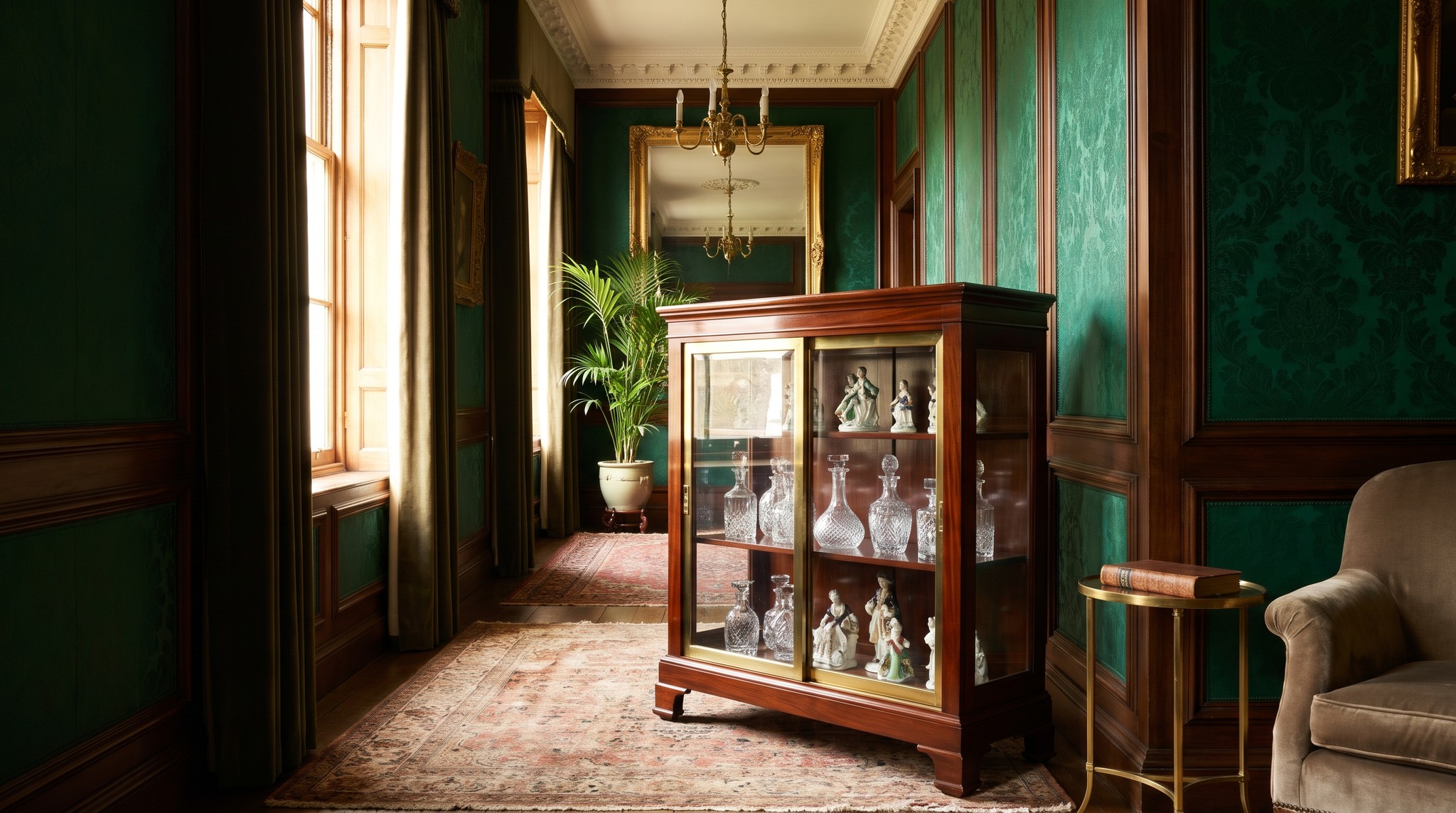
Display cabinet with sliding doors: when this saves space in front of the furniture
Anyone wishing to set up a display cabinet often faces the question of whether hinged doors or sliding doors are the better choice. Particularly in rooms with limited floor space, the design can determine comfort and usability. Sliding doors require no swing radius, but they also bring special characteristics. This article shows in which situations a display cabinet with sliding doors makes sense and what you should consider when planning.
The decisive advantage: no space needed for opening
A display cabinet with hinged doors requires approximately 60 to 80 cm of free space in front of the furniture so that the doors can open fully. Sliding doors eliminate this space requirement completely. They move sideways in a frame or behind a fixed pane and do not protrude into the room. This makes them ideal for narrow hallways, tight dining rooms or positions directly next to passageways. Even when an armchair or table stands close in front of the display cabinet, access to the interior remains possible at all times.
When sliding doors reach their limits
Sliding doors always expose only part of the display cabinet front. With two-door models, a maximum of half the width is accessible, with three-door models approximately two thirds. Anyone who frequently redecorates or moves large objects in and out often finds this restrictive. Furthermore, sliding doors require precise guidance: tracks or rollers must run smoothly, otherwise the mechanism jams. In very wide display cabinets from 180 cm width onwards, the weight of the glass doors can make sliding more difficult.
Typical dimensions and installation situations
Display cabinets with sliding doors are usually available in widths between 100 and 200 cm. The depth is typically 35 to 45 cm, the height between 180 and 210 cm. For a hallway with 120 cm width, a 100 cm wide display cabinet with sliding doors is sufficient, whereas a model with hinged doors would hardly be usable there. In living rooms with seating groups, a distance of at least 80 cm between the display cabinet and sofa edge is recommended so that you can walk past comfortably. With sliding doors, you can reduce this distance to 60 cm without blocking access to the display cabinet.
Material and maintenance of the running tracks
The guidance system for sliding doors usually consists of aluminium or stainless steel, less commonly of plastic. Stainless steel tracks are more durable and run smoothly even after years. Plastic rollers tend to wear out with heavy glass doors. Clean the tracks every few months with a dry cloth to remove dust. You should avoid moisture and cleaning agents, as they can damage the mechanism. High-quality Display Cabinets have adjustable rollers with which you can realign the doors afterwards if the furniture does not stand absolutely level.
Alternatives and combinations
Some display cabinets combine sliding doors in the upper section with hinged doors or drawers in the base. This unites the space saving above with easy access below. For very small rooms, a display cabinet with a flap door that opens upwards may also be an option. In rooms with sufficient space, however, the classic hinged door remains the most flexible solution, as it exposes the entire interior at once.
Conclusion: sliding doors for confined positions
A display cabinet with sliding doors is worthwhile wherever the space in front of the furniture is limited or used for other purposes. It saves 60 to 80 cm of swing radius and enables positions that would not work with hinged doors. The price for this is restricted access to the interior and higher maintenance effort for the mechanism. Measure your available space precisely and check how often you open and rearrange the display cabinet. This way you will find out whether sliding doors are the right choice for your situation.
Related items: Coffee Tables, Decorations, Dining Tables. baroque mirrors. The complete range: Baroque furniture.
Related categories: Coffee Tables, Decorations, Dining Tables. The full range: Baroque Furniture.
Read more: Dining table for six people: what minimum size is required, Coffee Table with L-Shaped Seating: Finding the Right Position, Mirrors in the Dressing Room: Which Size Shows the Entire Body, Water Column on the Terrace: Distance to Seating Area and House Wall, Display Cabinet Without Back Panel: When Transparency Makes Sense