

Mirrors in the Hallway: Height, Size and Where to Place the Light
The hallway is often the first room you and your guests enter. A mirror is part of the basic equipment here: for that final glance before leaving the house, to visually enlarge narrow spaces and as a decorative element. But how high should you hang it, what size is suitable and where do you position the lighting? These questions determine whether the mirror fulfils its purpose or simply hangs on the wall.
The Right Height for the Hallway Mirror
The lower edge of the mirror should be approximately 120 to 140 cm above the floor. This allows shorter people to see their face and upper body without stretching. The centre of the mirror should ideally be at eye level, at approximately 160 to 170 cm. With a large standing mirror that reaches to the floor, this consideration is unnecessary: it shows the entire figure and can be leaned directly against the wall or positioned a few centimetres away.
Which Size Suits the Hallway
The mirror size depends on the width and length of the hallway. In a narrow corridor with 100 to 120 cm width, a mirror of 50 to 70 cm width is sufficient. Wider hallways from 150 cm can accommodate 80 to 100 cm as well. The height should be at least 80 cm, preferably 100 to 120 cm, so you can see yourself from head to hip. Full-length mirrors with 160 to 180 cm height are suitable for hallways from 3 metres length; in shorter spaces they often appear too dominant.
Lighting from the Side or from Above
Light directly above the mirror casts shadows under the eyes and chin. Two wall lights to the left and right of the mirror are better, mounted at the height of the upper third, approximately 170 to 180 cm above the floor. The distance to the mirror edge should be 30 to 40 cm. Alternatively, a light above the mirror works if it has at least 20 cm distance to the upper edge and the light shines diffusely downwards. Warm white light with 2700 to 3000 Kelvin ensures natural colour rendering.
Combining Mirror Above the Console
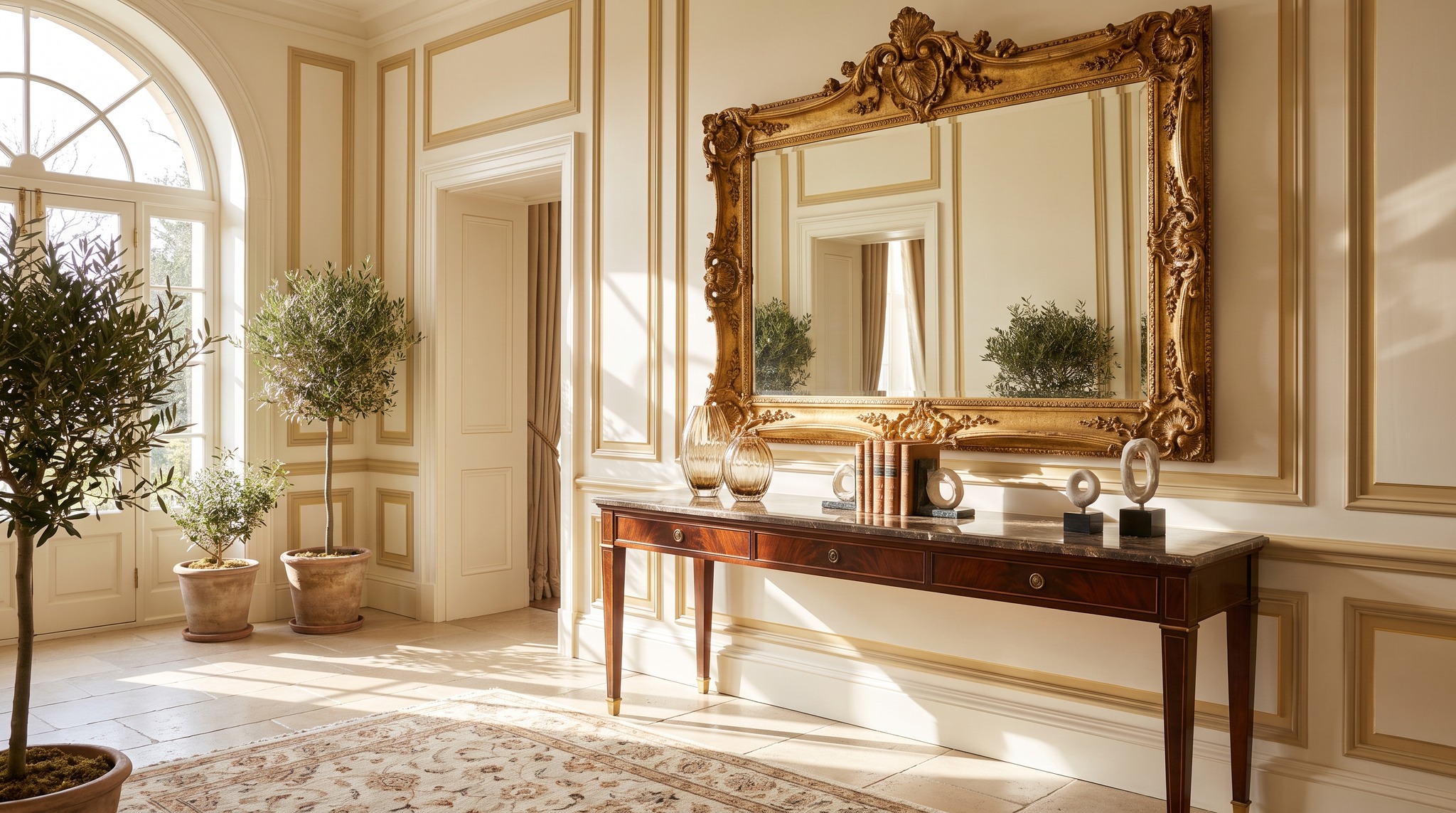
Many hallways use a console as a surface for keys, post and decoration. The mirror then hangs directly above it, the lower edge approximately 10 to 15 cm above the console top. The mirror width should not be wider than the console, ideally 10 to 20 cm less. This creates a clear vertical line. High-quality Consoles made of solid wood or with metal frames not only provide storage space, but also create a design accent in the entrance area together with the mirror.
Coordinating Frame and Style
The frame shapes the effect of the mirror. Baroque frames with ornaments and gold leaf suit classical interiors and high ceilings from 2.70 metres. Simple wooden frames in natural or black fit into modern and country house styles. Frameless Mirrors with bevelled edges appear timeless and make the room seem calmer. Ensure that frame width and ornamentation match the room size: in narrow hallways under 120 cm width, frames should not be wider than 8 to 10 cm.
Practical Notes on Installation
Heavy mirrors from 5 kg require plugs and screws suitable for your wall type. For plasterboard walls, use cavity plugs or locate the stud. Hang the mirror so that it is not in the direct passage area, but offset to the side: this prevents collisions and gives you more distance when viewing. A minimum distance of 80 cm to the opposite wall ensures that you can see yourself comfortably in the mirror without having to stand directly in front of it.
Related categories: Commodes, Columns and Pedestals, Armchairs. The full range: Baroque Furniture.
Read more: Wall Colours for Dark Furniture: Which Colours Harmonise Best, The Right Rug Under Dining Table and Sofa: Size and Placement, Luxury Bronze Sculptures by Casa Padrino, Exclusive Art Pieces for Sophisticated Interiors, Baroque and antique style flower pot collection by Casa Padrino, Ceiling Height and Furniture Height: When a Room Tips Over