

Plant Containers with Saucers: When the Gap Is Necessary
Many plant enthusiasts place their containers directly on patios, balconies or parquet flooring without considering a saucer. But when is the gap between floor and vessel truly necessary, and when can it be dispensed with? The answer depends on the material of the surface, the drainage of the container and the care intensity of the plant. Those who wish to avoid waterlogging, discolouration or frost damage should be familiar with the following points.
Why Saucers Prevent Damage to Floor Coverings
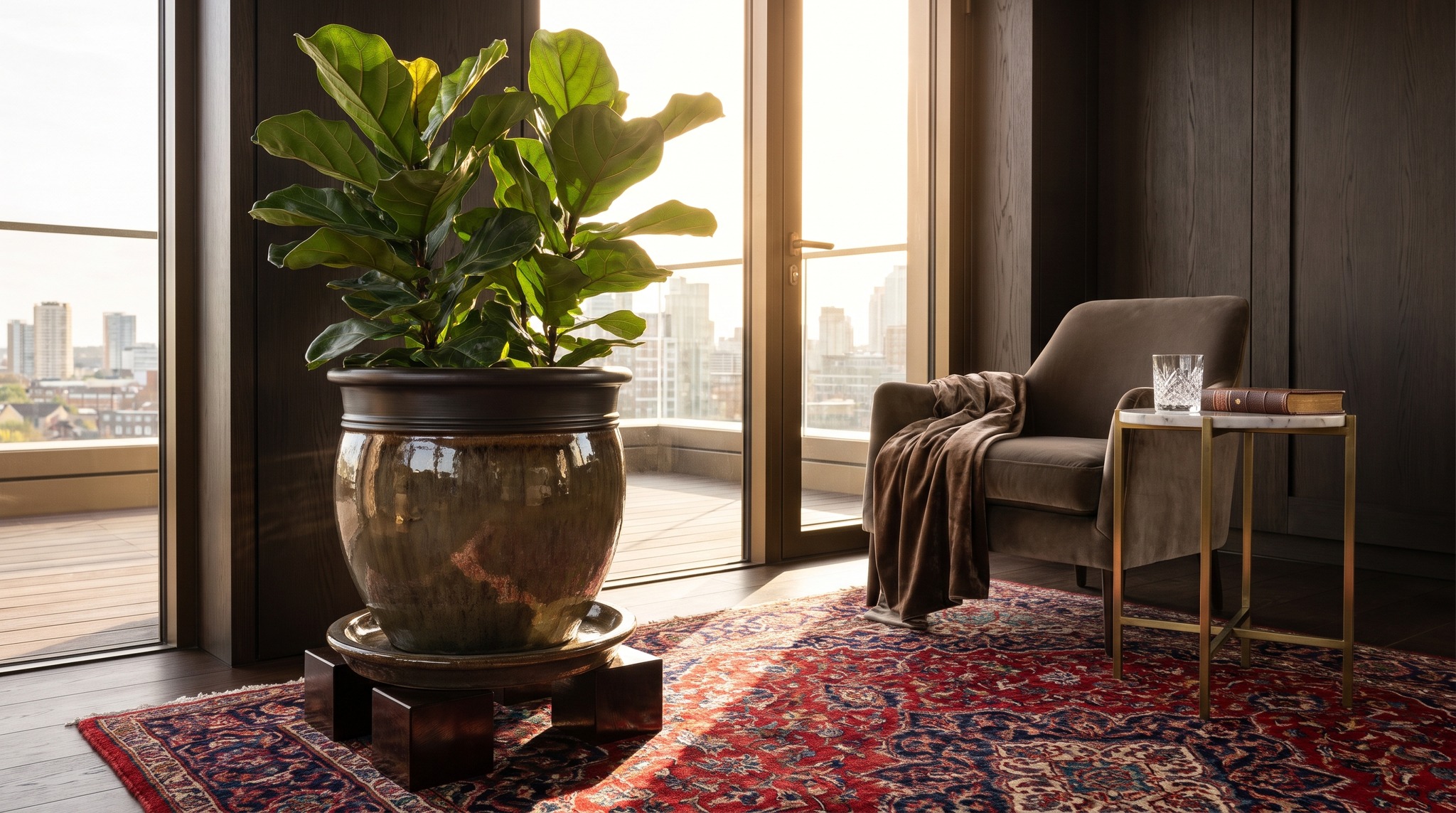
Plant containers with drainage holes release excess watering downwards. Without a saucer, the moisture collects directly on wooden boards, tiles or natural stone and leaves lime rings, discolouration or even mould formation there. Terracotta and unglazed ceramic in particular release water slowly and keep the contact area permanently moist. A saucer catches the draining water and thus protects the floor covering. For sensitive surfaces such as oiled parquet or polished marble, a gap of at least 5 mm between container and floor is advisable to enable air circulation.
When the Saucer Is Mandatory Outdoors
On balconies and patios, a saucer prevents watering from draining uncontrolled and disturbing neighbours or passers-by. It also protects against frost damage: if a container stands directly on cold stone or concrete in winter, the water in the soil freezes more quickly and the roots suffer damage. A saucer made of plastic or wood insulates and raises the container slightly, so that cold penetrates less from below. The selection of Flower Pots includes models with and without integrated drip trays, so that the appropriate solution can be found for every situation.
Materials and Their Requirements for Saucers
Not every container material requires the same protection. Plastic and fibreglass are waterproof and do not release moisture outwards; a saucer here serves primarily to catch watering. Terracotta, concrete and unglazed ceramic, however, are porous and absorb water that evaporates on the outside or transfers to the surface. For these materials, a saucer with a raised rim that is at least 2 cm high is recommended. Metal containers conduct cold particularly well; here the saucer should additionally have an insulating effect, for example through a cork pad or a wooden board.
Coordinating Drainage and Watering Behaviour Correctly
A plant container without a drainage hole does not need a saucer, but carries the risk of waterlogging inside. Those who nevertheless opt for a closed vessel must dose the watering quantity precisely and plan for a drainage layer of expanded clay or gravel. For containers with drainage, the saucer should be emptied regularly, at the latest 30 minutes after watering. If the water stands longer, the roots absorb it again and a moist microclimate develops that encourages fungi and rot. For heavy-feeding plants such as tomatoes or oleander, which are watered daily in summer, a large saucer with a capacity of at least 2 litres is advisable.
Decorative Solutions for Indoor and Outdoor Areas
Saucers need not be purely functional. Models made of zinc, copper or glazed ceramic blend harmoniously into the Garden Decoration and set their own design accents. Indoors, flat bowls made of porcelain or natural stone are suitable, which can be colour-coordinated with furniture and textiles. For large containers from 40 cm diameter onwards, there are mobile saucers with castors that facilitate moving and simultaneously provide ventilation. Those who wish to dispense with visible saucers can place the container on small feet or spacers made of rubber, which are only a few millimetres high and yet allow sufficient air underneath.
Rule of Thumb for Practice
Basically, the following applies: wherever water can escape or moisture condenses, a saucer belongs under the plant container. This concerns all containers with drainage holes, porous materials and locations on sensitive floors. Outdoors, the saucer additionally protects against frost and prevents watering from draining uncontrolled. Only with closed vessels on insensitive surfaces such as concrete or tiles can the gap be dispensed with, provided the watering quantity is strictly controlled.
Related items: Sideboards, Sculptures, Sofas. baroque mirrors. The complete range: Baroque furniture.
Related categories: Sideboards, Sculptures, Sofas. The full range: Baroque Furniture.
Read more: Coffee Table with Shelf: What Height Between the Levels, Cast Iron Garden Table: Which Weight Withstands Storms, Metal Garden Table: Care for Rain and Sun, Bed Without a Nightstand: Which Alternatives Work, Water Column in the Courtyard: Size and Wall Distance for Acoustics