

Art Deco Furniture: Geometry, Brass and Glass for the Modern Interior
Art Deco is the last style that told a whole room what to do. It arrived with straight lines and stepped outlines when Europe had had enough of curling foliage, it dressed the ocean liners, cinemas and hotel halls of the nineteen twenties and thirties, and it still reads as modern, because its shapes were drawn with ruler and compass rather than grown like a plant. Casa Padrino, one of the leading international specialists for luxury furniture, supplies pieces in that vocabulary right across the catalogue, with lighting as the deepest part of the range, delivered worldwide.
One thing is worth saying plainly at the start. There is no Art Deco department in this shop, and this page does not pretend that there is. The style runs through lamps, seating, cabinets and mirrors as a set of features, geometry, brass, lacquer and coloured glass, and the lamps carry it furthest.
Where Art Deco came from: Paris 1925 and after
The style has an address and a date. In 1925 Paris staged the Exposition Internationale des Arts Decoratifs et Industriels Modernes, a vast show of decorative art and industry along both banks of the Seine. The name Art Deco is a later contraction of that title, and it only became the common term in the nineteen sixties, when collectors and writers rediscovered the period. Everything built in the style before then simply called itself modern.
What the exhibition gathered had been forming since the First World War. Paris cabinetmakers were working rare veneers at a level of finish not seen since the eighteenth century, while architects borrowed from Cubism, from Egyptian and Aztec ornament and from the machine. It was a luxury style that admired industry instead of hiding from it.
Then it travelled fast, because it suited the new buildings and the new ships. The Chrysler Building was completed in New York in 1930 with its stepped steel crown, Radio City Music Hall opened in 1932, and the French liner Normandie entered service in 1935. Cinemas across Europe and America adopted the same sunbursts, chevrons and stepped ceilings, which is why the style still feels theatrical.
The Second World War ended it as a living fashion, and it keeps coming back for a practical reason: Art Deco is the one historic style whose proportions already suit modern rooms, with level ceilings, plain walls and large windows. A carved Baroque interior needs an architecture to argue with, an Art Deco one simply needs a rectangle.
How to recognise Art Deco: the design vocabulary
The style is easier to identify by its grammar than by a list of objects. Six features do most of the work, and a genuine piece shows several at once.
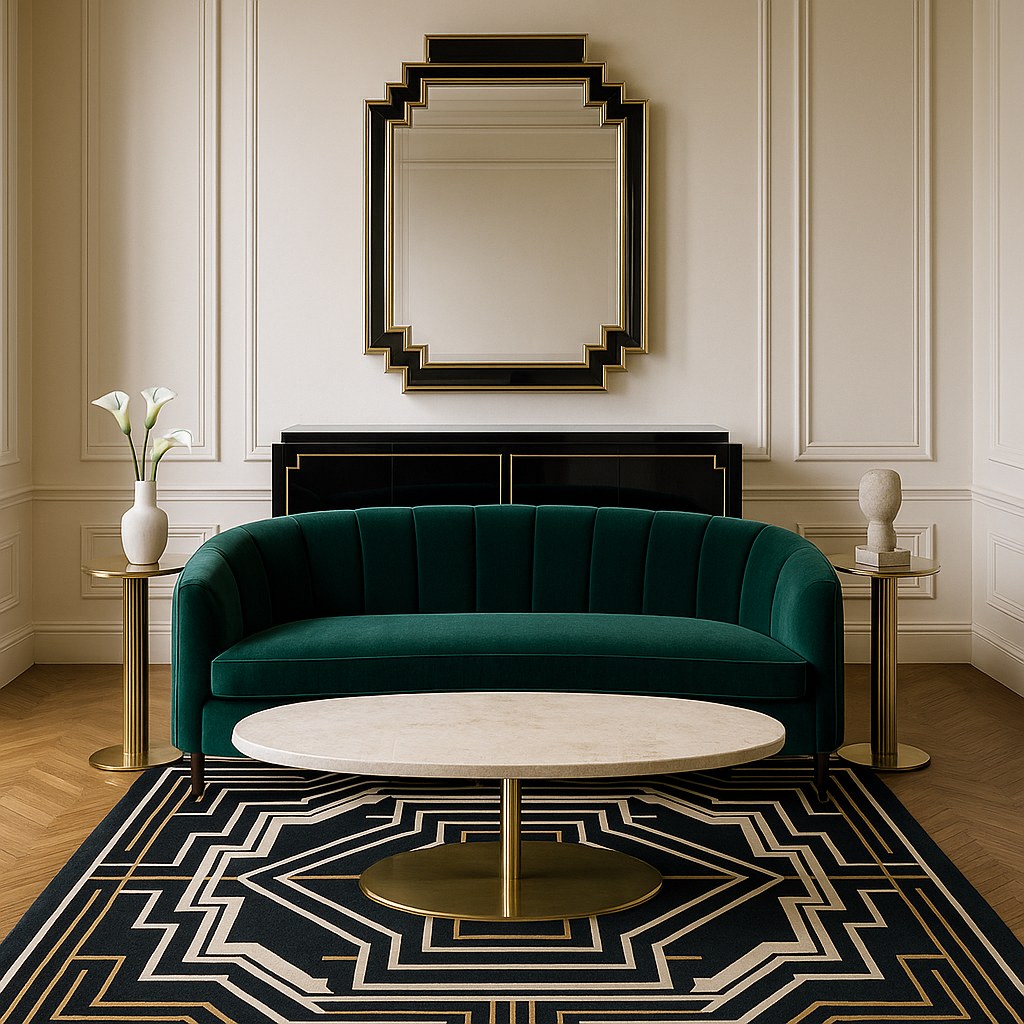
- Geometric form. Circles, semicircles, octagons, chevrons and zigzags, set out symmetrically. Curves appear constantly, but they are drawn curves, arcs and half rounds rather than growing lines.
- Stepped outlines. The ziggurat profile, borrowed from ancient Mesopotamian and Central American building, on cabinet tops, mirror crests, table bases and above all on lampshades built in tiers.
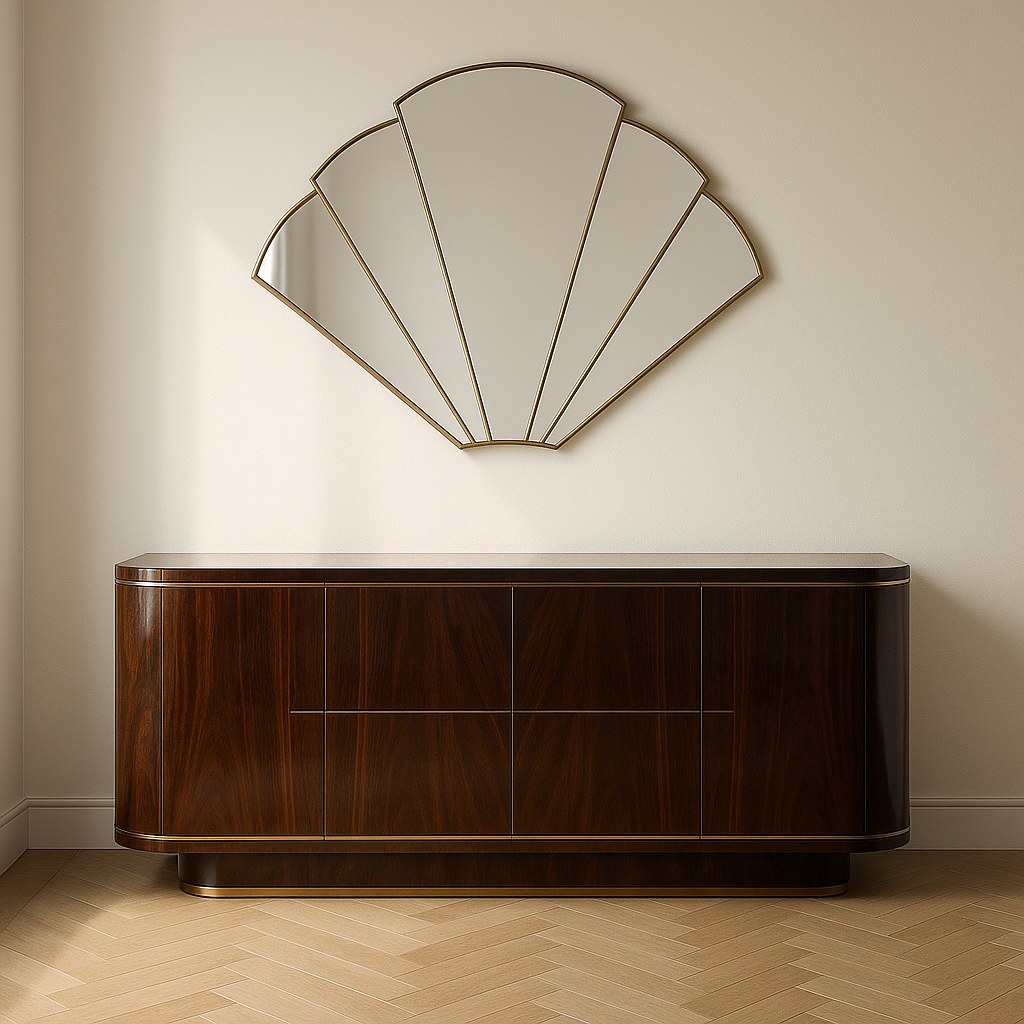
- Sunburst and sunray patterns. Rays spreading from a centre, cut into glass, laid in veneer or worked in metal. The most recognisable signature of the period.
- Metal inlay and trim. Brass, bronze and chrome used as line rather than mass: a thin band along an edge, a fluted collar on a leg, an inlaid strip dividing a cabinet front.
- High gloss lacquer. Deep black, oxblood, ivory and dark green surfaces polished until they behave like mirrors, set against a matt or metallic detail.
- Rich woods and dramatic figure. Dark, strongly grained timbers, veneers laid in mirrored or radiating patterns so that the grain becomes the ornament, paired with glass, marble or leather.
Two habits separate the real thing from a merely gold and black room. Art Deco repeats a motif at several scales, so the fan on a chair back reappears in the mirror above it, and it keeps its surfaces flat, because ornament belongs in the outline rather than in applied carving.
Art Deco or Art Nouveau: where the line runs
The two names are constantly swapped, and the difference fits into one sentence. Art Nouveau came first, roughly from 1890 to the First World War, and its line is organic: stems, tendrils, poppy heads, the long whiplash curve that never repeats itself. Art Deco came after the war and answered with geometry, the same wish to decorate but ordered, symmetrical and machine minded.
The quickest test is to ask how a curve was made. If it looks grown, uneven and asymmetric, it belongs to the earlier style. If it could be set out with a compass and mirrored on the other side of the piece, it is Art Deco. Materials follow the same split: the earlier period loved leaded glass, wrought iron and pale carved wood, the later one lacquer, chrome, mirrored glass and dark veneer.
If the flowing, floral line is what you actually want, our companion page on art nouveau furniture covers that side in the same detail. It is worth knowing that the leaded glass lamp associated with Tiffany belongs by origin to the earlier period, even though such lamps sit happily in Deco rooms.
Lighting is the strongest part of our Art Deco collection
Honesty first. A complete Art Deco furniture programme, a suite where every piece was designed together, is not what this catalogue holds. What it holds in real depth is lighting, which is where the style shows itself most clearly anyway, because a lamp is mostly outline and material.
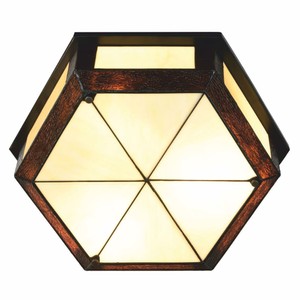
- Tiered and stepped pendant lights in frosted, satin or opal glass, the shade repeating the ziggurat profile in two or three levels.
- Brass and chrome fittings with fluted stems, ribbed collars and geometric ceiling roses, the metal treated as drawn line.
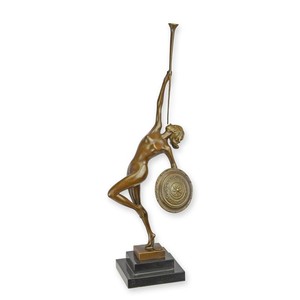
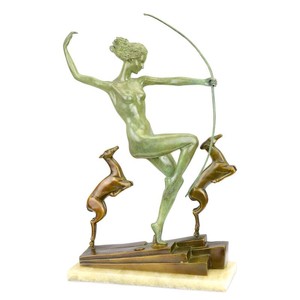
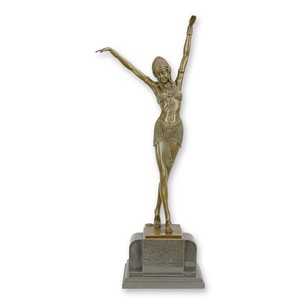
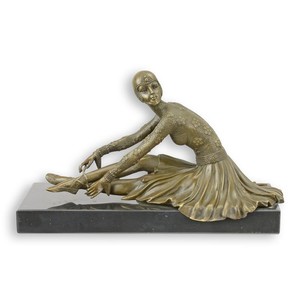
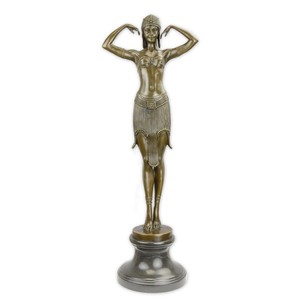
- Table lamps with figures and columns, descendants of the bronze and glass lamps of the twenties.
- Tiffany style lamps with leaded glass shades in strong colours, assembled by hand from individually cut pieces, the largest single group in this part of the range.
- Wall lights and uplighters throwing light at the ceiling, which is how Deco interiors were lit in the first place.
The whole range sits under lamps and chandeliers, with the larger hanging pieces in chandeliers. Two points decide how good they look once fitted. Use warm light, around 2700 kelvin, because coloured and satin glass turns grey under cold white light. And put the circuit on a dimmer, since glare from a bare bright bulb ruins the effect.
Seating and case furniture in the Art Deco manner
The furniture itself is spread across the ordinary categories, so it is found by looking for the features rather than by opening one department.
- Low, deep seating. The Deco sofa sits lower than a classical one, with a generous seat depth, rolled or squared arms and velvet or leather upholstery. The range is in sofas.
- Club and tub chairs. Rounded backs, short legs, arms as thick as the body. Deep buttoned leather was the period standard, which is why chesterfield furniture works so well here, alongside the models in armchairs.
- Sideboards and chests. Long, low bodies with plain fronts, brass banding and strongly figured veneer, listed under commodes and chests of drawers.
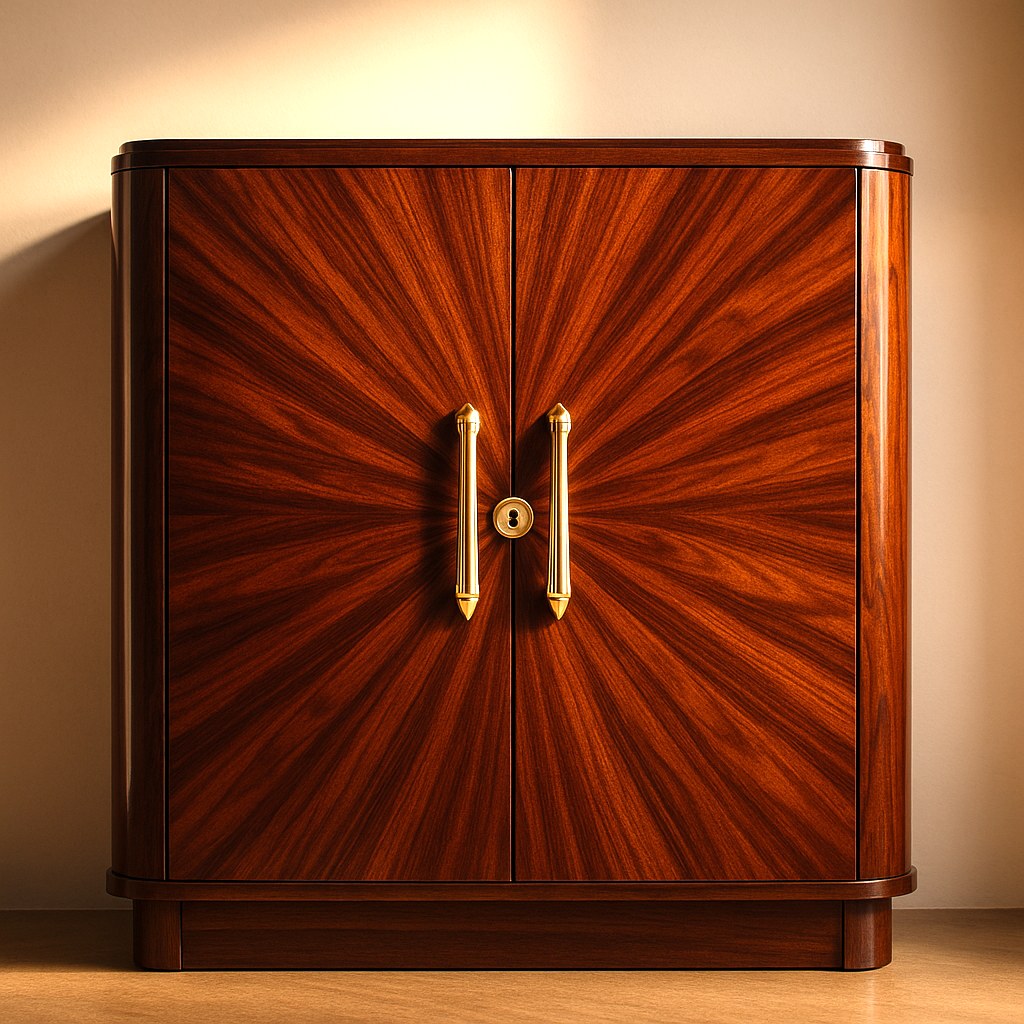
- Bar and display cabinets. The bar cabinet is the most Deco object of them all, since the period made the cocktail hour a domestic ritual. Look in cabinets.
- Pedestal and column tables. Round or oval tops on a single sculpted base rather than four legs, which seats an extra guest and clears the floor visually. See dining tables.
- Round and sunburst mirrors. The circle answers the rectangles of the room, and the rayed frame is pure period. The choice runs from mirrors to the more elaborate pieces in luxury mirrors.
Art Deco room by room
The living room takes the style best when the seating stays low and the height comes from lamps and mirrors instead. A pair of matching table lamps on a long sideboard, a round mirror centred above it, and one strongly figured surface will do more than six patterned pieces.
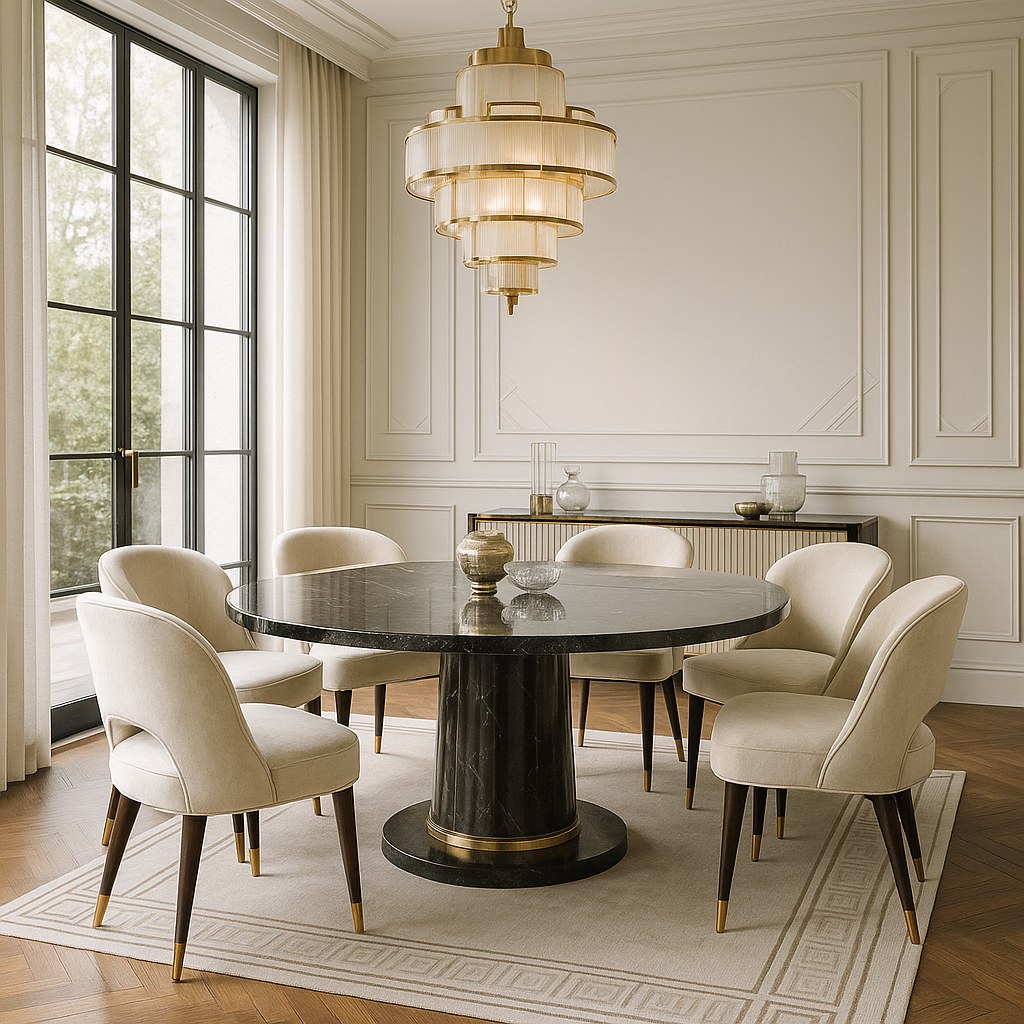
The dining room is the easiest of all, because a round table under a tiered pendant light is already the whole composition. Keep the chairs quiet, in leather or plain velvet, and let the light fitting be the ornament.
The bar is where the period is most at home. A cabinet with a mirrored interior, glass shelves, a stool and one wall light will carry a corner of an ordinary living room.
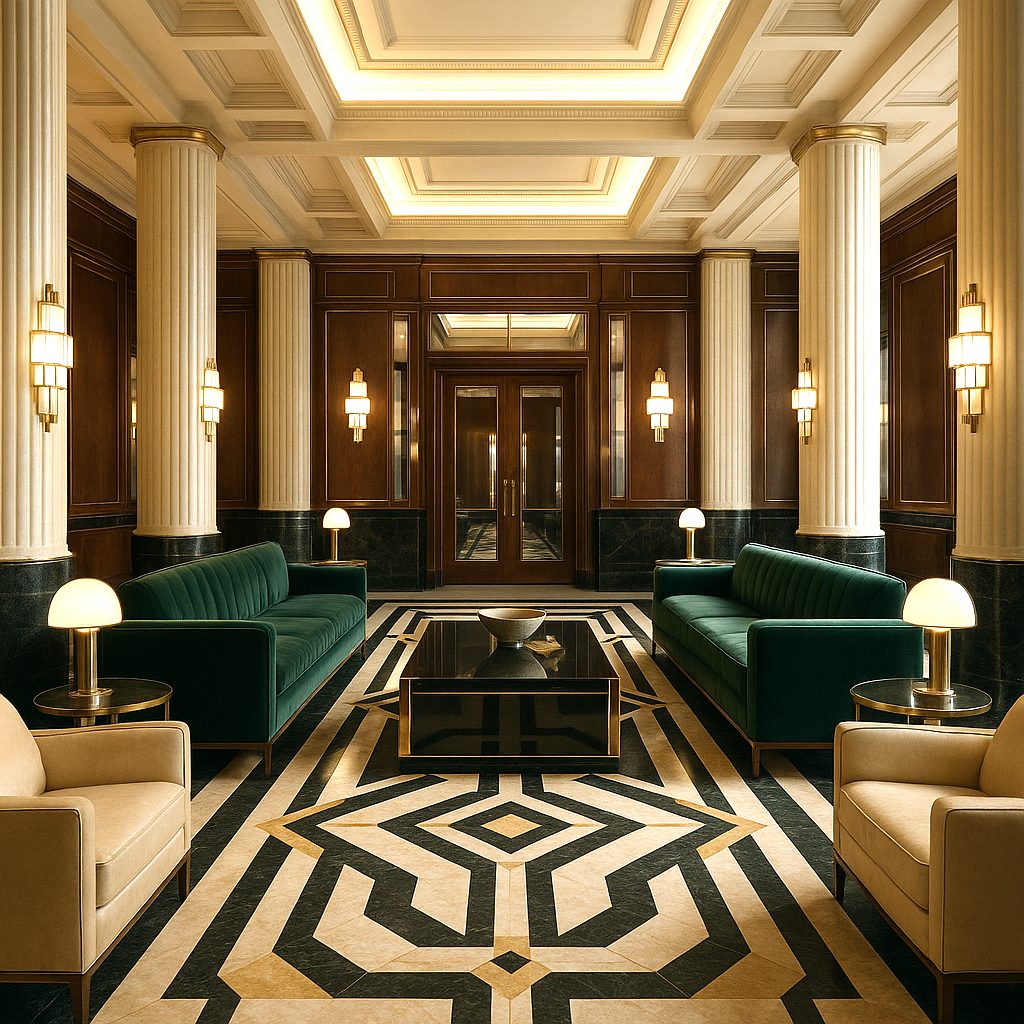
The hotel hall and the restaurant use the style for the same reason the liners did: it photographs well, it survives crowds, and its symmetry gives a large space a centre. Pieces suited to contract projects are collected in hotel furniture and decoration.
Symmetry, ceiling height and how much pattern a room takes
Art Deco fails in practice for reasons that have nothing to do with taste. It is a formal style, and formality is a matter of measurement.
Work in pairs and along an axis. Where a classical interior can be arranged loosely, Deco wants a centre line: two identical table lamps rather than one, two wall lights flanking the mirror, chairs facing each other. Order the second lamp at the same time, because the model may not be available later and half a symmetry looks like an accident.
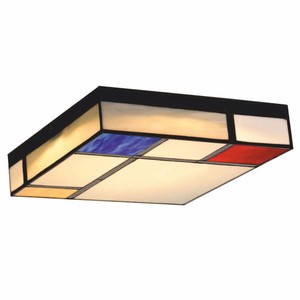
Ceiling height decides the light fitting. A tiered pendant needs air above and below it. In a walkway keep at least 210 cm clear under the lowest point, and above a dining table hang the lower edge roughly 75 to 85 cm above the tabletop, so that faces across the table stay visible. With a ceiling under about 240 cm, choose a flush or semi flush fitting and put the drama into wall lights instead.
One patterned surface leads. The rule that keeps these rooms from becoming exhausting is simple: one strong geometry per room, everything else plain. If the rug is a chevron, the upholstery is a solid colour. If the cabinet front is a starburst veneer, the wall behind it stays quiet.
Give the long pieces the right wall. A Deco sideboard is meant to read as a horizontal band, so it wants roughly two thirds of its wall and clear space at both ends. Cramped into an alcove it looks like storage.
Check the seat height. Period seating sits low, often around 40 cm, with a deep seat that invites you to lean back. Glorious in a lounge, awkward for anyone who finds it hard to stand up again, so compare the dimensions with a chair you already own.
Measure the route, not just the room. Lacquered and veneered case pieces arrive assembled and cannot be taken apart, so the limiting dimension is the diagonal of the crate through the tightest turn: front door, stairs, lift car and room door.
Delivery and care
Casa Padrino ships worldwide. Large and heavy pieces travel by freight forwarder with a delivery appointment, smaller items and most lamps go by parcel service. Delivery is made kerbside to the address given. Carrying the piece into the building, up the stairs, into a lift or into the room where it will stand is not part of the standard service, so please arrange help on site beforehand. We do not operate a showroom, so advice is given by telephone and email.
Care is straightforward once the surfaces are understood. High gloss lacquer shows fingerprints and fine scratches more than any other finish: dust it with a dry microfibre cloth, wipe with a barely damp one, never with an abrasive cream. Brass is either lacquered, and then needs dusting and never metal polish, or untreated, and then darkens over time. Veneer dislikes direct sunlight and dry heat, so keep it away from radiators and south facing windows.
Why Casa Padrino
Casa Padrino has grown into one of the internationally known names for baroque, Art Nouveau, Art Deco and contemporary luxury furniture, with customers in more than fifty countries and a catalogue running into thousands of pieces. In May 2025 our designer Marvin Schertl received the International Design Award for Excellence in Luxury Furniture, presented at a gala dinner in Cannes.
For Art Deco, three things follow. A genuinely deep lighting range, which is where the style lives and where most projects begin. Furniture across the categories that shares the vocabulary, so a room can be built up rather than bought as a set. And one supplier for the whole setting, which matters in a style built on repetition. The complete collection is at casa-padrino.de.
Frequently asked questions about Art Deco furniture
What defines Art Deco furniture?
Geometric, symmetrical forms, stepped outlines, sunburst motifs, brass or chrome used as a fine line, high gloss lacquer and strongly figured veneers. Ornament sits in the outline rather than in carving.
When was the Art Deco period?
Roughly from the end of the First World War to the Second, with the Paris exhibition of 1925 as its landmark. The name itself came into general use only in the nineteen sixties.
What is the difference between Art Deco and Art Nouveau?
Art Nouveau, before 1910, is organic and floral, with a long asymmetric whiplash line. Art Deco, after the war, is geometric, symmetrical and drawn with compass and ruler.
Do you have a separate Art Deco category?
No. The pieces sit in the normal groups, lamps, sofas, armchairs, mirrors, chests and cabinets, and are found by their features. Lighting is by far the deepest part of the range.
Which woods and finishes are typical?
Dark, strongly grained timbers with veneers laid in mirrored or radiating patterns, combined with high gloss lacquer, brass, chrome, mirrored glass and leather.
How high should a pendant light hang above a dining table?
Set the lower edge roughly 75 to 85 cm above the tabletop, so that people can see each other across it. In walkways keep at least 210 cm of clear height under the fitting.
Can Art Deco pieces be combined with modern furniture?
Yes, and it is the easiest historic style to combine, because its proportions already suit plain walls and level ceilings. Let one Deco piece lead.
How much pattern does a room take?
One strong geometry per room. If the rug is patterned, the upholstery stays plain; if a cabinet front carries a starburst veneer, the wall behind stays quiet. Metallic finishes count too.
How do I clean high gloss lacquer and brass?
Use a dry microfibre cloth, then a barely damp one, and no abrasives. Lacquered brass needs only dusting and never metal polish. Untreated brass darkens over time.
Do you deliver worldwide, and how?
Yes. Large pieces travel crated by freight forwarder with a delivery appointment, smaller items by parcel service. Delivery is kerbside to the address given, so please arrange help for carrying the piece into the building.
Selected pieces from our collection




You may also be interested in
Back to the overview: Luxury Furniture for Hotels, Villas & Projects Worldwide