

Art Nouveau Furniture: Curved Lines, Leaded Glass and Period Bathrooms
Art Nouveau furniture is the only historic style that refuses to draw a straight line. Where the nineteenth century copied columns and pediments, the workshops of around 1900 took their shapes from stems, tendrils and wings, and carried it through the whole house, from the banister to the bath tap. Casa Padrino, one of the international specialists for luxury furniture, carries the style where it has always been strongest: light and water. Leaded glass lamps in the Tiffany manner, nostalgic outdoor lanterns, freestanding bath tubs and ceramic wall fittings made in Italy, alongside carved cabinets, mirrors and seating with the same flowing outline.
This page begins with the style rather than the catalogue: where it came from, how to recognise it, and what it asks of a room before anything is ordered.
Where Art Nouveau came from
The style was a deliberate break. Through most of the nineteenth century, European furniture was made in revivals, one historical costume after another and increasingly turned out by machine. A generation of architects decided that a new century needed an ornament of its own, and went looking for it in nature rather than in the archive.
The first building usually named as the result is the Hotel Tassel in Brussels, finished by Victor Horta in 1893, where iron stems grow out of the staircase. The name came from a shop: in 1895 the dealer Siegfried Bing opened his Paris gallery Maison de l Art Nouveau, and the label stuck. The world exhibition of 1900 made it an international fashion, and Hector Guimard gave Paris the cast iron metro entrances that still stand as its signature.
Every country renamed it: Jugendstil in Germany after the Munich magazine Jugend, Stile Liberty in Italy after the London department store, Modernismo in Catalonia, and a squarer Viennese version out of the Secession of 1897. It ended quickly, because the style depended on skilled handwork just as handwork was becoming expensive, and the First World War closed the workshops. Barely twenty years of production, which is why original pieces are rare and the shapes are made new today.
The whiplash line: how Art Nouveau furniture is recognised
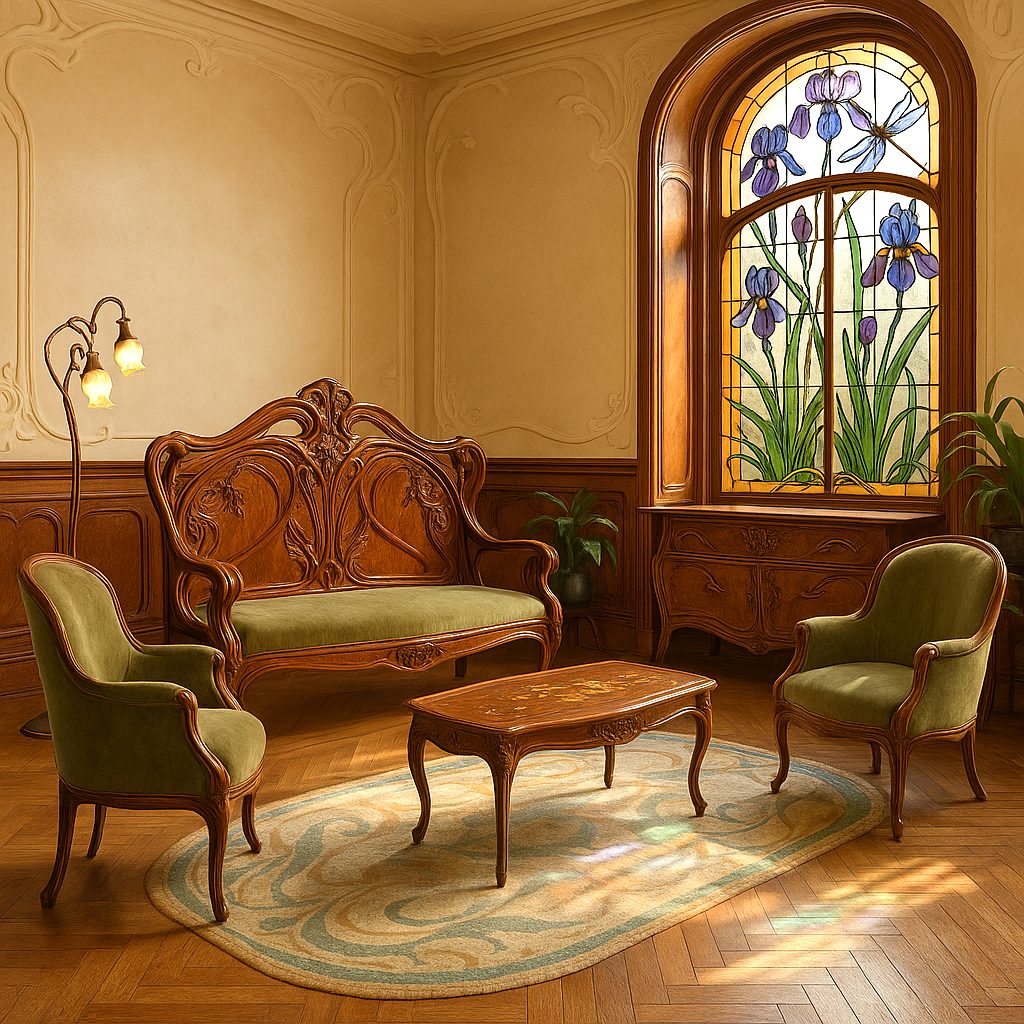
One motif holds the style together: the whiplash line, named after an 1895 embroidery by Hermann Obrist that a critic compared to the crack of a whip, is a long asymmetric curve that gathers energy at one end and releases it in a sudden turn. These are the practical marks of a genuine piece.
- Structure that curves. The line is not applied to a rectangular carcass, it is the carcass. Legs sweep outwards and rise into the frame, and the top of a cabinet is rarely a straight horizontal.
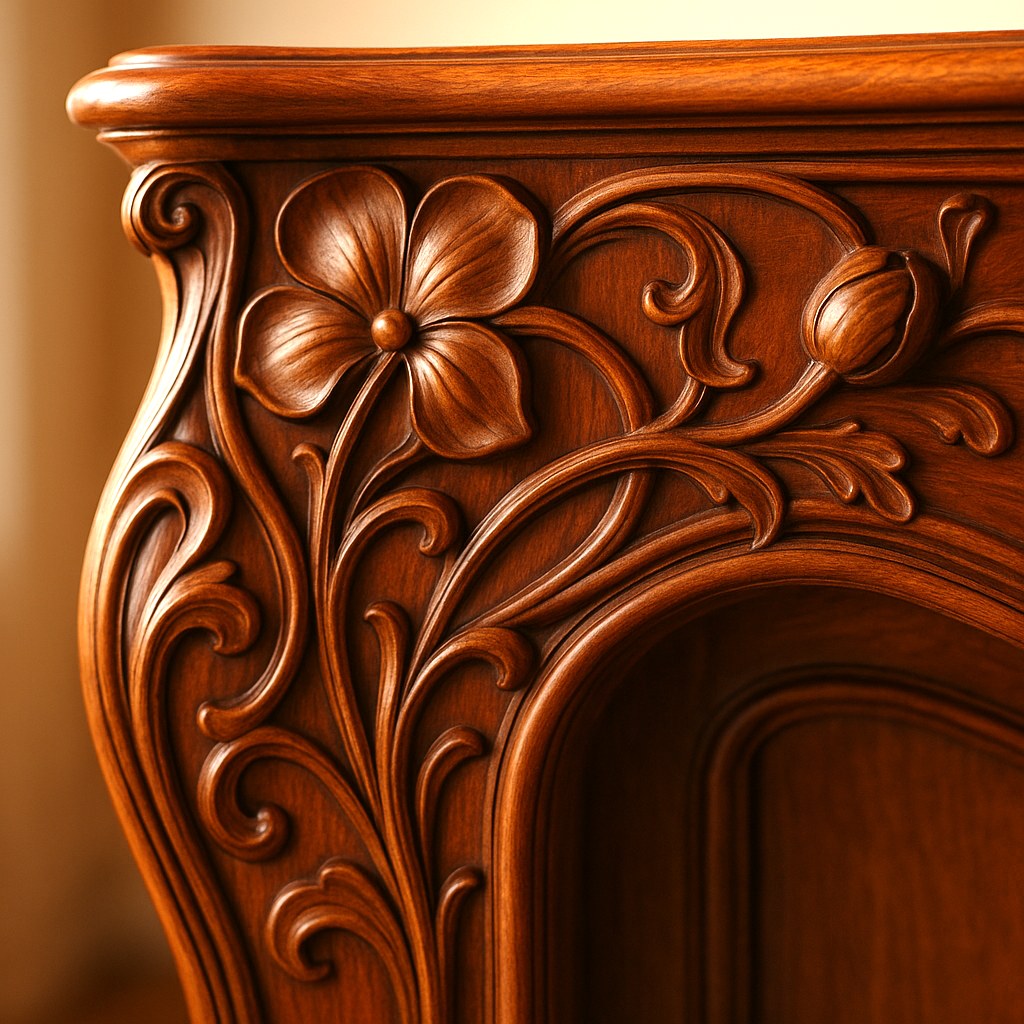
- Ornament taken from plants. Water lily, iris, poppy and ivy, carved in low relief rather than pinned on as separate rosettes.
- Asymmetry with balance. The two sides of a crest answer each other without matching, the clearest difference from Baroque work.
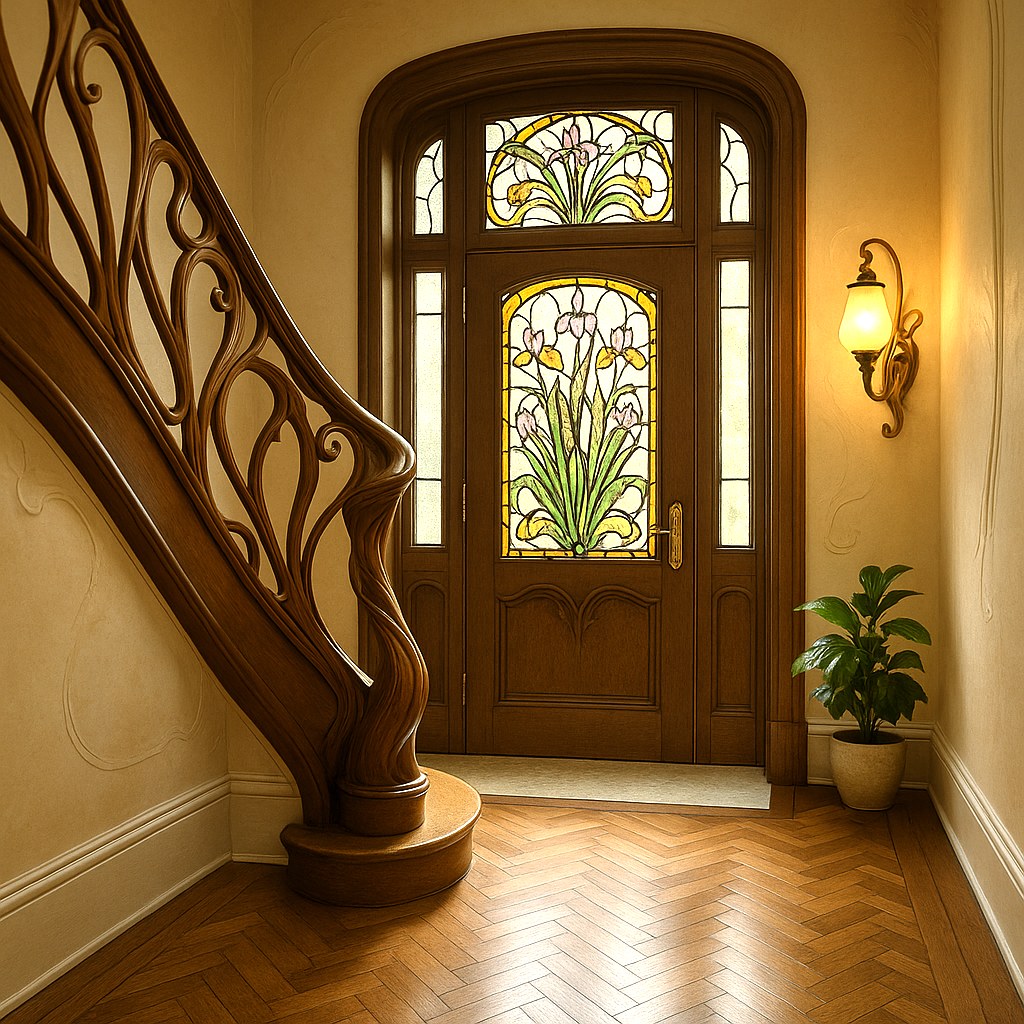
- Coloured glass. Leaded panels in cabinet doors, screens and lampshades, with the lead line drawn as part of the design instead of hidden.
- Metal treated as a plant. Wrought iron and bronze in stems and buds, used for lamp bases, brackets, handles and outdoor lanterns.
Art Nouveau and Art Deco: where one ends and the other begins
The difference fits in one sentence: Art Nouveau is organic and grows, Art Deco is geometric and is drawn with a set square. Art Nouveau is the earlier of the two, roughly 1890 to 1910, its ornament taken from living things and its glass coloured. Art Deco belongs to the years after the First World War and reached its public form at the Paris exhibition of decorative arts in 1925. Its ornament comes from geometry: stepped outlines, chevrons, sunburst veneers, mirrored symmetry, lacquer and polished brass. Where the earlier style hides a joint under a growing stem, the later one shows it as a crisp edge.
The two also want different rooms. A flowing interior tolerates an irregular floor plan and rewards a single strong piece against a quiet wall; a geometric scheme wants axes and pairs. If the second is what you are after, our separate page on Art Deco furniture covers it, and this page stays with the curve.
Tiffany, leaded glass and the lamps that carry the style
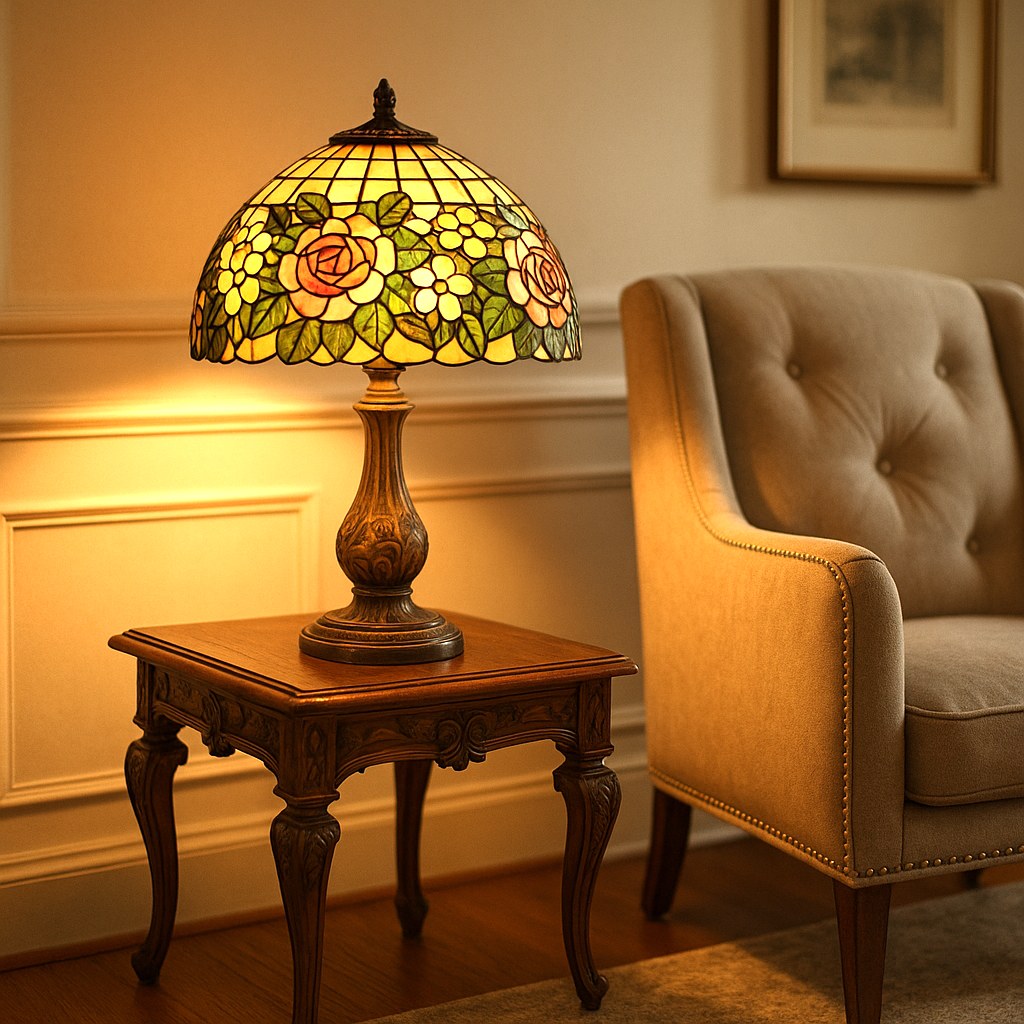
If one object stands for the whole period it is the leaded glass lamp, and the technique explains the price of a good one. Traditional stained glass is assembled in strips of lead came, wide and heavy and usable only on flat panels. Louis Comfort Tiffany and his studio in New York wrapped each piece of glass in thin copper foil instead and soldered the pieces together. The joints became narrow, the shape could curve in three dimensions, and a domed shade of hundreds of separate pieces became possible. His iridescent Favrile glass was patented in 1894.
For a lamp in that manner today it means the shade is built from individually cut pieces of coloured glass, not moulded as one bowl, so the colour is in the material and does not fade. Held up to daylight it shows streaks and shifts of tone; switched on, the shade becomes the source of the colour in the room.
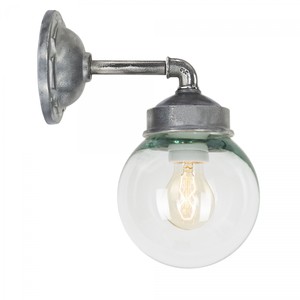
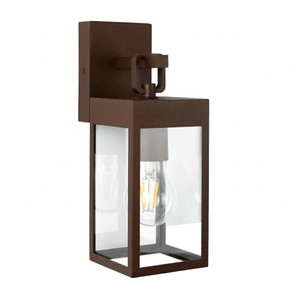
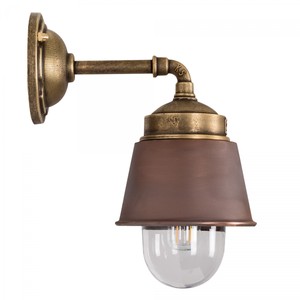
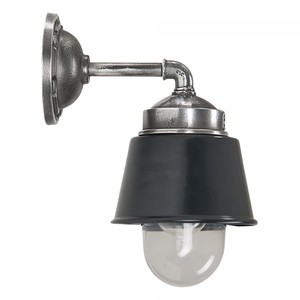
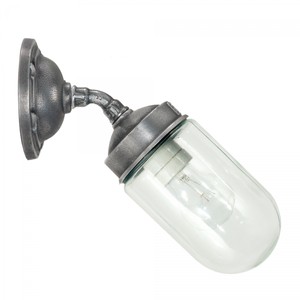
Our table lamps, floor lamps, pendants and wall lights in this manner sit in the lamps and chandeliers category, with the larger multi arm hanging pieces under chandeliers. The style also runs outdoors: nostalgic wall lanterns and post lights in cast metal with curved brackets belong to the same family and are listed with the garden furniture and decoration, and a pair flanking a front door changes the face of a period house.
The Art Nouveau bathroom, from freestanding tub to ceramic fittings
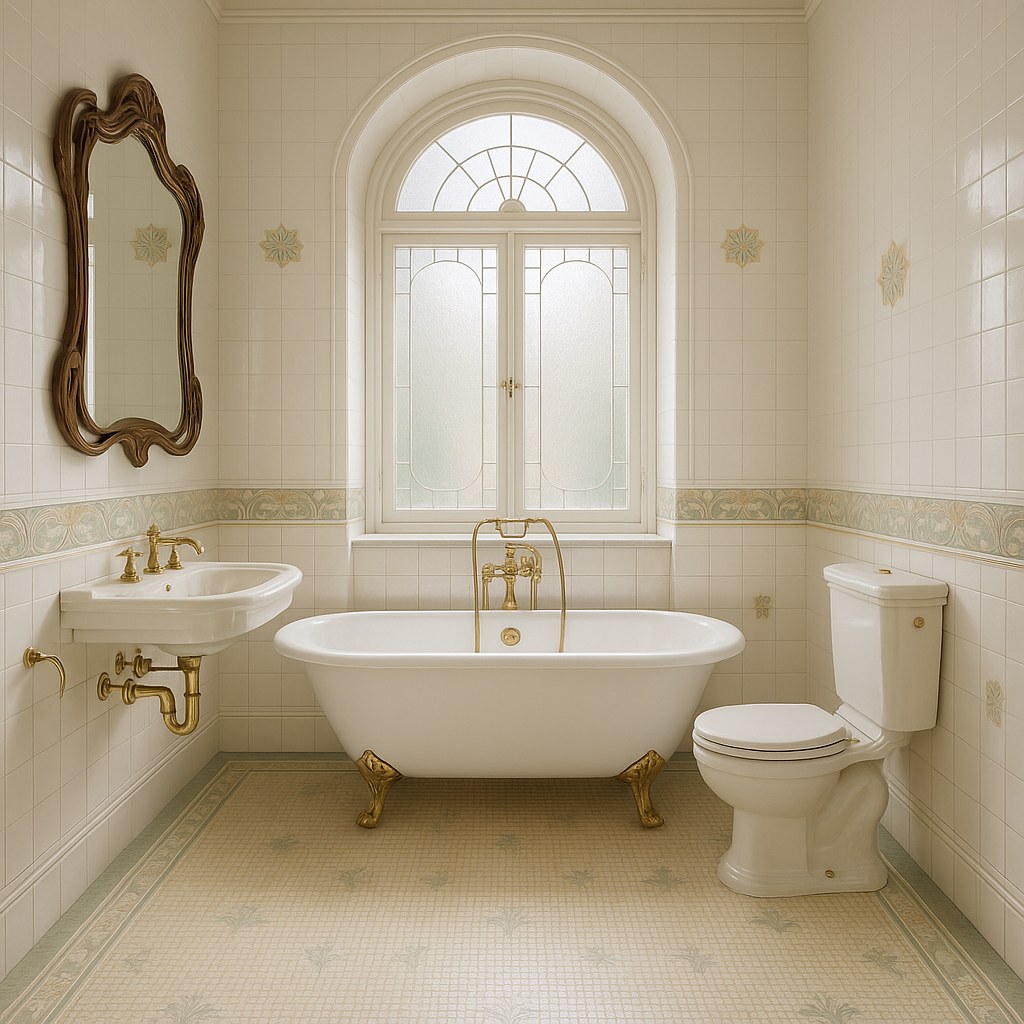
The bathroom is where this style has its second, and in our catalogue its strongest, home. The private bathroom as a room arrived in middle class houses at exactly the moment Art Nouveau was fashionable, so the first generation of proper bathrooms was decorated in it: white enamel, nickel and brass, curved taps, painted tiles and small ceramic pieces screwed to the wall.
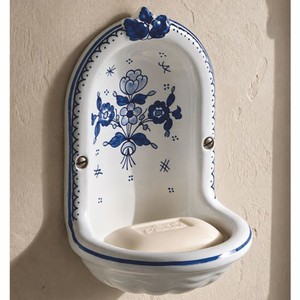
We carry that as a complete room rather than as single items. The centre is the freestanding bath, in enamelled cast iron, in copper, or in cast mineral composite with a high gloss finish, standing clear of the wall. Around it sit the smaller ceramic pieces that make the room read as period rather than modern: wall mounted soap dishes, brush holders, towel rails, shelves and paper holders, largely made in Italy, hand finished and usually white with a metal frame. Basins and washstands complete it, all grouped in freestanding bathtubs and bathroom furniture. This is also the one room where the style is genuinely practical, because enamel, copper and glazed ceramic cope with humidity far better than carved timber does.
Cabinets, seating and mirrors for the rooms around it
Away from the lamps and the bathroom, the style works best used sparingly: one or two strong pieces in a calm room is how the original salons were furnished.
In the hall and the dining room the carcass furniture carries it. A display cabinet with leaded glass doors is the classic piece, because the glass earns its keep twice, as ornament and as a way of lighting the contents. A chest of drawers or sideboard with a shaped front and floral inlay does the same work with less height, which suits a lower ceiling. Above either of them a wall mirror with a flowing carved frame finishes the wall, and the most elaborate hand finished frames sit under luxury mirrors.
For seating and tables the rule is comfort first and outline second. A sofa or a pair of armchairs with a shaped back rail and sweeping legs gives the room the line without turning it into a museum, and plain upholstery keeps the shape readable. A round or oval dining table suits the style better than a rectangle. The same pieces are specified constantly for hotels in period properties; that side of the range is in hotel furniture and decoration.
Measurements, light and fitting: the practical questions
More returns in this category come from technical detail than from taste. Settle these points before ordering.
Light colour decides whether the glass works. A leaded shade is a colour filter and can only return colours the lamp inside it emits. Use a warm source, around 2200 to 2700 kelvin, with a high colour rendering value, and the amber, red and gold glass glows as intended. Anything from about 4000 kelvin upwards drains the reds to grey and turns the greens acid, which is the commonest reason a new lamp looks wrong.
Bath taps have to be decided before the bath arrives. A freestanding tub takes one of three arrangements, not interchangeable once the floor is closed: a floor standing column tap, fed through the floor at a fixed point; a wall mounted spout, which needs pipework in the wall and the tub positioned to match; or a rim mounted set on pre drilled holes in the tub. Settle it with the plumber first, then order. Leave 15 to 20 cm of clear floor around the tub so it can be cleaned behind, and note that a cast iron tub full of water with a bather in it easily passes 500 kg, worth checking in an older building with timber joists.
Ceramic wall fittings need the right wall. Soap dishes, towel rails and shelves are drilled into tile. Start the hole through masking tape so the bit does not wander on the glaze, drill without hammer action, and use plugs rated for the material behind the tile. Keep clear of the runs above and beside taps and cisterns, where pipes sit, and set the height for use: a towel rail within arm reach of the tub.
Carved detail collects dust. Deep floral relief is the price of the style: dust it with a dry soft brush and not a cloth, which snags and leaves fibres in the undercuts. In a room used hard every day, shallower relief is the sensible choice.
Fitting the style to an older building. Art Nouveau furniture was made for tall rooms, so a high ceiling flatters it and a low one crowds it, particularly with a hanging lamp: keep the lower edge of a pendant at least 2.10 m above a floor people walk under, and about 75 to 85 cm above a dining table top. Curved outlines need free wall to be read, so leave the piece a clear stretch rather than wedging it between two doors. Measure the route in as well, since a tall glazed cabinet is the awkward shape on a staircase: door widths, the turn on the half landing and the lift car.
Delivery and care
Casa Padrino ships worldwide. Heavy pieces, meaning cabinets, sofas, dining tables and above all bath tubs, travel crated by freight forwarder with a delivery appointment. Lamps, mirrors and the ceramic fittings go by parcel service. Delivery is made kerbside to the address given; carrying the piece into the building, up the stairs, into a lift or into the room where it will stand is not part of the standard service, so please arrange help on site and check the route before ordering. We do not operate a showroom, so advice is given by telephone and email.
Care mostly consists of keeping water away from the wrong things. Treat oiled or waxed wood with a product made for that finish, and clean leaded glass with a barely damp cloth, dried at once, never with an abrasive or an alcohol based spray, because both attack the solder line. Copper and brass darken naturally, and enamelled cast iron takes ordinary bathroom cleaner but no scouring powder.
Why Casa Padrino
Casa Padrino has become one of the internationally known names for baroque, Art Nouveau, Art Deco and contemporary luxury furniture, with customers in more than fifty countries. In May 2025 our designer Marvin Schertl received the International Design Award for Excellence in Luxury Furniture, presented at the Beach Ball Gala Dinner in Cannes.
For this style, three things matter. The range is deep where the style is genuinely strong, which is lighting and the bathroom, rather than thin across everything. The pieces are hand finished, so carving, glass and metalwork are individual rather than moulded. And the whole setting comes from one house, so the lamp, the cabinet and the tub next door belong to the same idea. The complete collection is at casa-padrino.de.
Frequently asked questions about Art Nouveau furniture
What exactly is Art Nouveau furniture?
Furniture in the style of roughly 1890 to 1910, built around flowing asymmetric curves and ornament taken from plants. The same movement is called Jugendstil in Germany and Stile Liberty in Italy.
How is Art Nouveau different from Art Deco?
Art Nouveau comes first and is organic, with curved lines and floral carving before 1910. Art Deco follows the First World War and is geometric: stepped outlines, sunburst veneers, lacquer and brass.
Are these pieces antiques?
No, they are newly made in the style, hand carved and hand finished. Original pieces are rare because the movement lasted barely twenty years, and new production means matching sets and modern connections.
Which bulb should go in a leaded glass lamp?
A warm one, around 2200 to 2700 kelvin with a high colour rendering value. Cool white and daylight bulbs drain the reds and make the greens look acid.
Can a freestanding bath be installed in an older house?
Usually yes, but a cast iron tub filled with water and a bather passes 500 kg, so a timber joist floor should be assessed, and the tap arrangement chosen before floor and walls are closed.
What tap works with a freestanding tub?
Either a floor standing column tap fed through the floor, a wall mounted spout with pipework in the wall, or a rim mounted set on pre drilled holes in the tub.
How do I clean carved floral detail?
With a dry soft brush, working with the direction of the carving. Cloths snag and leave fibres in the undercuts, and water should be kept off the finish.
Does the style suit a modern flat?
Yes, used sparingly. One strong piece, a leaded glass lamp or a glazed cabinet, against plain walls reads far better than a whole room of curves.
Can I order matching pieces or a whole bathroom?
Yes. Tubs, basins, mirrors and the small ceramic wall fittings are made to work together, and for larger projects we advise by telephone or email.
Do you deliver worldwide, and how does delivery work?
Yes. Heavy pieces such as tubs and cabinets go crated by freight forwarder with a delivery appointment, smaller items by parcel service. Delivery is kerbside to the address given, so carrying the piece into the building or up stairs is not included.
Selected pieces from our collection
You may also be interested in
Back to the overview: Luxury Furniture for Hotels, Villas & Projects Worldwide