

Armoires: Freestanding Wardrobes in Solid Wood for Bedroom and Dressing Room
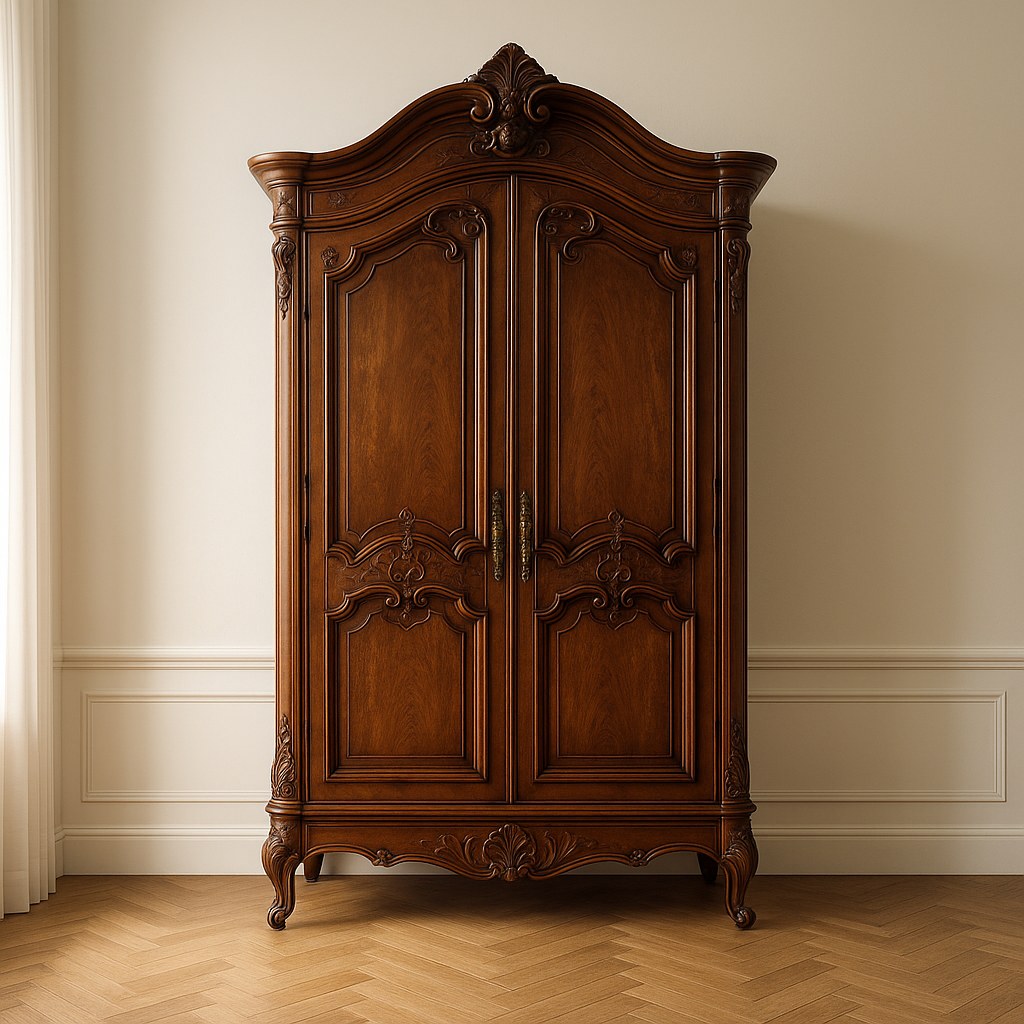
An armoire is what people buy when the building will not give them a cupboard. It stands on its own feet, needs no joiner and no wall opened up, and it moves house with you. That independence is why the carved French armoire outlived the fitted systems meant to replace it. Casa Padrino, one of the international specialists for luxury furniture, builds freestanding wardrobes in solid wood: carved baroque cases, painted country house pieces, dark colonial cabinets and armoires with mirrored doors, delivered worldwide.
This page begins with the object rather than the catalogue: where the armoire came from, how a good one is built, and then the part that decides whether it ever reaches the bedroom.
Where the armoire comes from
The word is older than the furniture. Latin armarium meant a cupboard for tools, and the Old French armaire kept that sense of a closed press. Only later did the term settle on the tall two door case we mean now.
Before it, the chest ruled the room. Everything a household owned in cloth was folded flat and stacked in a coffer, so reaching a shirt at the bottom meant lifting everything above it. The armoire is that chest set upright with doors on the front, so the contents become reachable in one movement.
By the sixteenth century French workshops were building the armoire a deux corps, two cases stacked with a moulded waist and fronts divided by carved columns, and under Louis XIV the marquetry armoires of Andre Charles Boulle turned the form into a display of wealth.
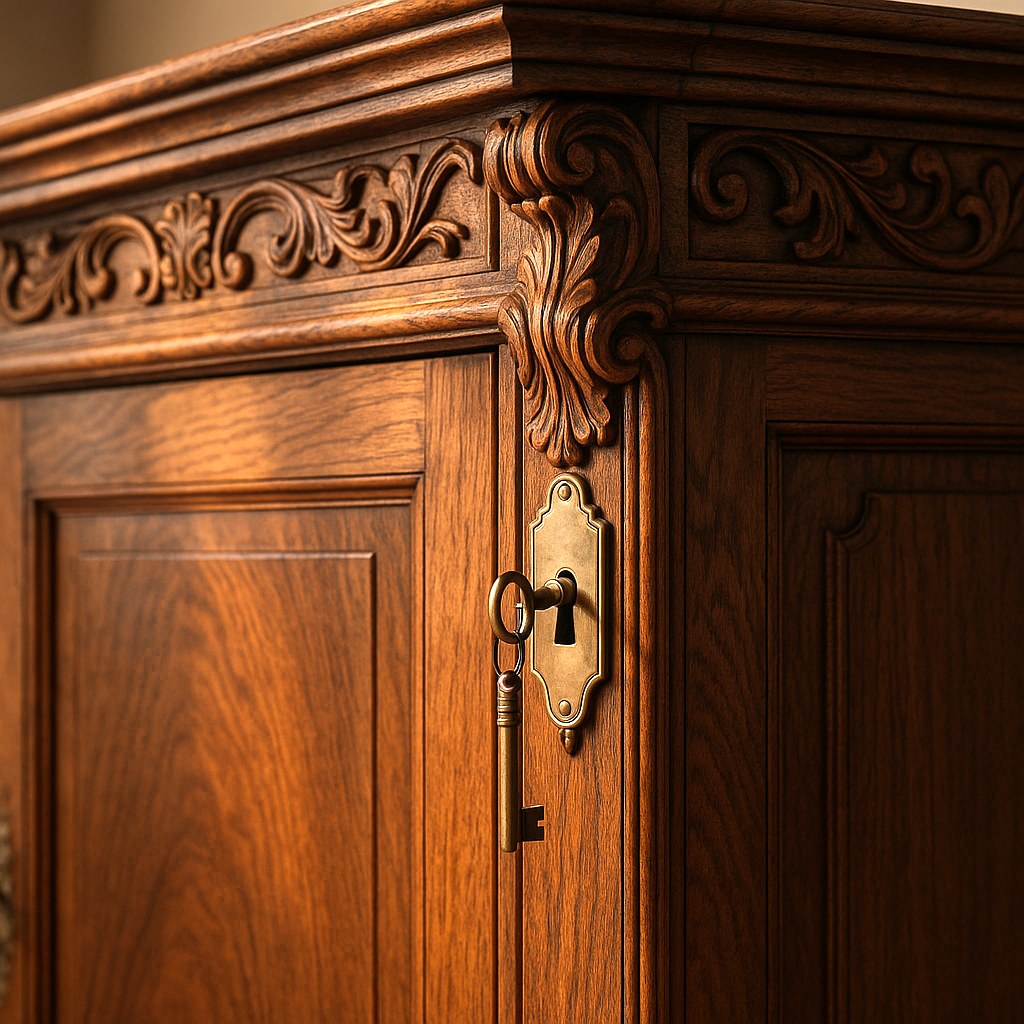
What kept the armoire alive, though, was the countryside rather than the court. In Normandy and Brittany the armoire de mariage was carved for a bride and formed the visible centre of her dowry: local oak, cherry or elm, a crest of wheat sheaves or doves across the cornice, long engraved brass hinges running the height of the doors, and a lock with a single key. Enough survive that the type is still the picture most people have of the word.
How a good armoire is built
Two sides, a top and bottom, a back, one or two doors, a cornice and a plinth: simple to describe and hard to do well. The quality sits in three places.
The panels. Solid timber swells in damp air and shrinks in a heated room, and it moves across the grain far more than along it, so a wide board fixed rigidly into a frame will split. The old answer is frame and panel construction: the panel sits loose in a groove and stays free to move while the frame holds the shape. It is why a two hundred year old armoire still closes and a badly made modern one does not.
The doors. A tall door is a lever, so long hinges spread the load down the stile instead of concentrating it at two points, which is why traditional armoires carry hand forged straps, not small cup hinges. The door is also the heaviest part, so the carcass has to be square and the feet level before it will sit right.
The surface. Carving is cut into solid stock, not pressed into a moulding, so the crest of one door is never quite the twin of the other. Gilded mouldings use the craft behind our baroque mirrors, gold leaf over a clay ground on carved wood.
Why freestanding wardrobes are coming back
For a generation the fitted wardrobe seemed to have won. Then the reasons against it accumulated.
- Period buildings have no cupboards. Flats built before the twentieth century were furnished with movable presses, not joinery, and fitting cupboards in means boxing over cornices and losing the proportions of the room.
- Rented flats do not allow building work. A freestanding piece needs no permission, leaves no repair bill and moves to the next address.
- Old walls are rarely square. A fitted run has to be scribed to the wall and every deviation shows. An armoire stands independently, so a wall that leans is simply a wall behind the piece.
- It is furniture, not fitting. A carved case with a cornice gives a plain bedroom the vertical accent it lacks, while built in doors are designed to vanish.
The same holds at the top of the market, which is why suites in restored hotels are furnished with freestanding pieces even where the budget for joinery exists, as on our page for luxury hotel furniture. The decision is about craft and material rather than about built in metres.
Baroque, country house or mirrored doors: the styles
The choice is really about how much wall the piece should occupy visually, since it will occupy the same amount physically either way.
- Carved baroque armoires. Deep relief carving, a shaped crest above the cornice, curved doors and gilded or antique gold detail. The most emphatic form, and the one that suits a high ceiling and a bed with presence from our baroque beds.
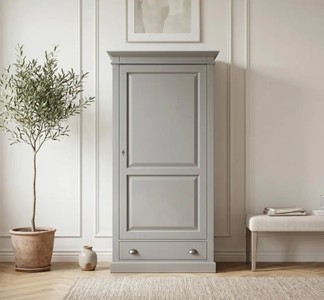
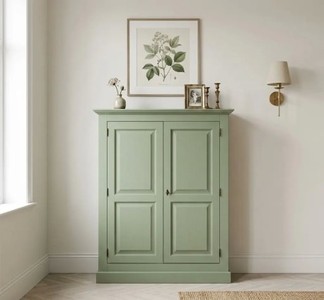
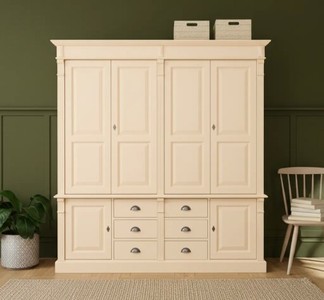
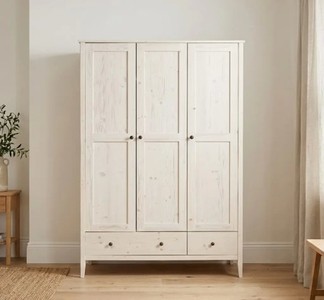
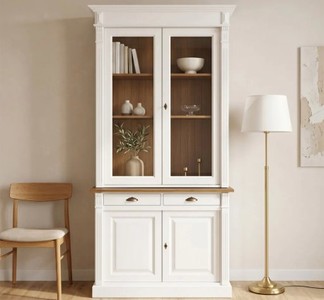
- Country house and painted armoires. White, cream, dove grey or soft green, panelled rather than carved, with turned feet and simple ironwork. A pale case reads as less bulk than a dark one of the same size.
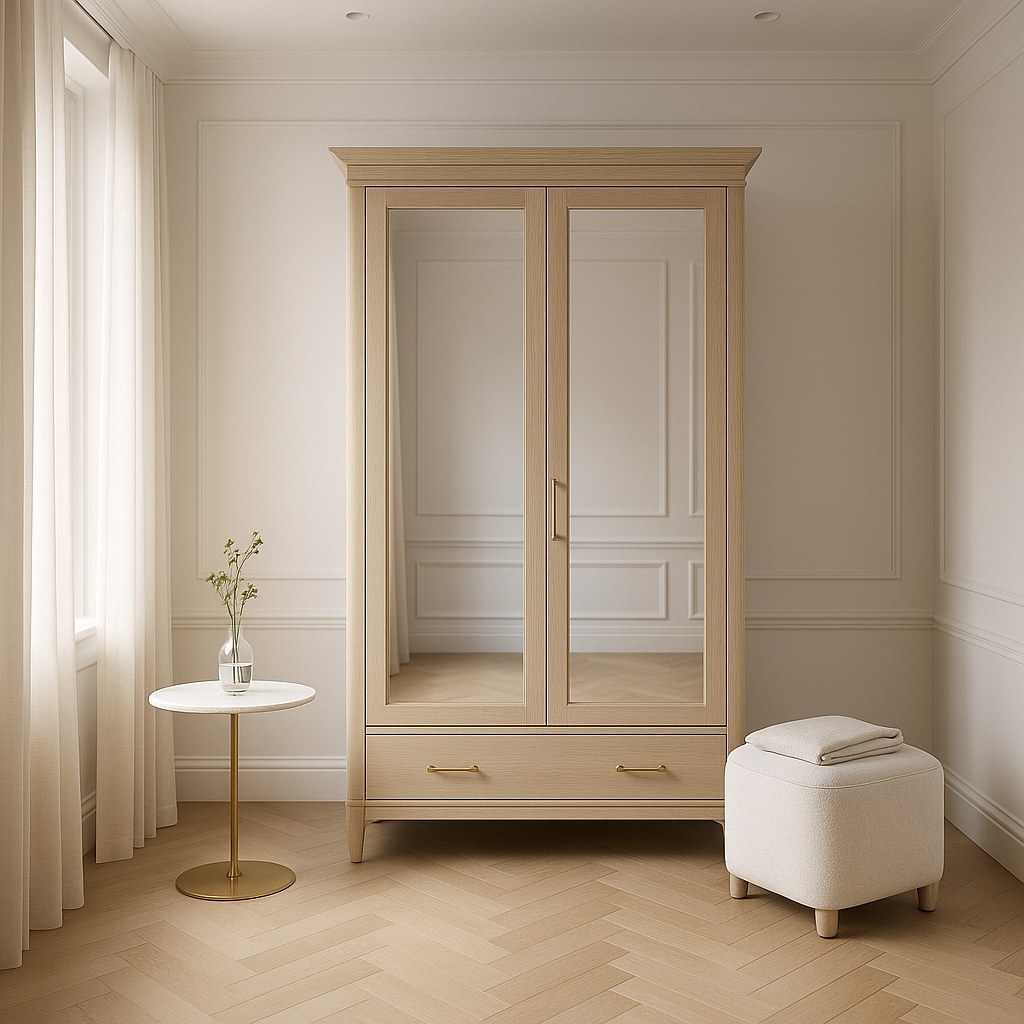
- Mirrored door armoires. One or both doors carry mirror glass, which does two jobs: the dressing mirror is already there, and the reflection returns light in a room with one window.
- Dark solid wood, colonial and Art Deco. Mahogany tones, brass fittings, veneer figure and plain strong lines, at home with leather seating and in dressing rooms.
Widths follow the same logic. A two door armoire is the classic single piece for a bedroom, a three door case is a wall in itself, and two matching pieces flanking a window are often the better answer in a long room. Related storage sits in the cabinets category.
Measuring for an armoire: ceiling, route and interior
More wardrobes are sent back over measurements than over taste, usually over one of these figures.
The ceiling has to allow the piece to be stood up, not just to stand. This is the mistake that costs most, because it is invisible on paper. An assembled armoire is tilted from flat to upright, and during that turn its longest dimension is not the height but the diagonal through height and depth. For a case 220 cm high and 65 cm deep that diagonal is roughly 230 cm, so a room with a 225 cm ceiling cannot take it upright even though the wardrobe is shorter than the ceiling. The rule of thumb: add 8 to 12 cm to the stated height of a piece of normal depth. Where the ceiling is lower, the armoire has to arrive dismantled and be built standing. Ask before ordering rather than after.
The route into the room decides the rest. Measure the entrance door, every turn and half landing of the staircase, the lift car and its door, and the doors of the flat and the bedroom. On a turning staircase the limiting figure is the diagonal at the turn, not the width of the flight. Compare that with the packed dimensions, which are larger than the furniture. Many armoires are delivered dismantled into sides, back, doors and cornice, which turns an impossible staircase into a straightforward carry.
Interior height decides what can hang. Coats and long dresses need about 150 cm of clear hanging height below the rail, floor length garments closer to 160 cm. Shirts, jackets and folded trousers need only about 100 cm, so a single rail in a tall interior wastes space while a double rail in one half doubles the capacity. Read the internal hanging height in the specification, never the external height of the case.
Depth decides whether hangers fit at all. A garment on a hanger occupies about 45 to 50 cm front to back, and the door, frame and rail fittings take the rest, so an armoire meant to hang clothes across its width needs roughly 60 cm of external depth. Anything shallower has to hang garments sideways on a pull out rail, which halves the capacity.
Space in front, and stability. A door 60 cm wide sweeps 60 cm of floor and someone has to stand there too, so plan 90 to 100 cm of clear floor in front. Level the feet on an old floor first, because a case standing out of true will not let its doors close evenly. And fix the armoire to the wall: a tall wardrobe is top heavy once the upper shelf is full, and a strap or bracket into masonry or a stud costs nothing.
Inside the armoire: rails, shelves and drawers
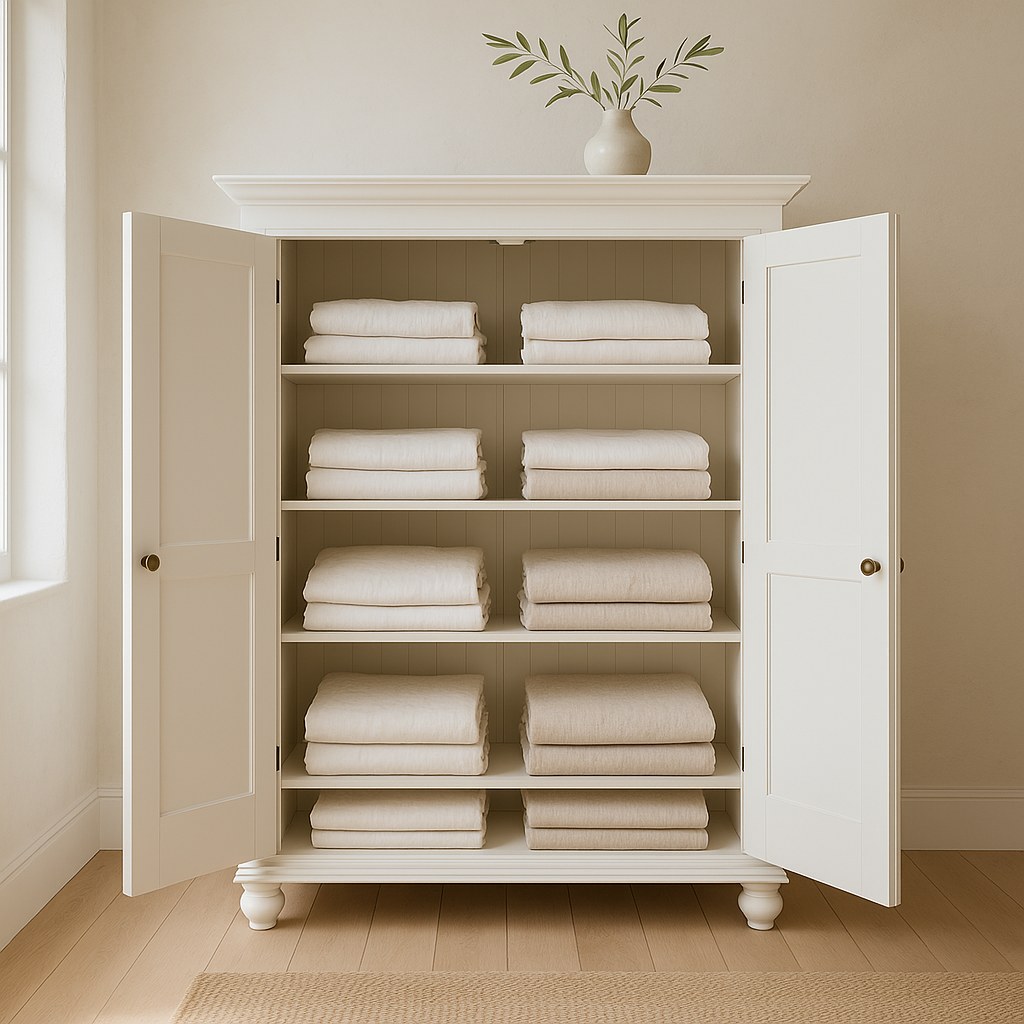
Most interiors divide into one of three arrangements: a full height hanging section, a hanging section beside a bank of shelves, or shelves throughout with drawers in the base. Work out the split from your own clothes rather than from the photograph: count what has to hang, add a third for growth, and remember that shirts and jackets can be double hung. Shelves suit knitwear, which stretches on a hanger, and bed linen. Where more drawer space is needed, the usual companion is a matching commode or chest of drawers rather than a deeper wardrobe.
Solid wood interiors need air, so leave a hand width free at the back of a packed rail, and cedar or lavender is the traditional protection against moths.
Bedroom, dressing room, suite: where the armoire goes
In a bedroom the armoire is the tallest object in the room, so it belongs on the wall you do not look at from the pillow, usually beside the door or behind the bed head. Bedside pieces and a low chest keep the horizontal line, and a bed from our beds category sets the level everything else answers to.
In a dressing room the case works differently: two or three armoires in a row, or one against each end wall. Here mirrored doors earn their place, and a full length mirror from our luxury mirrors range opposite gives the second view a single mirror cannot. The wider selection sits under mirrors.
In a hotel suite the wardrobe is packed and unpacked by strangers several hundred times a year, which argues for solid timber, long hinges and a lock that works. That specification runs through our hotel furniture and decoration category, and complete schemes appear on the page for luxury villa furniture, with seating in baroque armchairs.
In a period flat without built in storage the armoire often takes over a hallway or landing, holding coats near the door where a fitted cupboard would sit in a newer building.
Delivery, assembly and care
Casa Padrino delivers worldwide. Large armoires travel by freight forwarder, crated or blanket wrapped, with a delivery appointment arranged in advance; small pieces and fittings go by parcel service. Delivery is made kerbside to the address given. Carrying the wardrobe into the building, up stairs, into a lift or into the room where it will stand is not part of the standard service, so please arrange two people on site and measure the route beforehand. We do not operate a showroom, so advice is given by telephone and email.
Unpack the case upright, level the feet before loading it, and let solid wood stand a few days before judging how the doors sit, since timber settles to the humidity it finds. Dust with a dry cloth, wax occasionally, avoid silicone polishes, and keep the piece away from a radiator and out of long direct sunlight.
Why Casa Padrino
Casa Padrino is one of the internationally known names for baroque, Art Nouveau, Art Deco and contemporary luxury furniture, with customers in more than fifty countries. In May 2025 our designer Marvin Schertl received the International Design Award for Excellence in Luxury Furniture, presented at a gala dinner in Cannes.
For armoires that matters in three ways. The pieces are built as furniture rather than as boxes, with frame and panel carcasses, carving cut into solid stock and fittings sized for a tall door. The workshops that have supplied us for years also build to dimension, so an awkward ceiling height or a matching pair becomes a question of drawing rather than of luck. And the rest of the room can come from one house, so the wardrobe, the bed, the chest and the mirror belong together. The complete collection is at casa-padrino.de.
Frequently asked questions about armoires
What is the difference between an armoire and a wardrobe?
In practice the same thing, a freestanding cupboard for clothes. Armoire is the French term, usually used for taller carved or panelled pieces; wardrobe is the general English word and also covers built in cupboards.
How much ceiling height do I need for an armoire?
More than the height of the piece, because it has to be tilted upright and the diagonal through height and depth is longer than the height. Add 8 to 12 cm, or have the piece assembled standing.
How deep does a wardrobe have to be for hangers?
About 60 cm externally. A garment on a hanger takes 45 to 50 cm front to back and the door, frame and rail need the rest. Shallower cases use a pull out side rail.
How much hanging height do coats need?
Around 150 cm of clear height below the rail, closer to 160 cm for floor length garments. Shirts and jackets need only about 100 cm, so a double rail in one half adds real capacity.
Can an armoire be dismantled for the stairs?
Many models can, into sides, back, doors and cornice, which usually solves a narrow staircase. It depends on the piece, so ask us before ordering.
Does a freestanding wardrobe need fixing to the wall?
Yes. A tall case is top heavy once the upper shelf is loaded. Use an anti tip strap or bracket into masonry or a stud, and treat it as compulsory where there are children.
Are your armoires made of solid wood?
The traditional carved and painted pieces are built in solid timber with frame and panel carcasses. Some contemporary and Art Deco designs use figured veneer over a stable core, which is correct for those styles.
Do mirrored doors make a bedroom look larger?
They return light and depth, which reads as more space, and they save the wall a separate mirror would take.
Can I order an armoire in a size or finish that is not listed?
Yes. Our workshops build to dimension and match finishes, including pairs for a dressing room and cases adapted to a low ceiling.
How is a large armoire delivered?
By freight forwarder with a delivery appointment, worldwide. Delivery is kerbside to the address given, so carrying the piece into the building, up stairs or into a lift is not part of the service and should be arranged on site in advance.
Selected pieces from our collection




You may also be interested in
Back to the overview: Luxury Furniture for Hotels, Villas & Projects Worldwide