

Marble Fireplace Surrounds for Hotels, Villas and Period Buildings
A marble fireplace surround gives a hotel lobby, a suite or the drawing room of a villa its architectural centre. The stone frame around the firebox carries the mirror, the clock and the candelabra, it defines the axis of the room and organises the furniture around it. Casa Padrino offers fireplace surrounds, also called fireplace mantels or mantelpieces, in marble, travertine and sandstone: in white, beige, cream, yellow, green and red, from compact pieces about 130 cm wide to monumental installations more than four metres high.
This page is written for hotel operators, architects, interior designers and developers planning one or several surrounds for a project. It covers the main styles, how to measure the firebox and the wall, weight and installation, coordination with the fireplace installer and the combination with electric and bioethanol inserts. It deals with the surround only: the fireplace itself, the insert and the flue are not part of the delivery and are planned by a qualified installer.
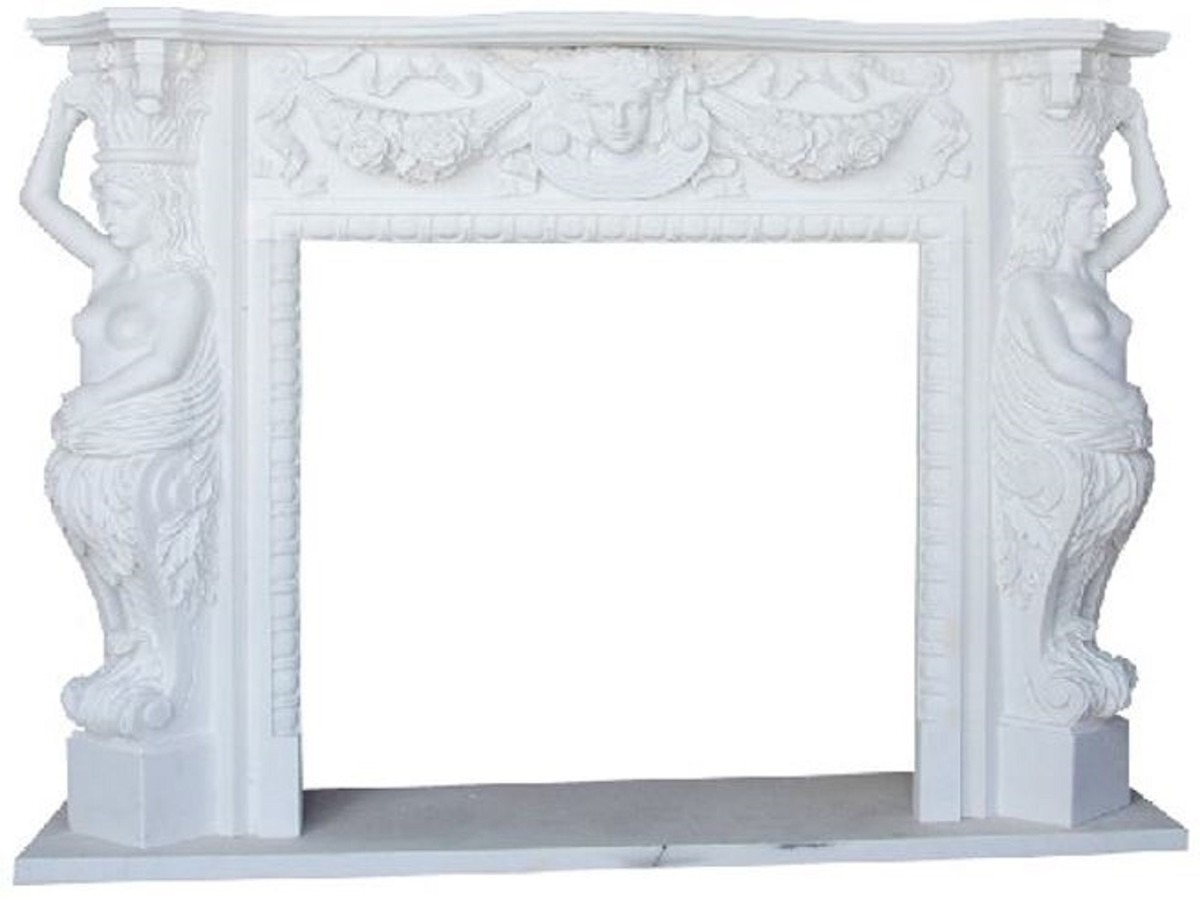
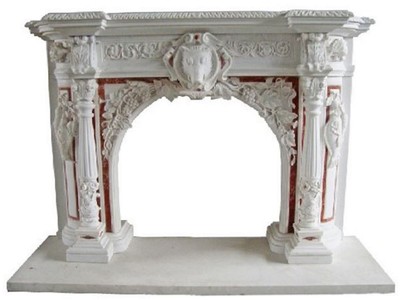
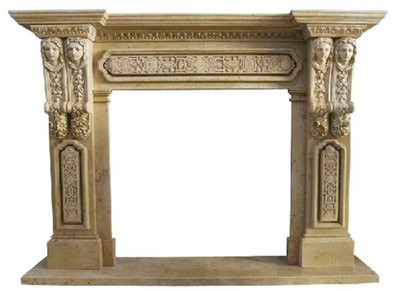
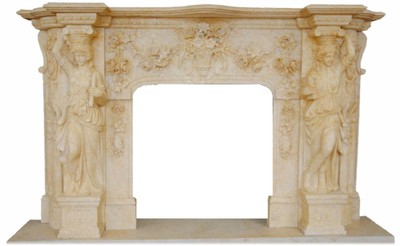
Two caryatids support the lintel, above them a frieze with a mask and garlands: white marble, 180 x 40 x 140 cm, around 500 kg. Pictured: Casa Padrino Luxury Baroque Fireplace Surround White 180 x 40 x H. 140 cm
Why the surround matters in a lobby, a suite or a bar
In a hotel, a fireplace is rarely about heating. It is a place where guests meet, wait and read, and the surround decides whether that place feels representative or generic. Solid stone has a presence that panels or plaster cannot match, and it ages with the building.
Typical locations in a hospitality project are the lobby and the main hall, the library or reading room, the bar, restaurants with a fireside corner, the living rooms of suites and presidential suites, and banqueting or ballrooms. In restored townhouses and historic apartments, a surround in the right period style often replaces a lost original.
Styles: Louis XV, Louis XVI, Empire and classic-contemporary
The shape of a mantelpiece tells its period at a glance. In planning, follow the rest of the architecture: plasterwork, doors and mouldings.
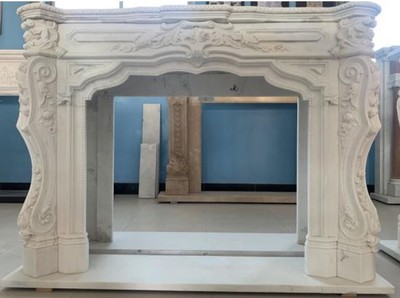
- Louis XV and Rococo: curved jambs, a serpentine lintel and a central shell or cartouche. Light and elegant, well suited to salons and suites with gilded mirrors.
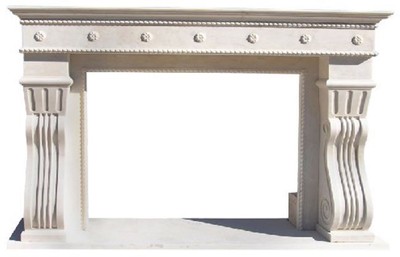
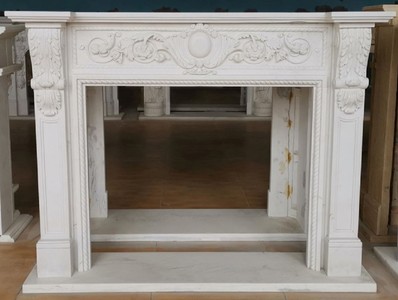
- Louis XVI: straight lines, fluted pilasters, corner rosettes and laurel or bead mouldings. Calm and disciplined, a natural fit for libraries, dining rooms and neoclassical interiors.
- Empire: columns, pilasters and strong cornices, often with caryatids (carved female figures acting as supports) or lion heads. These pieces need ceiling height and distance and belong in halls and ballrooms.
- Baroque with figures and foliage: putti, masks, flower garlands and twisted columns turn the surround into sculpture that can anchor an entire lobby.
- Classic-contemporary: a historic form against a plain wall, combined with modern furniture.
Marble, travertine and sandstone: stones and finishes
Marble can be carved in fine detail, takes a polish and tolerates the radiant heat of a correctly built fireplace. Every surround has its own pattern of veins and clouds, and small variations in colour and structure are the signature of natural stone rather than a defect. White marble shows relief work most clearly, beige and cream feel warm beside oak floors and fabrics in sand and gold, while green and red marble give bars and libraries a strong accent.
Travertine has an open, lively texture with a Mediterranean feel, sandstone is more matt and earthy. For the surface, there is polished (glossy, reflecting light and flames) and honed (satin, less prone to visible wear). In busy areas such as lobbies and bars, a honed finish is often the easier choice to maintain.
Measuring correctly: firebox, wall and ceiling height
Three dimensions decide which fireplace surround fits. First, the opening: what counts is the clear inner dimension, the width and height of the opening the firebox or insert faces. For an existing fireplace, measure the opening of the masonry or insert; the required clearance around it is set by the installer. In new builds it is often the other way round: the surround is chosen first and the firebox is planned to match.
Second, the wall: leave enough wall on each side so the surround does not look squeezed, as a guide 30 to 40 cm to corners, door frames and windows. Check the depth as well. The surrounds in the range are 30 to 65 cm deep, and this must suit the projection of the firebox. Third, the ceiling height: models 110 to 160 cm high fit almost any room from 2.50 m, monumental pieces with an overmantel need 3.50 m or more. Also note the delivery route with door widths and stairs.
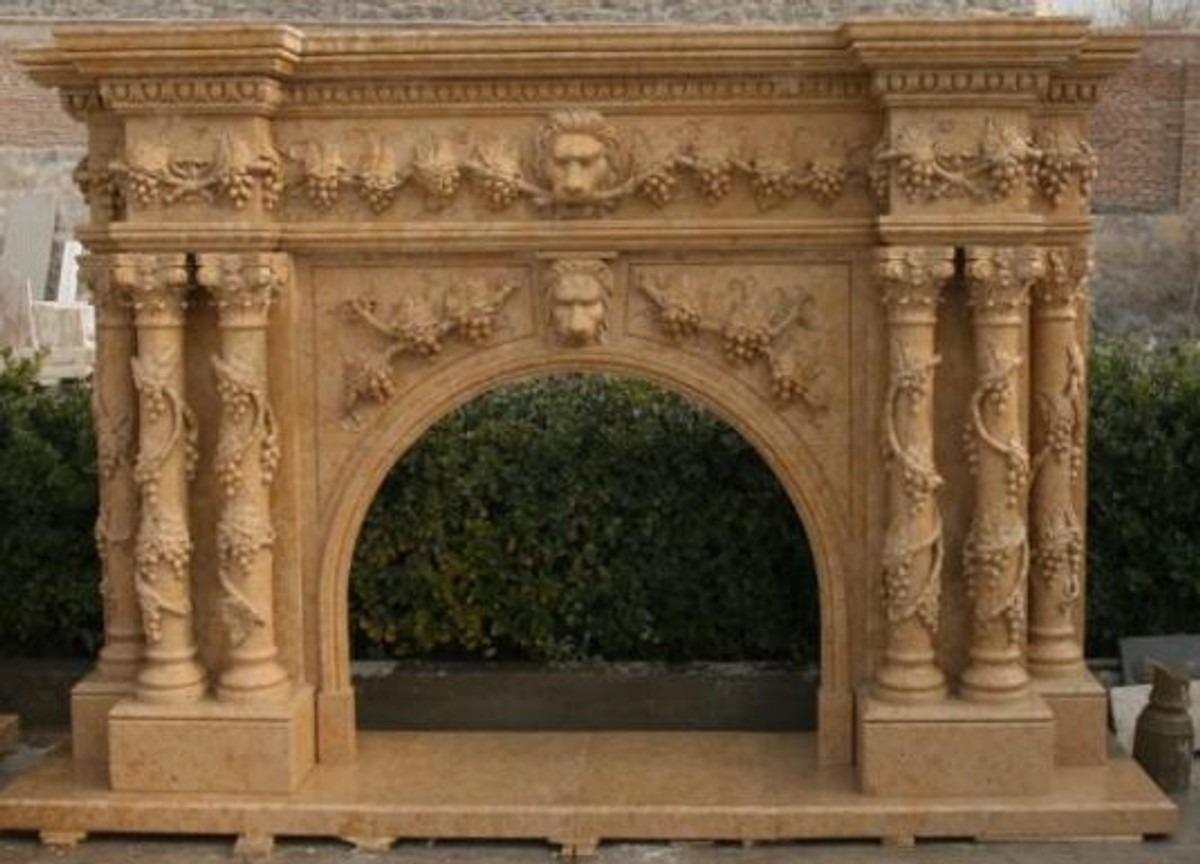
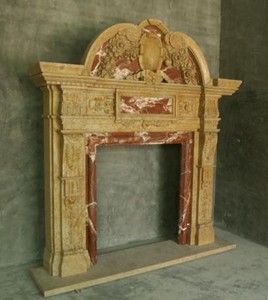
Twisted columns, lion heads and an arched opening: beige marble, 250 cm wide and 200 cm high, for a hall, lobby or ballroom. Pictured: Casa Padrino Luxury Baroque Fireplace Surround Beige 250 x 45 x H. 200 cm
Weight, structural load and installation
Solid marble is heavy. The surround shown above, 180 cm wide, weighs around 500 kg, and larger pieces weigh considerably more. For this reason the surrounds are delivered in sections: plinths, jambs or columns, lintel and shelf are assembled on site, bonded and mechanically fixed to the wall, for example with stainless steel anchors. A stonemason or the fireplace installer sets it.
Before purchase, the load-bearing capacity of the floor should be confirmed. On a concrete slab or at ground level this is usually straightforward. On timber joist floors in older buildings, on floating screed or on upper storeys, a structural engineer should assess the load; often a load-spreading plate is enough. For delivery, plan pallet trucks, enough people and, for large pieces, lifting gear.
Fire safety and inspection: the installer's part
A fireplace surround is not a heating appliance; it is set in front of one. A wood or gas fireplace is designed by a qualified fireplace or stove installer: firebox, insulation, ventilation gap, flue and the clearances to combustible materials, as well as the non-combustible hearth in front of the opening. Before first use the installation must be inspected and approved according to local regulations, in Germany by the district chimney sweep, elsewhere by the competent authority.
A sequence that works in practice: select the surround, pass the outer dimensions, opening and depth to the installer, have the firebox and clearances planned, and only then set the surround. This page does not replace professional advice.
Combining a surround with electric or bioethanol inserts
Many hotel rooms and city apartments have no chimney, and some buildings do not allow an open fire. A marble surround can then be combined with an electric insert. It needs only a power supply, produces a flame effect with light and optional heat, and can be switched centrally or by remote control, which is practical in a hotel with changing guests. Suitable appliances are listed under Electric Fireplaces.
A bioethanol insert gives real flames without a flue. It requires sufficient room volume and ventilation as specified by the appliance maker and clear refilling rules for staff, so it suits supervised restaurants and bars better than suites. See Bio-Ethanol Fireplaces. In both cases the opening of the surround is matched to the insert, and a stone or metal trim closes the gap.
For architects and interior designers
For architects and designers, a fireplace surround is a building element with interfaces to structural design, fireplace construction and electrical planning. On request we compile the data you need for detailed design: outer dimensions, opening, depth, weight and how the piece is divided into sections. Samples can be arranged on request, and so can made-to-measure pieces when a room calls for a different format or when a series of suites should receive identical surrounds.
Delivery is by freight forwarder, worldwide, and is timed to the construction schedule so that the surround does not arrive before the firebox is ready. One contact person handles selection, quotation and delivery date. More details are on our page for architects and dealers, and completed hotel projects are shown in our hotel references. In 2025 Casa Padrino received the "Excellence in Luxury Interior Design" award at the Festival de Cannes.
The process in five steps
- Enquiry with dimensions and plans: floor plan, wall elevation, firebox opening, ceiling height and number of pieces.
- Selection and samples: suitable models, stone colour and finish, stone samples on request.
- Quotation: tailored to your project, with dimensions, weights and delivery route.
- Production: carved by hand, made-to-measure pieces according to an approved drawing.
- Delivery: in sections by freight forwarder, worldwide, on the agreed date to the site or the property.
Caring for marble in daily hotel operation
Marble is a calcareous stone and reacts to acids. Wine, citrus, vinegar-based cleaners and descalers leave dull marks, so glasses on the shelf belong on coasters. For daily cleaning, a soft cloth and a pH-neutral stone cleaner are enough. A sealer reduces the absorption of grease and liquids and is renewed depending on use.
Soot on the inner edge is removed dry with a soft brush, stubborn marks with a dedicated natural stone soot remover. Abrasives, steam cleaners and scouring pads are not suitable.
More on terms and marble colours is in our guide Marble Fireplace Mantel, and all available models are in the category Fireplaces. For complete hotel interiors, see Furnishing of lobbies and foyers.
Frequently asked questions about marble fireplace surrounds
Does the fireplace surround include an insert?
No. We supply the stone surround. Firebox, heating insert and flue are planned and built by the installer, or an electric or bioethanol insert is fitted.
How heavy is a marble fireplace mantel?
That depends on size and design. The white marble surround 180 cm wide weighs around 500 kg, large installations considerably more. Delivery is therefore in sections.
Which dimensions do you need for an enquiry?
Width and height of the firebox opening, the free wall width, the ceiling height and the available depth in front of the wall. A photo of the wall and, for projects, a floor plan help with the selection.
Can a marble surround stand on a timber floor in an older building?
Yes, once a structural engineer has checked the load. A load-spreading plate is often sufficient, in some cases the floor needs reinforcing.
Who approves the fireplace?
Local regulations apply. In Germany the district chimney sweep inspects a fireplace before first use; your installer knows the rules in your country.
Can a hotel order several identical surrounds?
Yes, identical pieces for suites or room series are available on request, as are custom formats.
Does a marble surround suit a contemporary interior?
Yes. Against a plain wall, a classic surround creates a deliberate contrast; a Louis XVI shape with straight lines is the quieter option.
How is marble around a fireplace cleaned?
With a soft cloth and a pH-neutral stone cleaner. Acidic products, abrasives and steam cleaners are unsuitable; soot is brushed off dry.
Enquire about fireplace surrounds for your project
Send us dimensions, plans or photos of your project. You will receive a selection of suitable models and a quotation tailored to your project, with worldwide delivery by freight forwarder.
Email: info@casa-padrino.de · Phone: +49 212 14912917
More trades for your project
- Bronze sculptures
- Sculptures for hotels and gardens
- Marble works
- Fireplaces for hotels
- Marble columns
- Bathtubs for hotel bathrooms
- Consoles and side tables
- Garden furniture for hotels and resorts
Venues and sectors
- Hotel Room Furniture
- Hotel Sofas and Hotel Armchairs for Lobbies
- Bar Counter for Hospitality
- Lounge and Club Furniture for Bars and VIP
- Executive Office Furniture
- Beauty Salon Furniture
- Wedding Throne Chair
- Window Display Decoration for Malls and Retail
- Life-Size Fiberglass Statues for Theme Parks
- Christmas Market Decorations